
If you are gearing up for the RPSC Assistant Professor exam, you already know that quantum mechanics isn’t something you can skim through. It sits right in Unit 5 of the physics syllabus (which aligns closely with the CSIR NET / NTA framework). This unit is all about the core principles of quantum mechanics and how they apply to real physical systems. Right at the heart of this unit is the particle in a box model.
Particle in a Box: A Quantum Mechanical System for RPSC Assistant Professor
So, what exactly is a particle in a box? Imagine you trap a tiny particle of mass m inside a one-dimensional lane where it can move back and forth, but the walls at both ends have infinite potential energy. Inside this lane, the potential energy is zero, meaning the particle can roam completely free until it hits a wall. Think of it like a perfectly smooth, flat halfpipe with infinitely high vertical walls on both sides. In physics, we call this an infinite potential well.
To see what the particle is up to, we look at its wave function, written as ψ(x). For our particle in a box, this wave function turns out to be a classic sine wave that drops to exactly zero at the walls. Mathematically, it looks like this:
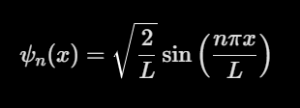
Here, L is the length of the box, and n is a positive integer (1, 2, 3…). The spots where the wave function hits zero inside the box are called nodes. At VedPrep, we like to think of these nodes as quantum “dead zones”—places where the particle has absolutely zero chance of being found.
Worked Example: Wave Function of a Particle in a Box
Let’s look at a quick math problem to see how this works. Suppose a particle of mass m is trapped in a one-dimensional box that is twice as long, with a length of 2L. The time-independent wave function for this specific setup is given by:
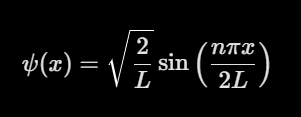
Our job is to make sure this wave function satisfies the boundary conditions and the normalization condition.
First, let’s check the boundary conditions. Because the walls are at x = 0 and x = 2L, the particle cannot escape, meaning the wave function must be zero at those points: ψ(0) = 0 and ψ(2L) = 0. Let’s plug in the numbers:
- For x = 0: ψ(0) = √2/L sin(0) = 0
- For x = 2L: ψ(2L) = √2/L sin(nπ) = 0 (since sin of any integer multiple of π is always zero).
This confirms the boundary conditions work perfectly. To check the normalization, you just integrate the square of the wave function from 0 to 2L and make sure it equals 1, proving the particle is definitely somewhere inside the box.
Particle in a Box: Applications in Quantum Mechanics for RPSC Assistant Professor
Even though a particle in a box feels like a pure math puzzle, it actually helps explain how the real world works, especially in solid-state and atomic physics.
Take atomic physics, for example. We use this exact model to get a grip on how electrons behave inside atoms. The model is a straightforward way to explain why energy levels are quantized—meaning electrons can only hold specific amounts of energy, which is why we get distinct color lines in atomic spectra. By pretending an electron is trapped in a tiny, box-like potential well, physicists can calculate its allowed energy states and wave functions quite accurately.
Exam Strategy: Particle in a Box for RPSC Assistant Professor
When you are prepping for highly competitive exams like RPSC Assistant Professor, CSIR NET, IIT JAM, or GATE, you can bet that questions on the particle in a box will pop up. Your best strategy is to get completely comfortable with how wave functions and energy levels change when you tweak the box.
Remember, a wave function is just a mathematical description of the particle’s quantum state, while the energy levels tell you the specific energy slots the particle is allowed to sit in. A favorite trick of exam paper setters is to change the width of the box from L to 2L, or shift the boundaries from (0, L) to (-L/2, L/2). At VedPrep, we suggest practicing these variations so you don’t get tripped up by sudden changes in symmetry during the actual exam.
Particle in a Box: Mathematical Formulation for RPSC Assistant Professor
To actually solve the particle in a box problem, we rely on the time-independent Schrödinger equation. For a one-dimensional setup, it looks like this:
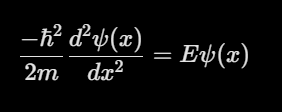
In this equation, Ψ(x) is the wave function we talked about, E is the total energy of the particle, m is its mass, and h¯ is the reduced Planck’s constant. When you solve this differential equation using the boundary conditions, you find that the energy E can’t just be any random number. It is quantized according to this formula:
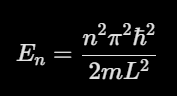
This shows us that the energy depends directly on n2, which means the gaps between energy levels get wider and wider as you go higher up.
Particle in a Box: Experimental Verification and Particle in a box For RPSC Assistant Professor
Can we actually see this in a lab? Yes, we can! Scientists use particle accelerators to speed up charged particles to incredible energies and trap them inside tiny spatial regions. This setup lets researchers study quantum behavior under conditions that match the particle in a box model almost perfectly. To make this work, the accelerators have to run inside an ultra-high vacuum with incredibly precise control over the accelerating fields. It is a brilliant mix of high-level theory and engineering that keeps quantum mechanics grounded in reality.
Misconception: Particle in a Box and Infinite Potential
Let’s clear up a common mistake that trips up a lot of students. Many people assume that the potential inside the box is infinite. That is actually backward! The potential inside the box is zero (or a flat, constant finite value), meaning the particle flies around completely unhindered.
The infinite potential exists completely outside the box. Think of it like a pinball machine with indestructible walls; the infinite potential energy acts as an unbreachable barrier that keeps the particle locked inside. If you mix this up, your boundary conditions won’t make sense, and your whole calculation will go off track.
Final Thoughts
When you dig into this topic, you will spend a lot of time with the Schrödinger equation and figuring out its solutions for simple systems. The particle in a box is the ultimate textbook example used to show how quantum mechanics actually works in practice. If you want to look at the classic texts, Lev Landau’s Quantum Mechanics and Linus Pauling’s Quantum Chemistry are great places to start. Here at VedPrep, we always remind our students that mastering this single foundational concept can easily help you score those crucial points in the exam.
To know more in detail from our faculty, watch our YouTube video:
Frequently Asked Questions
What are the boundary conditions for the particle in a box?
The boundary conditions for the particle in a box are that the wave function must be zero at the walls of the box and the probability of finding the particle outside the box is zero.
What is the time-independent Schrödinger equation for a particle in a box?
The time-independent Schrödinger equation for a particle in a box is -ℏ²/2m ∂²ψ(x)/∂x² = Eψ(x), where ψ(x) is the wave function, E is the total energy, ℏ is the reduced Planck constant, and m is the mass of the particle.
What are the eigenfunctions and eigenvalues for a particle in a box?
The eigenfunctions for a particle in a box are ψn(x) = √(2/L) sin(nπx/L) and the eigenvalues are En = n²π²ℏ²/2mL², where n is a positive integer, L is the length of the box, and x is the position within the box.
How is the particle in a box model used in quantum mechanics?
The particle in a box model is used to demonstrate the principles of wave-particle duality, quantization of energy levels, and the application of boundary conditions to solve the Schrödinger equation in quantum mechanics.
What is the significance of the particle in a box model in quantum mechanics?
The particle in a box model is significant in quantum mechanics as it provides a simple yet powerful example of wave-particle duality, quantization of energy levels, and the application of boundary conditions to solve the Schrödinger equation.
What are the implications of the particle in a box model for our understanding of quantum mechanics?
The particle in a box model has significant implications for our understanding of quantum mechanics, as it illustrates fundamental principles such as wave-particle duality, quantization of energy levels, and the role of boundary conditions in solving the Schrödinger equation.
How can the particle in a box model be applied to RPSC Assistant Professor exams?
The particle in a box model can be applied to RPSC Assistant Professor exams by solving problems related to energy level calculations, wave function determination, and expectation value evaluations, which are common topics in quantum mechanics.
What types of problems are commonly asked about the particle in a box in RPSC Assistant Professor exams?
Common problems asked about the particle in a box in RPSC Assistant Professor exams include calculating energy levels, determining wave functions, finding expectation values of position and momentum, and applying boundary conditions.
How can one use the particle in a box model to solve problems in RPSC Assistant Professor exams?
One can use the particle in a box model to solve problems in RPSC Assistant Professor exams by applying the model to calculate energy levels, determine wave functions, and evaluate expectation values, and by using these solutions to answer exam questions.
What are common mistakes made when solving particle in a box problems?
Common mistakes made when solving particle in a box problems include incorrect application of boundary conditions, miscalculation of energy levels and wave functions, and failure to normalize the wave function.
How can one avoid mistakes when solving particle in a box problems?
To avoid mistakes when solving particle in a box problems, one should carefully apply boundary conditions, double-check calculations, and ensure that the wave function is properly normalized.
What are some advanced applications of the particle in a box model?
Advanced applications of the particle in a box model include studying quantum confinement effects in nanostructures, understanding quantum computing concepts, and exploring quantum mechanical systems in condensed matter physics.
How does the particle in a box model relate to other quantum mechanical systems?
The particle in a box model serves as a basis for understanding more complex quantum mechanical systems, such as the harmonic oscillator, the hydrogen atom, and periodic potentials, by illustrating fundamental principles of wave-particle duality and quantization.
How does the particle in a box model relate to quantum field theory?
The particle in a box model can be related to quantum field theory by considering the box as a simplified version of a potential well in field theory, and by using the model to understand quantization and renormalization concepts.