
Think of phosphazenes as the chameleons of the inorganic chemistry world. At their core, these compounds are heterocyclic, meaning they feature a ring or chain structure made of different types of atoms—specifically, alternating phosphorus (P) and nitrogen (N) atoms. Attached to the phosphorus atoms are various side groups, or substituents, which can be anything from simple halogens like chlorine to complex organic rings.
To keep things simple, we generally split them into two main buckets based on how those atoms line up:
- Cyclophosphazenes: These are the ring-shifters. The P and N atoms close up to form neat little geometric shapes, most commonly six-membered rings (triphosphazenes) or eight-membered rings (tetraphosphazenes).
- Polyphosphazenes: These are the long-distance runners. Instead of closing into rings, the P-N backbone stretches out into long, linear, or branched polymeric chains.
Because you can swap out the groups attached to the phosphorus atom so easily, you can completely change how the material behaves. This structural flexibility gives phosphazenes some serious superpowers, like excellent thermal stability, a natural resistance to chemical breakdown, and top-tier flame retardancy.
Imagine you are designing a safety suit for race car drivers. Regular plastics melt or catch fire easily because of their carbon-heavy backbones. But if you weave polyphosphazenes into the fabric, that alternating phosphorus-nitrogen backbone acts like an invisible fire shield. It resists burning and won’t give off toxic smoke, making it a literal lifesaver. Here at VedPrep, we love these kinds of real-world connections because they make memorizing structural properties for the RPSC exam a whole lot easier.
Syllabus: Organic and Inorganic Chemistry (CSIR NET, IIT JAM, CUET PG)
If you are eyeing that RPSC Assistant Professor seat, or aiming to crack CSIR NET, IIT JAM, and CUET PG along the way, you cannot skip this topic. In the standard CSIR NET syllabus, phosphazenes sit comfortably inside the Inorganic Chemistry section (specifically Unit 5, covering main group elements and their compounds).
While most students lose sleep over transition metals or coordination chemistry, main group chemistry topics like phosphazenes are where you can score quick, definitive marks. You will find them discussed in classic textbooks like Inorganic Chemistry by James E. Huheey or even mentioned in specialized sections of advanced books.
To ace the exam, you need to go a bit deeper than just memorizing definitions. Focus on how these molecules are built, how they react, and how scientists prove their identity in the lab. Getting a solid grip on these fundamentals is what separates a top ranker from the rest of the crowd.
Nature of Bonding in Triphosphazenes
The bonding in triphosphazenes is where things get really interesting, and frankly, a bit debated in the chemistry community. Let’s look at the most famous member of the family: hexachlorocyclotriphosphazene, [NPCl2]3. It forms a six-membered ring that looks suspiciously like benzene.
Each phosphorus atom is bonded to two nitrogen atoms in the ring and two chlorine atoms on the outside. On paper, we often draw it with alternating single and double bonds (P=N). This double-bond character comes from a unique orbital handshake: the filled p-orbitals on the nitrogen atom share their electron density with the empty d-orbitals on the phosphorus atom. This is known as dπ-p\π bonding.
Because of this electron sharing, the P-N bonds end up being equal in length—somewhere between a single and a double bond—and the ring stays flat and rigid. However, unlike benzene, these electrons aren’t completely free to roam around the whole ring in a perfect cloud. Instead, the cloud is broken up into smaller, localized pockets.
Think of benzene’s bonding like a smooth, continuous lazy river where electrons float around the whole loop effortlessly. Triphosphazene’s bonding is more like a series of connected backyard swimming pools; the electrons are shared, but they are mostly confined to their specific zones between the atoms. Understanding this subtle difference in electron delocalization is a favorite trap for exam paper setters, so make sure you wrap your head around it.
Worked Example: Synthesis and Characterization of Triphosphazenes
When you are preparing for the RPSC exam, you will quickly realize that theory only gets you halfway. You need to know how these compounds are made and analyzed. Usually, you start with phosphorus pentachloride (PCl₅) and a nitrogen source to build that crucial P-N foundation.
A classic laboratory route involves reacting PCl5 with a nitrogen-rich compound like hexamethylenetetramine (HMTA) in an organic solvent like dichloromethane or chloroform to get trichlorotriphosphazene.
Let’s tackle a typical exam-style question:
What is the product of the reaction between phosphorus pentachloride (PCl₅) and hexamethylenetetramine (HMTA), and how would you characterize it using IR, NMR, and MS spectroscopy?
The Breakdown:
The reaction successfully builds the cyclic framework, giving you trichlorotriphosphazene (P3N3Cl3). To prove you actually made it, you look at three key spectroscopic clues:
- IR Spectroscopy: You will see a sharp, unmistakable peak right around 1250 cm-1. That is the fingerprint of the P=N stretching vibration in the ring.
- 31P NMR Spectroscopy: Because the ring is completely symmetrical, all three phosphorus atoms experience the exact same chemical environment. This gives you a single, clean peak at around 20 ppm. (Note: Since there are no hydrogens on the ring, a standard 1H NMR won’t show you anything here).
- Mass Spectrometry (MS): The machine weighs the molecule and throws a major parent ion peak at m/z 348, which perfectly matches the molecular weight of P3N3Cl3.
Common Misconceptions About Phosphazenes For RPSC Assistant Professor
Let’s clear the air on a few things that tend to trip students up during revision:
- Phosphazenes vs. Phosphates: Just because they both start with “phos” doesn’t mean they are cousins. Phosphates (like the ones in your DNA or fertilizers) rely on a phosphorus-oxygen backbone. Phosphazenes use a phosphorus-nitrogen backbone [RPNR’]n. They are entirely different chemical animals.
- Are they natural? Not at all. You won’t find a pocket of phosphazenes out in nature or buried in a mine. They are entirely synthetic, born and raised in chemistry labs.
- The “Either/Or” Reactivity Trap: Many students assume a molecule has to be purely covalent or strictly ionic. Phosphazenes break this rule. The backbone itself is heavily covalent, but because phosphorus and nitrogen have very different electronegativities, the bonds are highly polar. Depending on what side groups you attach, they can show a fascinating mix of both behaviors.
Real-World Applications of Phosphazenes For RPSC Assistant Professor
Why do scientists spend so much time on these molecules? Because their real-world uses are incredibly diverse.
Take aerospace engineering, for instance. Imagine engineers trying to build a next-generation heat shield for a capsule re-entering Earth’s atmosphere. The friction creates temperatures hot enough to melt standard aerospace plastics into a puddle. By using polyphosphazene-based composites, the shield can withstand incredible thermal stress without losing its structure.
Beyond rocket science, they are making big waves in medicine. Because you can design them to be completely non-toxic and non-corrosive, scientists use certain biodegradable phosphazene polymers to create time-release drug delivery systems. Think of a microscopic capsule floating in the bloodstream, slowly dissolving at a controlled rate to release medicine exactly where a patient needs it.
Exam Strategy: Focus on Understanding the Chemical Structure and Properties of Phosphazenes
When you sit down to study for the RPSC Assistant Professor exam, you need to be strategic. Don’t just read the pages passively; look for patterns.
- Spot the difference: Make sure you can instantly tell a cyclic phosphazene apart from a linear polymer, and know how their physical properties shift as a result.
- Master the orbital interactions: Spend extra time drawing out the d\π-p\π interactions. Questions on bond angles, bond lengths, and ring planarity show up constantly.
- Test yourself: Grab past year question papers and solve them under a timer.
If you ever feel stuck or need a bit of direction, you can always check out the resources and free video lectures over at VedPrep. We break down these dense inorganic concepts into bite-sized, understandable pieces so you can study smarter, not harder.
Phosphazenes For RPSC Assistant Professor: A Solved Question
Let’s look at another classic synthetic route that frequently pops up in competitive exams.
Question:
Synthesize the triphosphazene derivative [NPCl₂]₃ from PCl₅ and a suitable nitrogen-containing compound.
Solution:
Instead of using a complex organic amine, you can go route-one by reacting phosphorus pentachloride with simple ammonia (NH₃) or ammonium chloride (NH₄Cl). The reaction goes through a couple of main steps:

Three of these intermediate units then quickly organize and ring close to give you the stable cyclic trimer, releasing chlorine gas along the way:
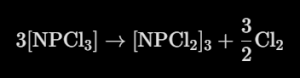
Just like our previous example, you verify your success by checking the IR spectrum for the P=N and P-Cl stretches, and running a 31P NMR to look for that single, tells-it-all symmetric peak.
Important Subtopics to Focus on for RPSC Assistant Professor Exam
As you wrap up your study session, make sure you have checked off these critical areas:
- Structure & Bonding: The exact mechanism behind d\π-p\π bonding and why the ring remains planar.
- Synthesis Protocols: The classic reactions of PCl₅ with NH₄Cl or amines, including the reaction conditions.
- Substitution Reactivity: How the chlorine atoms on [NPCl₂]₃ can be replaced by nucleophiles like alcohols, amines, or organometallic reagents to create custom derivatives.
- Spectroscopic Fingerprints: Knowing exactly where the key peaks show up on IR and NMR charts.
Keeping these core topics clear in your mind will give you a massive confidence boost on exam day. If you want to keep this momentum going, our team at VedPrep has put together comprehensive study materials and practice question banks designed specifically for chemistry aspirants.
Final Thoughts
Phosphazenes might seem like just another niche topic in your inorganic chemistry syllabus, but mastering them gives you a massive edge on exam day. They perfectly bridge the gap between fundamental orbital bonding theory and cutting-edge material science, which is exactly why RPSC examiners love to test them. Don’t let the complex ring diagrams intimidate you—once you get a feel for how that alternating phosphorus-nitrogen backbone operates, the synthesis routes and spectroscopic data fall right into place.
To know more in detail from our faculty, watch our YouTube video:
Frequently Asked Questions
What is the general structure of phosphazenes?
The general structure of phosphazenes is (RPN)3 or (RPN)4, where R represents organic substituents. The phosphorus and nitrogen atoms alternate in a ring or chain structure, with phosphorus in a +5 oxidation state.
What are the main types of phosphazenes?
The main types of phosphazenes are cyclophosphazenes, which form ring structures, and polyphosphazenes, which form chain-like structures. Cyclophosphazenes are further classified into cyclic trimer and tetramer phosphazenes.
What are the applications of phosphazenes?
Phosphazenes have applications in various fields, including as fire retardants, in biomedicine, and as precursors to ceramic materials. They are also used in the synthesis of inorganic polymers and as ligands in organometallic chemistry.
How are phosphazenes synthesized?
Phosphazenes are typically synthesized through the reaction of phosphorus pentachloride with ammonia or amines, followed by substitution reactions to introduce organic substituents. The method allows for a wide range of derivatives to be prepared.
How do phosphazenes relate to main group elements?
Phosphazenes are directly related to main group elements as they contain phosphorus and nitrogen, both of which are main group elements. Their chemistry is a significant part of main group chemistry, showcasing the diversity and complexity of compounds formed by these elements.
What are the key characteristics of phosphazenes?
Key characteristics of phosphazenes include their phosphorus-nitrogen backbone, the ability to form rings or chains, and their reactivity, which allows for the introduction of various organic and inorganic substituents. Their properties can be tailored through chemical modification.
How are phosphazenes relevant to the RPSC Assistant Professor exam?
Phosphazenes are relevant to the RPSC Assistant Professor exam as they are a topic within inorganic chemistry, specifically under main group elements. Understanding their structure, properties, and applications is crucial for questions in inorganic and analytical chemistry.
What kind of questions about phosphazenes can be expected in the exam?
In the RPSC Assistant Professor exam, questions about phosphazenes may cover their synthesis, structure, properties, and applications. Candidates should be prepared to answer questions that test their understanding of phosphazene chemistry and its relevance to broader topics in inorganic chemistry.
How can I apply knowledge of phosphazenes to analytical chemistry?
Knowledge of phosphazenes can be applied to analytical chemistry through understanding their use as reagents or substrates in analytical techniques. Phosphazenes can be involved in reactions that are analytically useful, such as in the detection of certain metals or in the development of new analytical methodologies.
What are common mistakes in understanding phosphazene chemistry?
Common mistakes include confusing phosphazenes with other phosphorus-nitrogen compounds, misunderstanding their oxidation states, and not recognizing the diversity of their structures and applications. It's also common to overlook the significance of phosphazenes in inorganic and materials chemistry.
What is a common misconception about the properties of phosphazenes?
A common misconception is that phosphazenes are all highly reactive and unstable. While some phosphazenes can be reactive, many are stable and have well-defined properties, making them useful in various applications.
What are some advanced topics in phosphazene research?
Advanced topics in phosphazene research include the development of new synthetic methods, the design of phosphazene-based materials with specific properties, and their applications in catalysis and as functional materials. Research also focuses on the theoretical understanding of phosphazene structures and reactivity.
What future directions are there for phosphazene research?
Future directions for phosphazene research include the exploration of their applications in energy storage, as catalysts, and in the development of new materials with unique optical or electronic properties. Research is also aimed at expanding the synthetic methodologies to access a wider range of phosphazene derivatives.
What are phosphazene-based materials?
Phosphazene-based materials refer to compounds or polymers derived from phosphazenes, which exhibit unique properties suitable for applications in materials science. These materials can have tailored properties for use in electronics, catalysis, and as functional materials.