

Steady state approximation is a mathematical technique used to simplify complex reaction mechanisms in chemistry, assuming the concentration of intermediates remains constant, allowing students to predict reaction rates and equilibrium constants for CSIR NET and other competitive exams, which is a key concept in Stationary State Hypothesis For CSIR NET.
Syllabus: Steady State Approximation in CSIR NET and IIT JAM Syllabus
If you look at the official NTA syllabus for CSIR NET, or even the syllabi for IIT JAM and GATE, Chemical Kinetics is always a heavyweight unit. Specifically, complex reaction mechanisms and the Stationary State Hypothesis are major focus areas. Examiners love testing your ability to derive rate laws from multi-step pathways, making this a non-negotiable topic if you want to sail past the cutoff.
What is the difference between steady state and equilibrium?
This is the ultimate interview and exam question!
-
Equilibrium means the forward and reverse rates of a reaction are completely equal. The concentrations of reactants and products stop changing because the system has reached its lowest energy state. No energy is required to maintain it.
-
Steady State just means the concentration of the intermediate stays constant over time because its production rate matches its destruction rate. However, the overall reaction is still actively moving forward, converting reactants to products. It is a dynamic state that often requires a continuous flow of matter or energy to keep going.
Overview: Steady state approximation For CSIR NET
Real-world chemical reactions rarely happen in a single, neat step. Most reactions go through a series of chaotic loops, creating short-lived, highly reactive species called intermediates.
Imagine a busy coffee shop during morning hours. The barista (Intermediate) takes an order from the cashier (Reactant) and passes the coffee to the customer (Product). The barista works incredibly fast. As soon as an order drops, they fulfill it. Because they process orders as fast as they receive them, the number of orders waiting in the barista’s hands stays pretty much constant throughout the rush.
That is exactly what the Steady State Approximation assumes. For a highly reactive intermediate, its rate of formation equals its rate of consumption. Because its concentration [I] stays incredibly low and constant during the main course of the reaction, we can set its rate of change over time to zero:
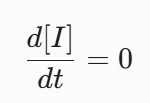
As per Steady state approximation, by making this clever assumption, we can eliminate the hard-to-measure intermediate from our equations and express the overall rate law purely using the concentrations of the reactants we started with.
Worked Example: Steady State Approximation For CSIR NET
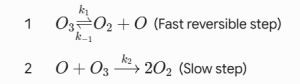
Here, atomic oxygen (O) is our highly reactive intermediate. Let’s apply the SSA to find its concentration.
Step 1: Set the net rate of formation of O to zero.

(Note: O is formed in the forward first step, but consumed in both the reverse first step and the second step).
Step 2: Solve for [O].
Rearranging the equation to isolate [O] gives us:
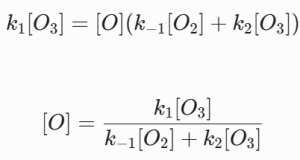
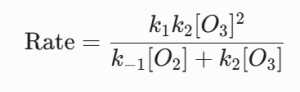
Step 3: Write the overall rate law. The overall reaction rate is determined by the final step where the product is formed:
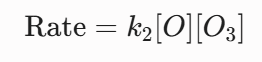
Substitute our value of [O] into this rate law:
Misconception: Common Mistakes
As per Steady state approximation, a classic trap that students fall into is assuming that the Stationary State Hypothesis can be applied blindly to every single reaction mechanism.
Let’s clear this up: SSA only works beautifully when the intermediate is highly unstable and reacts almost the instant it forms. If your reaction builds up a stable intermediate, or if the initial induction period hasn’t passed yet, setting d[I]/dt = 0 will lead to completely wrong answers. Also, when dealing with complex networks of multiple consecutive intermediates, you have to be extra careful about which species truly reach a steady state.
Real-World Application: Steady State Approximation in Chemical Engineering
This isn’t just a textbook trick to torture you in exams; it’s used every day by chemical engineers to design massive industrial reactors.
Take the famous Haber-Bosch process for synthesizing ammonia (NH3). The reaction happens on the surface of an iron catalyst where nitrogen and hydrogen molecules break apart and recombine. The intermediate species bound to the catalyst surface are incredibly short-lived. By applying the steady-state assumption to these surface intermediates, engineers can easily predict how temperature and pressure changes will affect production without needing to measure every single microscopic step.
-
Boosts Efficiency: Helps optimize reaction conditions for maximum product yield.
-
Saves Money: Reduces costs associated with expensive catalysts and high energy consumption.
-
Scales Production: Widely applied from polymerizing polyethylene to refining fuels.
Exam Strategy: Steady State Approximation For CSIR NET: Tips and Tricks
When you’re sitting in the exam hall, clock ticking, you don’t want to get bogged down in long algebraic derivations. Here is how we at VedPrep recommend tackling these questions:
-
Identify the Intermediates Immediately: Look at the overall reaction. Any species that appears in the mechanism steps but isn’t in the final overall reaction is your intermediate.
-
Watch the Signs: Remember, if an intermediate is formed, its rate term is positive (+). If it is consumed, its rate term is negative (–). Missing a single minus sign is the quickest way to pick the wrong option.
-
Practice Boundary Conditions: Master how the rate law changes when certain steps are much faster or slower than others. NTA loves asking conceptual questions based on these approximations.
Advanced Topic: Steady State Approximation in Non-Linear Reaction Mechanisms
Things get incredibly interesting when we look at non-linear mechanisms—like oscillating reactions or autocatalytic loops (where a product acts as its own catalyst). These systems involve complex feedback loops, making their differential equations a nightmare to solve directly.
Applying the Stationary State Hypothesis helps simplify these non-linear systems down to manageable math. It allows researchers to derive elegant rate equations and chart out stable operating regions for highly sensitive chemical reactions.
Final Thoughts
Mastering the Steady State Approximation is a non-negotiable step for any aspirant aiming to crack the Physical Chemistry section of the CSIR NET exam. By simplifying the kinetic analysis of complex, multi-step mechanisms, this mathematical tool allows you to derive rate laws that would otherwise be nearly impossible to calculate.
Whether you are distinguishing it from the equilibrium approximation or applying it to industrial setups, a clear conceptual grasp is your greatest asset. If you ever feel stuck or want to practice with exam-level test series, remember that VedPrep is always around with expert-led guidance and comprehensive resources tailored for your success.
To know more in detail from our expert faculty, watch our YouTube video:
Frequently Asked Questions
When is the steady state approximation used?
The steady state approximation is used when the intermediate is highly reactive and its concentration is very low, making it difficult to measure directly.
What are the assumptions of the steady state approximation?
The steady state approximation assumes that the rate of formation of the intermediate is equal to its rate of consumption, and that its concentration remains constant over time.
How does the steady state approximation differ from the equilibrium approximation?
The steady state approximation assumes that the intermediate is not in equilibrium with the reactants, whereas the equilibrium approximation assumes that the intermediate is in equilibrium with the reactants.
What are the limitations of the steady state approximation?
The steady state approximation is limited to reactions where the intermediate is highly reactive and its concentration is very low, and may not be accurate for reactions where the intermediate is stable or has a long lifetime.
What is the role of the steady state approximation in physical chemistry?
The steady state approximation plays a crucial role in physical chemistry, particularly in the study of chemical kinetics and reaction mechanisms.
What are the key equations used in the steady state approximation?
The key equations used in the steady state approximation include the rate laws for the formation and consumption of the intermediate, and the assumption that its concentration remains constant over time.
How is the steady state approximation applied in CSIR NET?
The steady state approximation is often applied in CSIR NET questions related to chemical kinetics, where it is used to simplify the analysis of complex reactions and determine the rate laws.
What types of questions can be answered using the steady state approximation in CSIR NET?
The steady state approximation can be used to answer questions related to the rates of reactions, the orders of reactions, and the mechanisms of reactions.
How can I practice applying the steady state approximation for CSIR NET?
Practice problems and past-year questions can help you develop your skills in applying the steady state approximation to different reaction scenarios.
What are common mistakes made when applying the steady state approximation?
Common mistakes include assuming that the steady state approximation is always valid, and not checking the assumptions of the method before applying it.
How can the steady state approximation be misinterpreted?
The steady state approximation can be misinterpreted as implying that the intermediate is in equilibrium with the reactants, when in fact it is not.
How does the steady state approximation relate to the concept of quasi-steady state?
The quasi-steady state approximation is a related concept that assumes that the concentration of an intermediate changes slowly over time, but not necessarily at a constant rate.
What are the implications of the steady state approximation for understanding reaction mechanisms?
The steady state approximation can provide insights into the mechanisms of reactions, by allowing researchers to infer the presence of intermediates and determine their roles in the reaction.
How does the steady state approximation relate to other concepts in chemical kinetics?
The steady state approximation is related to other concepts in chemical kinetics, such as the rate-determining step and the Arrhenius equation.