

Surface catalysis is a critical concept in CSIR NET that deals with the study of chemical reactions at interfaces between solid and liquid or gas phases, and its applications in various industrial processes, which is a key aspect of Heterogeneous Catalysis For CSIR NET.
Syllabus: Surface Chemistry and Catalysis For CSIR NET
Preparing for the CSIR NET Chemical Sciences exam can feel like trying to drink water from a firehose. You have an enormous syllabus to cover, and Unit 2 (Surface Chemistry and Catalysis) is one of those high-yield areas where you simply cannot afford to lose easy marks. If you want to crack this exam, getting a firm grip on surface catalysis and heterogeneous kinetics is absolutely essential.
When you dive into this unit, you are essentially looking at how chemical reactions behave when they are pushed into a corner—specifically, the boundary layer where a solid meets a liquid or a gas. The exam love to test you on three major pillars: surface science, the math behind adsorption, and the grit of heterogeneous catalysis.
To really nail this section, standard textbooks like Atkins’ Physical Chemistry are great for the heavy theoretical frameworks. But if you want to understand how these concepts actually show up in those tricky Part B and Part C questions, we at VedPrep always suggest focusing on the core mechanism models and how they map onto real-world data.
Surface Catalysis For CSIR NET: Definition and Importance
what exactly is surface catalysis? In plain terms, it is the study of chemical reactions that refuse to happen in the open air or bulk solution, choosing instead to take place right at the border crossing between two different phases.
Think of a solid catalyst as a busy, high-end match-making club. The reactant molecules (the gases or liquids swirling around) are the guests. Instead of floating around aimlessly hoping to bump into each other in a massive room, they land on the solid surface, get held close together in the perfect orientation, and boom—the reaction happens way faster than it ever would on its own. Once the product forms, it leaves the club to make room for the next guests.
This boundary-layer chemistry runs the show in massive industrial setups. Take petroleum refining, for example. We rely on these surface interactions to break down raw crude oil into things we actually use every day, like gasoline and diesel. For anyone prepping for the exam, understanding how to tweak reaction conditions or predict how a catalyst surface will behave isn’t just academic trivia—it is the bread and butter of industrial chemistry and a favorite topic for CSIR NET paper setters.
Worked Example: Langmuir-Hinshelwood Kinetics in Surface Catalysis For CSIR NET
The Langmuir-Hinshelwood mechanism is an absolute favorite in the CSIR NET exam, especially for those high-weightage Part C questions. This model explains the kinetics of bimolecular reactions on solid surfaces by assuming that both reactant molecules must be adsorbed onto neighboring sites on the catalyst surface before they can react with each other.
Let’s break down a classic textbook example: the reaction between carbon monoxide and oxygen on a platinum surface to form carbon dioxide:

To make the derivation easy to follow, let’s look at a generalized reaction between two gas-phase molecules, A and B, to form a product P on a surface.
Step-by-Step Derivation
Step 1: Adsorption of Gas A onto the surface
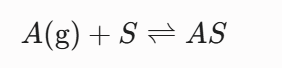
The fractional surface coverage of A is represented by θA.
Step 2: Adsorption of Gas B onto the surface
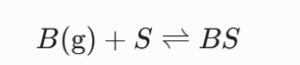
The fractional surface coverage of B is represented by θB.
Using the Langmuir adsorption isotherm for two competing gases, we can write the coverage expressions as:
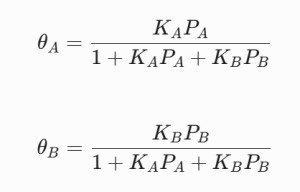
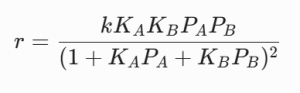
Where KA and KB are the adsorption equilibrium constants, and PA and PB are the partial pressures of the gases.
Step 3: Reaction between the adsorbed molecules
This is the rate-determining step (RDS). The molecules react on the surface to form the product:
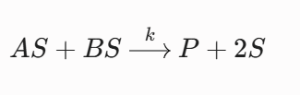
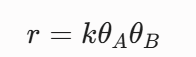
The rate of the reaction (r) is directly proportional to the probability that an adsorbed A molecule is right next to an adsorbed B molecule. This means the rate is proportional to the product of their surface coverages:
Now, substitute the expressions for θA and θB into the rate law:
Misconception: Adsorption vs Absorption in Surface Catalysis For CSIR NET
It is incredibly easy to mix up adsorption and absorption when you are racing through a timed exam, but they are entirely different beasts.
Let’s use a quick, fictional analogy to keep them straight. Imagine you are painting a wooden front door. If you spill a bucket of blue paint onto the surface, that paint sits right on top of the wood, forming a distinct layer. That is adsorption—a strict surface phenomenon. Now, imagine it starts raining, and that unsealed wood sucks up the water molecules right into its deepest core, causing the whole door to swell. That is absorption—a bulk phenomenon where the substance travels all the way inside.
[Image comparing adsorption on a surface versus absorption into the bulk]
Here is a quick cheat sheet to keep you from falling into traps on exam day:
| Feature | Adsorption | Absorption |
| Location | Limited to the surface only. | Spreads uniformly throughout the bulk. |
| Concentration | Higher on the surface than in the bulk. | Uniform throughout the material. |
| Reversibility | Usually reversible (desorption is common). | Often irreversible or tough to separate. |
| Reaction Type | Exothermic, typically starts fast and slows down. | Uniform rate, not driven by surface energy. |
In surface catalysis, we care almost exclusively about adsorption. If your reactants start absorbing deep into the bulk of your solid catalyst, it usually means your catalyst is degrading or getting poisoned, which ruins its efficiency.
Application: Surface Catalysis in Petroleum Refining For CSIR NET
To see surface catalysis in action, look no further than a petroleum refinery. Cracking down giant, complex hydrocarbons into small, high-value molecules like petrol requires some serious chemical intervention.
Refineries rely heavily on zeolites, which are microporous aluminosilicate minerals. You can think of zeolites as molecular multi-story parking garages. They have incredibly intricate, tiny channels and cages that give them a massive internal surface area.
When heavy oil vapors pass through these zeolites under high temperatures and pressures, the large molecules get trapped in these custom-fit cages. The active acid sites on the zeolite walls go to work, snapping the long carbon chains into perfectly sized pieces for fuel.
At VedPrep, we like to emphasize these industrial examples because CSIR NET questions love to test your understanding of how catalysts behave under extreme conditions. For instance, you might see questions on Fluid Catalytic Cracking (FCC) or hydrotreating, where understanding catalyst stability, surface area optimization, and resistance to clogging (coking) is key to solving the problem.
Heterogeneous vs Homogeneous Catalysis
When you look at catalysis as a whole, it splits into two main camps: heterogeneous and homogeneous. Knowing the trade-offs between them is a classic theme for conceptual exam questions.
-
Heterogeneous Catalysis: The catalyst and the reactants are in completely different phases. Usually, this means a solid catalyst working on gases or liquids.
-
Homogeneous Catalysis: Everything is in the same phase. The catalyst and the reactants are all mixed together in a single liquid solution or gas mixture.
While homogeneous catalysts can be highly specific, industrial chemists usually prefer heterogeneous catalysts for surface catalysis because they offer massive practical advantages:
-
Massive Surface Area: Solid catalysts can be engineered with tiny pores or as nanoparticles, packing an unbelievable amount of active reaction space into a tiny volume.
-
Easy Separation: When your reaction is done, you can just filter out the solid catalyst or pump the gases away. You don’t have to deal with a messy, expensive chemical separation process to get your product out.
-
Recyclability: Solid catalysts are durable and can be used over and over again before they wear out.
Worked Example: Freundlich Adsorption Isotherm
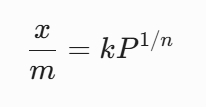
The Freundlich adsorption isotherm is an empirical equation used to describe how a gas binds to a solid surface when that surface is rough and uneven (heterogeneous).
The classic formula is written as:
Where:
-
x is the mass of the gas adsorbed.
-
m is the mass of the solid adsorbent.
-
P is the pressure of the gas.
-
k and n are constants that depend on the nature of the gas and the solid at a given temperature. (Usually, n > 1).
Let’s work through a typical numerical problem you might encounter in the exam.
Future Directions
The world of surface catalysis isn’t frozen in old textbooks—it is evolving rapidly. As we try to build cleaner industries and greener chemical processes, researchers are pushing this field into exciting new territory.
If you are thinking about what happens after you clear the CSIR NET and venture into a PhD or research fellowship, here are the big fronts where the action is happening right now:
-
Nanostructured Catalysts: Engineers are designing materials at the atomic level to maximize active surface sites, making reactions faster while using less material.
-
Smart Support Materials: Finding better ways to mount catalysts so they remain stable under brutal industrial pressures and temperatures without degrading.
-
Operando Spectroscopy: Using advanced lasers and X-rays to watch chemical bonds snap and form on a catalyst surface in real-time while the reaction is actually running.
Final Thoughts
Mastering surface catalysis is one of the smartest moves you can make while preparing for the CSIR NET Chemical Sciences exam. By getting comfortable with the Langmuir-Hinshelwood mechanism, learning to spot the subtle traps between adsorption and absorption, and practicing the math behind isotherms, you can confidently secure some high-value marks.
At the end of the day, cracking this exam isn’t about memorizing endless blocks of text—it is about understanding how these molecular systems interact in the real world. If you ever feel stuck or want to streamline your prep with structured guidance and practice papers, we at VedPrep are always here to help you clear the fog and ace your goals.
To know more in detail from our expert faculty, watch our YouTube:
Frequently Asked Questions
How does surface catalysis differ from homogeneous catalysis?
Surface catalysis involves a heterogeneous catalyst, which is in a different phase from the reactants, whereas homogeneous catalysis involves a catalyst in the same phase as the reactants. Surface catalysis often occurs at the interface between the catalyst and reactants.
What are the key factors influencing surface catalysis?
The key factors influencing surface catalysis include the surface area of the catalyst, the nature of the catalyst and reactants, temperature, pressure, and the presence of poisons or promoters. These factors can significantly impact the rate and efficiency of the catalytic reaction.
What is the role of adsorption in surface catalysis?
Adsorption plays a crucial role in surface catalysis as it allows reactants to accumulate on the catalyst surface, increasing their concentration and reactivity. The strength and type of adsorption can significantly influence the catalytic activity and selectivity.
How does surface catalysis apply to real-world scenarios?
Surface catalysis has numerous applications in industries such as petroleum refining, chemical synthesis, and environmental remediation. It is also essential in biological systems, where enzymes act as catalysts, and in fuel cells, where surface catalysis enhances energy conversion efficiency.
What is the significance of surface chemistry in surface catalysis?
Surface chemistry plays a vital role in surface catalysis as it determines the interactions between the catalyst and reactants. Understanding surface chemistry is essential for designing and optimizing catalysts for specific reactions.
What are the different types of surface catalysis?
There are several types of surface catalysis, including heterogeneous catalysis, homogeneous catalysis, and biocatalysis. Each type has distinct characteristics and applications, and understanding their differences is essential for selecting the appropriate catalyst and reaction conditions.
How can surface catalysis be applied to solve problems in CSIR NET Physical Chemistry?
Understanding surface catalysis is essential for solving problems related to catalytic reactions, reaction kinetics, and surface chemistry in CSIR NET Physical Chemistry. It requires applying concepts such as Langmuir-Hinshelwood kinetics and understanding the role of surface area and adsorption.
What types of questions related to surface catalysis can be expected in CSIR NET?
CSIR NET may include questions on the principles of surface catalysis, types of catalysts, reaction mechanisms, and applications. Questions may also involve analyzing data from catalytic reactions, interpreting kinetic models, and understanding the role of surface properties in catalysis.
How can surface catalysis be used to understand biological systems?
Surface catalysis is crucial in biological systems, where enzymes act as catalysts. Understanding surface catalysis can provide insights into enzyme kinetics, substrate binding, and catalytic mechanisms, which are essential for understanding biological processes.
What common mistakes should be avoided when studying surface catalysis?
Common mistakes include confusing surface catalysis with homogeneous catalysis, neglecting the importance of surface area and adsorption, and failing to consider the role of poisons and promoters. Additionally, students should be cautious when applying kinetic models and interpreting experimental data.
What are common misconceptions about surface catalysis?
Common misconceptions include assuming that surface catalysis only occurs on solid catalysts, neglecting the role of surface area and adsorption, and believing that all catalysts are equally effective for a given reaction.
What are some recent advancements in surface catalysis research?
Recent advancements in surface catalysis research include the development of nanostructured catalysts, the use of computational methods to model catalytic reactions, and the exploration of new catalytic materials such as single-atom catalysts and metal-organic frameworks.
How does surface catalysis relate to energy applications?
Surface catalysis plays a critical role in energy applications such as fuel cells, where it enhances energy conversion efficiency, and in the production of clean energy carriers, such as hydrogen, through catalytic reactions.
What is the future of surface catalysis research?
The future of surface catalysis research is focused on developing sustainable and efficient catalytic systems, exploring new materials and technologies, and understanding complex catalytic reactions. This research has the potential to transform various industries and address pressing environmental challenges.