

Enzyme kinetics (Michaelis-Menten) For CSIR NET involves understanding the rate of enzyme-catalyzed reactions, enzyme-substrate complex formation, and saturation kinetics to solve problems in competitive exams. Enzyme kinetics (Michaelis-Menten) For CSIR NET is essential for success in CSIR NET.
Enzyme Kinetics (Michaelis-Menten) For CSIR NET
Preparing for the CSIR NET exam can sometimes feel like trying to cross a chaotic intersection during rush hour. Among all the heavy-duty topics in the syllabus, enzyme kinetics stands out as a massive checkpoint. At its core, enzyme kinetics is just the study of how fast enzymes do their jobs and what makes them speed up or slow down.
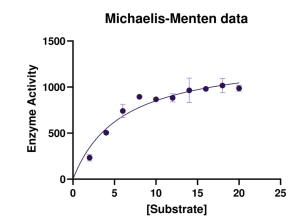
Think of Enzyme kinetics like an assembly line worker packing boxes. The substrate is the raw material waiting to be packed. If you only throw one or two boxes at the worker, they pack them quickly, and the overall rate is slow because they are waiting for more. But if you flood the floor with boxes, the worker hits top speed and cannot physically move any faster. That is the essence of saturation kinetics—the moment where adding more stuff does not make the process go any quicker.
For a CSIR NET aspirant, getting a firm grip on these concepts is non-negotiable. It is one of those high-yield topics that shows up year after year, and nailing it can seriously boost your scorecard.
Understanding the CSIR NET Syllabus for Enzyme Kinetics (Michaelis-Menten)
If you scan through the CSIR NET syllabus, you will find this topic tucked under the Biophysics and Physical Chemistry sections. It acts as a bridge between pure, theoretical chemistry and actual biological systems. Because it sits at this intersection, questions can swing from straightforward math to conceptual riddles about cellular behavior.
To get a handle on this, standard textbooks are your best friends. Many students swear by Biophysics: Principles and Techniques by C. R. Rao because it breaks down the physical math behind biological systems without making your head spin. Whether you are studying for CSIR NET, IIT JAM, or GATE, having a reliable guide makes a world of difference. Here at VedPrep, we often remind students that you do not need to memorize every single line of text out there; you just need to understand how the pieces fit together so you can apply them when the exam timer starts ticking.
Enzyme kinetics (Michaelis-Menten) For CSIR NET: A Detailed Analysis
Let’s look at the math that keeps everyone up at night: the Michaelis-Menten equation.
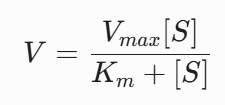
Where:
-
V is the current rate of the reaction.
-
Vmax is the absolute maximum speed the enzyme can reach.
-
[S] is the substrate concentration.
-
Km is the Michaelis constant (the substrate concentration where the reaction hits exactly half of Vmax).
Let’s look at a classic type of question you might see on the exam:
Sample Problem: A researcher is tracking an enzyme-catalyzed reaction and collects the following numbers:
| Substrate concentration (mM) | Rate of reaction (μmol/min) |
| 1 | 2 |
| 2 | 4 |
| 5 | 8 |
| 10 | 10 |
Determine Vmax and Km for this enzyme.
Trying to figure this out directly from a curvy graph is tough. Instead, we flip everything upside down using a Lineweaver-Burk plot (a double reciprocal plot of 1/V against 1/[S]).
The equation transforms into a straight line:
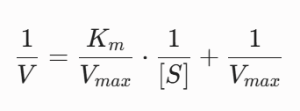
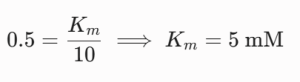
If you plot the data points from the table onto this straight-line graph, you get a y-intercept of 0.1 and a slope of 0.5. Since the y-intercept is equal to 1/Vmax:
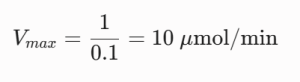
And since the slope is Km / Vmax:
Common Misconceptions about Michaelis-Menten For CSIR NET
As per Enzyme kinetics, the biggest trap students fall into is assuming that because the Lineweaver-Burk plot is a straight line, the Michaelis-Menten equation itself is linear. It isn’t. The actual relationship between substrate concentration and reaction rate is a hyperbola.
Imagine you own a small coffee shop with one barista. If two customers walk in, the barista makes the drinks instantly. If five walk in, they work a bit faster. But if a tour bus drops off fifty people all at once, the barista hits a ceiling. They are working at absolute maximum capacity (Vmax). Adding a fifty-first person to the line will not make the coffee come out any faster.
The relationship between the number of customers and coffee output curves upward and then flattens out. It is not a straight diagonal line. Keeping this distinction clear in your mind prevents easy mistakes on conceptual true-or-false exam questions.
Real-World Applications of Enzyme Kinetics (Michaelis-Menten) For CSIR NET
Enzyme kinetics isn’t just something designed to torture students during exams; it runs massive real-world industries.
Imagine a fictional scenario where a biotech company wants to manufacture a sustainable biofuel using a specialized enzyme that breaks down agricultural waste. If the engineers do not know the exact Km and Vmax of their enzyme, they might dump millions of dollars worth of raw materials into a massive bioreactor, only to realize the enzymes are completely overwhelmed or sitting idle. Knowing the kinetics allows them to design the perfect tank size, control the flow of ingredients, and keep production costs low.
The same rules apply to enzyme engineering. If scientists want to create a better laundry detergent enzyme that eats grass stains at lower temperatures, they use kinetic analysis to see if their engineered mutations actually improved the enzyme’s affinity for the stain.
Exam Strategy: Mastering Enzyme Kinetics (Michaelis-Menten) For CSIR NET Success
When you are staring down a heavy exam paper, raw memorization will only get you so far. You need a game plan.
At VedPrep, we recommend breaking your study sessions down into manageable, focused blocks rather than trying to swallow the whole textbook at once. Focus on these three core areas:
-
The Hyperbolic Curve vs. The Linear Plot: Make sure you can comfortably switch back and forth between Michaelis-Menten and Lineweaver-Burk models.
-
Enzyme Inhibition: Understand how competitive, uncompetitive, and non-competitive inhibitors shift your Vmax and Km values on a graph.
-
The Physical Meaning of Km: Remember that a small Km means the enzyme has a high affinity for its substrate (it doesn’t take much substrate to get it working at half speed).
Practicing diverse question formats builds the muscle memory you need to handle whatever the exam throws at you.
Key Concepts in Enzyme Kinetics (Michaelis-Menten) For CSIR NET: Enzyme-Substrate Complex Formation
Before a product can be made, the enzyme (E) and the substrate (S) have to shake hands and form a temporary team called the enzyme-substrate complex (ES).
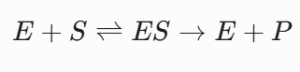
This intermediate state is the heart of the entire reaction cycle. How quickly this complex forms and breaks down dictates the overall speed of the reaction. The Michaelis constant (Km) is a direct reflection of this balancing act. If the ES complex holds onto each other tightly, the reaction has a high affinity. If they bounce off each other without locking in, the affinity is low. Understanding this molecular handshake makes it much easier to predict how changes in temperature, pH, or salt levels will alter your experimental numbers.
Analyzing Enzyme Kinetics Data: A Case Study Using the Michaelis-Menten Equation
Let’s look at one more data-driven scenario to see how this plays out in practice.
Sample Problem: Imagine you get the following dataset during your revision session:
| Substrate Concentration (mM) | Reaction Rate (μmol/min) |
| 1 | 2.5 |
| 2 | 4.2 |
| 5 | 7.1 |
| 10 | 9.5 |
Find Vmax and Km.
If you take these numbers and convert them to reciprocals (1/[S] and 1/V), you can plot them to see where the line crosses the axes. For this specific set of numbers, running the calculations gives you a Vmax of roughly 10.2 μmol/min and a Km of 2.5 mM.
When you can look at a table of numbers and visualize exactly where that reaction levels off, you have moved past simple memorization and truly mastered the concept.
Final Thoughts
Mastering enzyme kinetics is all about seeing the balance between how tightly an enzyme grabs its substrate and how fast it turns it into something new. Once you learn to connect the theoretical curves to the practical straight-line graphs, this tricky section of biochemistry becomes a reliable place to score points.
If you want to streamline your revision, practice with realistic mock tests, or talk through these tricky graphs with mentors who have been in your shoes, VedPrep has structured study tools and expert guidance ready whenever you need a hand.
To learn more from our faculty, watch our YouTube video:
Frequently Asked Questions
What is the Michaelis-Menten model?
The Michaelis-Menten model describes the kinetic behavior of enzymes during enzymatic reactions. It relates the reaction rate to the concentration of the substrate, introducing the Michaelis constant (Km) and the maximum rate (Vmax) of the reaction.
What is the significance of Km in enzyme kinetics?
The Michaelis constant (Km) is a measure of the affinity of an enzyme for its substrate. A low Km indicates high affinity, meaning the enzyme can effectively bind and act on the substrate at lower concentrations.
How does pH affect enzyme activity?
pH affects enzyme activity by altering the ionization state of amino acids in the enzyme's active site, thereby influencing substrate binding and catalysis. Each enzyme has an optimal pH range in which it is most active.
What is Vmax in the context of enzyme kinetics?
Vmax, or the maximum rate, is the highest rate of the enzymatic reaction when the enzyme is completely saturated with substrate. It reflects the enzyme's catalytic efficiency and is influenced by factors like enzyme concentration and temperature.
What is the role of enzyme kinetics in drug development?
Enzyme kinetics plays a crucial role in drug development by helping to understand how drugs interact with enzymes, which can lead to the design of more effective and safer drugs. Kinetic studies can reveal how drugs act as inhibitors or substrates.
What are the assumptions of the Michaelis-Menten model?
The Michaelis-Menten model assumes that the enzyme-substrate complex is in a steady-state condition, that the substrate concentration is much greater than the enzyme concentration, and that the reaction is not limited by product formation or inhibition.
How is the Michaelis-Menten equation applied in CSIR NET exams?
In CSIR NET exams, the Michaelis-Menten equation is applied to solve problems related to enzyme kinetics, such as determining Km and Vmax from given data, understanding the effects of inhibitors, and interpreting enzyme activity under various conditions.
What types of questions on enzyme kinetics can be expected in CSIR NET?
CSIR NET exams may include questions on deriving and applying the Michaelis-Menten equation, interpreting kinetic plots like Lineweaver-Burk plots, understanding the effects of different types of inhibitors, and relating enzyme kinetics to biochemical pathways.
How to interpret a Lineweaver-Burk plot?
A Lineweaver-Burk plot is a double reciprocal plot of the Michaelis-Menten equation, used to analyze enzyme kinetics. It plots 1/V vs. 1/[S], allowing for the determination of Km and Vmax and the identification of inhibition types.
What are common mistakes in applying the Michaelis-Menten equation?
Common mistakes include incorrect assumptions about enzyme-substrate interactions, misinterpretation of Km and Vmax, failure to account for inhibitors or activators, and not considering the limitations of the Michaelis-Menten model, such as non-linear kinetics.
How can one avoid errors in calculating Km and Vmax?
To avoid errors, ensure accurate data collection, use appropriate graphical analyses like Lineweaver-Burk plots, and apply nonlinear regression analysis when necessary. It's also crucial to understand the assumptions underlying the Michaelis-Menten model.
What are cooperative enzymes and how do they differ from Michaelis-Menten enzymes?
Cooperative enzymes exhibit cooperative binding, where the binding of one substrate molecule affects the binding of subsequent substrate molecules. This differs from Michaelis-Menten enzymes, which do not exhibit cooperativity, and leads to sigmoidal rather than hyperbolic kinetic curves.
How does allosteric regulation affect enzyme kinetics?
Allosteric regulation involves the binding of effectors at sites other than the active site, which can either increase (positive allosteric modulation) or decrease (negative allosteric modulation) enzyme activity. This regulation can significantly alter the enzyme's kinetic behavior.
How does temperature affect enzyme kinetics?
Temperature affects enzyme kinetics by influencing the rates of chemical reactions and the stability of the enzyme. While higher temperatures can increase reaction rates, they can also lead to enzyme denaturation and loss of activity.