
Hybridization For IIT JAM refers to the phenomenon of intermixing atomic orbitals of equal or slightly different energies, resulting in the formation of new set of orbitals with equivalent energies and shape, essential for molecular geometry and bonding.
Syllabus and Key Textbooks for Hybridization For IIT JAM
Before you dive headfirst into your notes, you need to know exactly what the exam expects from you and where to find the best explanations.
The JAM Syllabus Breakdown
For the IIT JAM chemistry paper, hybridization isn’t just a standalone definition; it is woven into both organic chemistry (stereochemistry, reactive intermediates like carbocations and carbanions, and aromaticity) and inorganic chemistry (chemical bonding and coordination compounds). You will need to calculate steric numbers, predict geometries, and understand how d-orbitals get involved when dealing with transition metals.
The Ultimate Booklist
To get your concepts crystal clear, skip the random internet forums and stick to these standard student favorites:
-
Inorganic Chemistry by J.D. Lee: The holy grail for understanding how orbitals overlap and why certain shapes exist.
-
Inorganic Chemistry by Miessler & Tarr: Incredible for visualizing molecular orbital theory alongside hybridization.
-
Organic Chemistry by Clayden: If you want to understand how hybrid orbitals affect organic reactions and mechanisms, look no further.
Hybridization For IIT JAM: A Fundamental Concept
Imagine you are trying to make a perfectly uniform set of purple paints, but all you have are individual cups of red and blue. You can’t just throw a blob of red and a blob of blue onto the canvas and expect it to look seamless. You have to mix them thoroughly in a separate tray first.
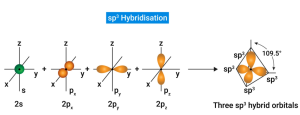
That is exactly what an atom does with its orbitals during hybridization. It takes atomic orbitals of slightly different energies (like an s and a p orbital) and mixes them together to create a brand-new set of completely identical hybrid orbitals.
Here is the deal: the number of hybrid orbitals you get out is always exactly equal to the number of atomic orbitals you put in. If a carbon atom mixes one s orbital and one p orbital, it gets two sp hybrid orbitals back.
Quick Geometry Cheat Sheet
The whole point of this orbital mixing is to help the molecule find its most comfortable shape, minimizing electron repulsion. Here is how the most common types shake out:
| Hybridization Type | Resulting Geometry | Ideal Bond Angle |
| sp | Linear | 180° |
| sp2 | Trigonal Planar | 120° |
| sp3 | Tetrahedral | 109.5° |
Mastering this core idea is a massive step toward cracking your exam. When you can look at a molecule and instantly visualize its three-dimensional structure, predicting its chemical behavior becomes way easier.
Types of Hybridization For IIT JAM
When you dig into the IIT JAM and CSIR NET question banks, you will see that questions love to jump between simple organic molecules and complex coordination compounds. That means you need to be comfortable with all the major flavors of hybridization: sp, sp2, sp3, dsp2, d2sp3, and sp3d2.
The first three (sp, sp2, sp3) are the bread and butter of organic chemistry. They explain everything from the straight-line shape of acetylene to the perfect pyramid-like structure of methane.
But when you step into the world of transition metals and coordination complexes, things get wilder. Suddenly, those inner or outer d-orbitals join the party. For instance, a dsp2 hybridization gives you a flat, square planar geometry—which you will see a lot in certain nickel or platinum complexes. On the other hand, d2sp3 and sp3d2 create six-bonded octahedral shapes. We often emphasize to our students at VedPrep that learning to spot which d-orbitals are involved is the secret to solving those tricky coordination chemistry questions under exam pressure.
Hybridization For IIT JAM: S And P Orbitals
To really get hybridization, we have to look at the raw ingredients: the s and p orbitals.
Think of an s orbital as a perfect sphere centered around the nucleus. Because it is completely symmetrical, it can shake hands with other orbitals from any direction, making it great at forming strong, direct sigma (σ) bonds.
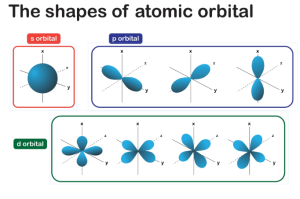
Now, picture a p orbital. It looks like a dumbbell, with two lobes separated by a flat area called a nodal plane where the chance of finding an electron is zero. Because p orbitals point along specific axes (x, y, and z), they can overlap side-by-side. This sideways handshake is what creates a pi (π) bond, which gives double and triple bonds their extra strength and rigidity.
When you mix these spheres and dumbbells together, magic happens. Take methane (CH4) as a classic example. Carbon blends its single 2s sphere and three 2p dumbbells to create four perfectly identical sp3 hybrid orbitals. These new orbitals push away from each other as far as possible, pointing directly toward the corners of a tetrahedron. This is why methane isn’t flat—it is a perfectly symmetrical 3D pyramid.
This orbital mixing isn’t just textbook theory, either. It explains why materials like graphene are so incredibly strong and why certain enzymes in your body fit their target molecules like a key in a lock.
Worked Example: Hybridization For IIT JAM
Let’s walk through a classic exam-style problem together so you can see how to apply this on test day.
Problem: Consider the ethylene molecule (C2H4). Figure out the hybridization of the carbon atoms and explain its overall shape.
Step-by-Step Solution:
-
Look at the Setup: If you draw out the Lewis structure for C2H4, you will see each carbon atom is double-bonded to the other carbon, and single-bonded to two hydrogen atoms.
-
Count the Electron Domains: Pick one carbon atom and count how many “regions of electron density” surround it. Remember, a double bond counts as just one region or domain. So, we have two single C-H bonds and one double C=C bond. That makes 3 electron domains.
-
Match with Hybridization: A steric number of 3 means the carbon needs three hybrid orbitals. To get three, it mixes one s and two p orbitals, giving us sp2 hybridization.
-
Determine the Shape: These three sp2 orbitals naturally spread out as far as they can, resulting in a trigonal planar geometry with bond angles around 120°.
What about the leftover orbital? Each carbon still has one unhybridized p orbital sitting perpendicular to the flat plane. These two leftover dumbbells overlap sideways to create the π-bond in the C=C double bond. This locks the whole molecule into a flat, rigid sheet, which explains why ethylene reacts so readily in addition reactions.
Common Misconceptions about Hybridization For IIT JAM
It is super easy to trip up on the theory if you are just memorizing formulas. Let’s clear up two big myths that stumble many JAM aspirants.
Myth 1: “Hybridization is happening all over the atom.”
Actually, it only involves the valence shell (the outermost electron shell). The inner-shell electrons are buried deep near the nucleus and don’t participate in this orbital mixing dance at all.
Myth 2: “Hybridization and bonding are the exact same thing.”
This is a huge trap. Hybridization is the prep work an isolated atom does to get its orbitals ready. Bonding is the actual interaction that happens when two different atoms share electrons.
To visualize this, imagine a fictional scenario where you are rearranging the furniture in your living room to make space for a new couch. Moving your current chairs around is like hybridization—you are prepping your own space. Delivering the new couch and hooking it up is bonding—an interaction involving an outside party. In methane (CH4), carbon rearranges its orbitals into sp3 hybrids first, and then those hybrids overlap with the hydrogen atoms to form the actual bonds. Keeping this timeline straight will save you from making silly errors on conceptual multiple-choice questions.
Real-World Applications of Hybridization For IIT JAM
Why should you care about this beyond passing the exam? Because hybridization runs the world around us.
Take carbon, for instance. The exact same element can turn into two completely different materials just because of how its orbitals mix:
-
Diamonds: Every single carbon atom is sp3 hybridized, forming a tight, ultra-strong 3D cage. That is why a diamond is one of the hardest materials on Earth.
-
Graphite (Pencil Lead): The carbon atoms choose sp2 hybridization instead, forming flat, slippery layers that easily slide past each other onto your notebook page.
Understanding these structural differences is exactly how scientists design next-generation materials like carbon nanotubes and flexible electronics.
Exam Strategy: Tips for Mastering Hybridization For IIT JAM
As you wrap up this topic, here are a few quick tips from our team at VedPrep to help you secure full marks on hybridization questions:
-
Master the Shortcut Formula: Don’t waste time drawing massive structures during the exam. Use the steric number formula:

-
(Where V = valence electrons of the central atom, M = number of monovalent atoms attached, C = cationic charge, and A = anionic charge).
-
Watch out for Lone Pairs: Remember that lone pairs take up space in hybrid orbitals and alter the ideal bond angles due to extra repulsion (thanks to VSEPR theory).
-
Practice Coordination Compounds: Don’t just stop at organic molecules. Spend extra time figuring out when a transition metal uses inner d-orbitals versus outer d-orbitals.
Final Thoughts
At the end of the day, mastering hybridization isn’t about memorizing a table of shapes and angles—it is about training your brain to see molecules in three dimensions. Once you can visualize how these orbitals mix and match, topics like reaction mechanisms, chemical reactivity, and coordination chemistry start falling into place naturally. It takes some practice to get fast at it, but staying consistent with your revision will make a world of difference on exam day. If you ever feel stuck or need a clearer way to visualize these concepts, we are always here to help you break them down at VedPrep.
To know more in detail from our faculty, watch our YouTube video:
Frequently Asked Questions
How do lone pairs affect the geometry predicted by hybridization?
Hybridization tells you the arrangement of the electron domains (electron geometry), but lone pairs alter the actual shape (molecular geometry). Because lone pairs repel other electrons more strongly than bonding pairs, they squash the bond angles, making them smaller than the ideal angles.
: Can d-orbitals participate in the hybridization of organic molecules?
Generally, no. For the organic compounds you will face in IIT JAM, carbon, nitrogen, and oxygen only use their valence s and p orbitals. Mixing d-orbitals is a feature typically reserved for heavier inorganic main-group elements (like P or S) and transition metals.
Does a π (pi) bond ever count toward hybridization?
No, π bonds are formed by the sideways overlap of unhybridized p or d orbitals. When calculating the steric number or counting electron domains, you only count σ (sigma) bonds and lone pairs.
Can an atom undergo hybridization if it has no unpaired electrons?
Yes, it can! This is where excitation comes in. An atom can absorb a small amount of energy to unpair its electrons and promote one to a higher empty orbital right before mixing them. Alternatively, it can hybridize fully filled orbitals to hold lone pairs.
How do I know whether to use VSEPR theory or Hybridization theory?
They actually work hand-in-hand. Hybridization gives you a mathematical model of how the atomic orbitals mix to prepare for bonding. VSEPR theory helps you quickly predict how those resulting orbitals and lone pairs will spatially arrange themselves to minimize repulsion.
Does hybridization apply to transition metal complexes?
Yes, it does, especially when looking at Valence Bond Theory (VBT) for coordination compounds. It helps explain shapes like square planar (dsp2) or octahedral (d2sp3), though you will also learn Crystal Field Theory (CFT) at VedPrep to explain their magnetic properties and colors.
What type of hybridization does a carbocation have?
A standard carbocation (like CH3+) has three σ bonds and zero lone pairs, giving it a steric number of 3. This means it is sp2 hybridized with a flat, trigonal planar shape and an empty, unhybridized p orbital.
What is the hybridization of carbon in a carbanion?
A carbanion (like CH3-) has three σ bonds and one lone pair. That adds up to four electron domains, meaning it is sp3 hybridized. Its molecular shape is trigonal pyramidal due to the lone pair pushing down on the bonds.
Can odd-electron species (free radicals) be hybridized?
They can, but it depends on the electronegativity of the attached groups. For example, the methyl radical (·CH3) is essentially planar and holds its single electron in an unhybridized p orbital (sp2). However, a CF3 radical is pyramidal (sp3) because the highly electronegative fluorine atoms change the energy balance.
Which textbook should I trust if two books disagree on complex bonding shapes?
For the IIT JAM syllabus, J.D. Lee’s Inorganic Chemistry is generally the gold standard followed by paper setters in India. If you run into conflicting theories, it is safest to align your concepts with Lee or standard NCERT/IIT-level interpretations.
Is hybridization a real, physical phenomenon that we can observe under a microscope?
No, hybridization is purely a theoretical concept or a mathematical model. Atoms don't physically "chop and mix" their orbitals like a blender. We created this model because it perfectly explains the experimental realities of bond angles, lengths, and molecular shapes that we observe in the lab.
Where can I find high-quality practice questions specifically tailored to JAM-level hybridization?
We regularly compile and update targeted question banks featuring previous years' question trends, common traps, and detailed solution steps over at VedPrep to help you build speed and accuracy for test day.