
Molecular Orbital Theory (Diatomic molecules) For IIT JAM is a fundamental concept in chemistry that explains the electronic structure of diatomic molecules. It helps students understand the bonding and antibonding molecular orbitals, electron configurations, and molecular properties, which is essential for mastering Molecular Orbital Theory (Diatomic molecules) For IIT JAM.
Syllabus and Key Textbooks: IIT JAM Chemistry Syllabus
Preparing for the IIT JAM is a massive undertaking, and Unit 1.1 is where the real fun begins. Molecular Orbital Theory (MOT) for diatomic molecules isn’t just another topic to cross off your checklist; it’s a heavyweight concept that frequently crosses over into the IIT JAM syllabus (Molecular Structure). Master this now, and you are essentially setting yourself up for future success too.
When you want to dive deep without getting lost in the weeds, stay away from random internet threads and stick to the classics. Here are the textbooks that should be on your desk:
-
Atkins, Physical Chemistry (10th edition): It unpacks quantum principles and molecular structure with excellent clarity, helping you build a solid mental framework.
-
Levine, Physical Chemistry (6th edition): If you want a thorough, step-by-step treatment of how atomic orbitals blend together, Levine is your best bet.
These books give you the exact mathematical and conceptual grounding you need to crush those tricky multiple-choice questions (MCQs) and multiple-select questions (MSQs) from Molecular Orbital Theory.
Molecular Orbital Theory: An Introduction
Think back to school when we learned about Lewis structures and Valence Bond Theory. They were great for a start, but they fail to explain why an oxygen molecule sticks to a magnet. That is where Molecular Orbital Theory comes to the rescue.
The core idea is simple: when atoms come close to form a molecule, their individual atomic orbitals lose their identity. Instead, they merge into a collective set of molecular orbitals that belong to the whole molecule.
To visualize this, imagine two friends moving into a shared apartment. They don’t just stay confined to their old rooms; they now share the entire space. When atomic orbitals combine, they split into two main types:
-
Bonding Molecular Orbitals: Lower in energy, highly stable, and where electrons love to hang out because they pull the nuclei together.
-
Antibonding Molecular Orbitals: Higher in energy, unstable, and featuring a “node” (a place with zero electron density) between the nuclei that pushes them apart.
By filling these orbitals with electrons according to the same old rules you already know (Aufbau, Pauli, and Hund’s rule), you can figure out a molecule’s bond order, bond energy, and magnetic behavior to cover Molecular Orbital Theory.
Types of Molecular Orbitals
When you are sketching out these diagrams for your prep, you will run into two main kinds of bonds: Sigma (σ) and Pi (π).
-
Sigma (σ) Orbitals: These form from head-on overlapping. A bonding σ orbital is perfectly symmetrical around the bond axis. Flip it to an antibonding σ* orbital, and you get a glaring nodal plane right between the atoms, which destabilizes the bond.
-
Pi (π) Orbitals: These happen when orbitals overlap sideways. A bonding π orbital looks like two lobes of electron density above and below the bond axis. The antibonding π* orbital introduces an extra node, cutting through the space where the atoms are trying to connect.
Knowing how σ, π, σ*, and π* orbitals form is your golden ticket to solving structural problems quickly during the exam.
Worked Example: Applying Molecular Orbital Theory (Diatomic molecules) For IIT JAM to Diatomic Molecules
Let’s do a quick walkthrough with a classic exam favorite: the nitrogen molecule (N2).
A single nitrogen atom has 7 electrons (1s2 2s2 2p3), meaning an N2 molecule has a total of 14 electrons to distribute. For molecules like nitrogen (where Z ≤ 7), mixing of the 2s and 2p orbitals alters the usual energy ordering. The π2p orbitals actually sit lower in energy than the σ2pz orbital.
The molecular orbital configuration looks like this:

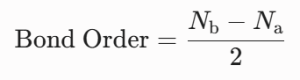
To calculate the bond order, we use a straightforward formula:
| Aspect | Value / Formula |
| Bonding Electrons (Nb) | 10 |
| Antibonding Electrons (Na) | 4 |
| Calculation | (10 – 4) / 2 |
| Final Bond Order | 3 |
A bond order of 3 tells us that nitrogen has an incredibly strong triple bond. Because every single electron is paired up, N2 is diamagnetic. If you run into a question about O2 or F2, remember that the energy ordering flips back because the s-p mixing becomes negligible!
Common Misconceptions
A frequent trap that candidates fall into is assuming that a higher bond order automatically means a molecule is completely unreactive. While a high bond order gives a molecule great thermodynamic stability, kinetics can tell a different story depending on what it is reacting with.
Another classic slip-up is forgetting to change the orbital energy sequence when moving from nitrogen to oxygen. Skipping that adjustment will completely mess up your magnetic property predictions, turning an easy mark into a silly mistake.
Application: Molecular Orbital Theory in Chemistry Lab
We don’t just study this to pass exams; it actually explains how real things work. Imagine a fictional scenario where a lab team wants to create a molecule that changes color when exposed to specific toxic gases. They cannot just mix random chemicals and hope for the best.
Instead, researchers model the Highest Occupied Molecular Orbital (HOMO) and the Lowest Unoccupied Molecular Orbital (LUMO). By figuring out the exact energy gap between these two levels, scientists can engineer materials that absorb specific wavelengths of light or react with precise targets.
While calculating these states exactly can get messy—requiring tricks like the Born-Oppenheimer approximation to ignore nuclear jitter and focus strictly on electron paths—the underlying concept remains pure Molecular Orbital Theory. It serves as the foundation for modern quantum chemistry, catalysis, and advanced materials science.
Mastering Molecular Orbital Theory for IIT JAM
If you want to secure a top rank, you need to be able to draw these MO diagrams in your sleep. The exam questions will test your grasp on how adding or removing an electron changes everything. For instance, they love asking whether O2+ is more stable than O2, or whether B2 is paramagnetic.
Here is a straightforward strategy to nail this topic:
-
Master the Core Diagrams: Practice the specific structural differences between homonuclear diatomics (like C2, N2, O2) and heteronuclear diatomics (like CO and NO).
-
Link Bond Order to Properties: Remember that a higher bond order means a shorter bond length and higher bond dissociation energy.
-
Spot Magnetism Instantly: Look for unpaired electrons. If you see one, it’s paramagnetic; if everything is paired, it’s diamagnetic.
We at VedPrep understand that staring at dry, theoretical text can get overwhelming. Mixing your self-study routine with targeted problem-solving sessions is the best way to make these concepts stick.
Real-World Applications of Molecular Orbital Theory
The power of this theory goes far beyond simple textbook molecules. If you look at modern technology like the screen on your smartphone, you are looking at Molecular Orbital Theory in action.
Organic Light-Emitting Diodes (OLEDs) and solar cells rely on conjugated organic molecules where electrons hop between different molecular orbitals. By tuning the HOMO-LUMO gap using computational methods like Density Functional Theory, scientists design organic materials that emit brilliant colors or capture sunlight with high efficiency.
Every time you see a crisp, bright display on a phone, remember that it’s just a practical application of electrons moving through carefully engineered molecular orbitals.
Final Thoughts
Mastering molecular orbital theory isn’t just about memorizing configurations or blindly applying formulas to score high on the IIT JAM—it’s about training your mind to look at chemical bonding through a realistic, quantum mechanical lens. When you transition from simply drawing Lewis structures to actively visualizing electron density clouds, tricky exam questions on bond parameters and magnetic behavior become second nature.
To learn more from our expert faculty, watch our YouTube video:
Frequently Asked Questions
Why do bonding molecular orbitals have lower energy than the parent atomic orbitals?
Bonding molecular orbitals (BMOs) are formed by the constructive interference (in-phase combination) of atomic orbital wave functions. This increases the electron density between the two nuclei, shielding them from mutual repulsion and resulting in a more stable, lower-energy state.
What exactly happens to the electron density in an antibonding molecular orbital?
Antibonding molecular orbitals (ABMOs) are the result of destructive interference (out-of-phase combination). The wave functions cancel each other out between the nuclei, creating a region of zero electron density known as a nodal plane. Because the nuclei are exposed to each other, repulsive forces increase, driving the energy up.
What are non-bonding molecular orbitals, and when do they form?
Non-bonding molecular orbitals form when atomic orbitals have incompatible symmetries or are too far apart in energy to interact. The electrons in these orbitals do not contribute to or detract from the bond strength, so their energy remains identical to that of the parent atomic orbitals.
How do you construct a molecular orbital diagram for a heteronuclear diatomic molecule like CO or NO?
The basic principles remain the same, but the atomic orbitals of the more electronegative atom (like Oxygen) sit lower in energy than those of the less electronegative atom (like Carbon or Nitrogen). This asymmetry means the bonding molecular orbitals look and act more like the electronegative atom's orbitals, while the antibonding molecular orbitals align closer to the electropositive atom.
Why does the CO molecule have an anomalous bond order calculation?
CO exhibits significant s-p mixing and severe asymmetry. Electrons are removed from a weakly antibonding or non-bonding orbital (σ2s*) when it ionizes to form CO+. Consequently, while CO has a bond order of 3, CO+ surprisingly increases its bond order to 3.5, making it a favorite trick question in the IIT JAM exam.
Can a molecule have a fractional bond order, and what does it mean?
Yes, fractional bond orders like 0.5, 1.5, or 2.5 are perfectly normal in MOT. They indicate that the molecule contains an odd number of electrons distributed across its bonding or antibonding fields. While stable enough to exist under specific laboratory conditions (like H2+ or O2-), they are generally more reactive than molecules with whole-number bond orders.
If two molecular species have the exact same bond order, how do you determine which one is more stable?
Look closely at the distribution of the electrons. The species with more electrons sitting in antibonding orbitals will be less stable because antibonding electrons destabilize a molecule more than bonding electrons stabilize it.
How do you quickly determine if a diatomic species is diamagnetic or paramagnetic?
Count the total number of valence electrons. If the total electron count is odd (like NO with 15 electrons), it is automatically paramagnetic. If the count is even, it is usually diamagnetic—except for species with 10 or 16 total electrons (like B2 and O2), which are paramagnetic due to degenerate π or π* orbital structures.
Why is the Born-Oppenheimer approximation essential for calculating molecular orbitals?
Nuclei are thousands of times heavier than electrons, meaning they move at a snail's pace by comparison. The Born-Oppenheimer approximation allows quantum chemists to treat the nuclei as fixed points while focusing entirely on calculating the rapid motion of the electrons, making highly complex molecular wave equations solvable.
What does the term "LCAO" mean in the context of MOT?
LCAO stands for Linear Combination of Atomic Orbitals. It is the mathematical method used to construct molecular orbitals by adding or subtracting the wave functions (ψ) of individual atomic orbitals.
Can Molecular Orbital Theory be applied to polyatomic molecules?
Absolutely, but it gets complicated fast. Instead of simple diatomic diagrams, polyatomic MOT requires group theory and advanced symmetry principles to map out how orbitals stretch across three or more atoms. For your IIT JAM prep, focusing tightly on homonuclear and heteronuclear diatomics will cover the vast majority of your test questions.