
If you are gearing up for the IIT JAM, you already know that the inorganic chemistry section can be a serious rank-booster if you play your cards right. Right in the middle of that syllabus sits a massive, high-yield topic: the synthesis and reactions of hydrides.
Whether you are looking at main group elements or transition metals in synthesis and reactions of hydrides, how these compounds form and behave tells us a lot about bonding, periodic trends, and chemical reactivity.
Understanding the Syllabus and Key Textbooks
Synthesis and reactions of hydrides falls squarely under the main block of Inorganic Chemistry in the IIT JAM official syllabus. If you want to crack top-tier competitive exams like IIT JAM, CSIR NET, or GATE, you really need to get a firm grip on this area.
To build your foundation on synthesis and reactions of hydrides, you can dive into classic standard textbooks like Inorganic Chemistry by J.D. Lee or Advanced Inorganic Chemistry by Cotton and Wilkinson (and for specialized reactions, Johnson and Gilbert’s work is fantastic). These books layout everything you need to know about hydrides, breaking down how we make them and how they react.
At VedPrep, we always tell our students that mastering the preparation methods and periodic properties of these compounds is the absolute secret weapon for scoring high in the exam.
Overview: Synthesis and reactions of Hydrides For IIT JAM
Let’s break it down simply: synthesis and reactions of hydrides are just compounds where hydrogen bonds with another element. But based on who hydrogen is partnering up with, we classify them into three main buckets: ionic (saline), covalent (molecular), and metallic (interstitial) hydrides.
Ionic Hydrides: Think of these as the pairing between hydrogen and highly electropositive metals, mostly from Group 1 and Group 2 (like NaH or CaH2). Here, hydrogen acts as the hydride ion (H–).
Covalent Hydrides: These happen when hydrogen shares electrons with non-metals or metalloids. Think of everyday gases like methane (CH4) or ammonia (NH3).
Metallic Hydrides: These form when hydrogen sneaks into the gaps or cavities inside the crystal lattices of transition metals (like LaNi5 or TiH2).
When it comes to getting these compounds of synthesis and reactions of hydrides ready in the lab, we usually rely on three main paths:
Direct Synthesis: Literally forcing hydrogen gas to react directly with another element. This usually needs a lot of heat and high pressure to get going.
Indirect Synthesis: Using a clever workaround, like reacting a metal halide with a strong reducing agent like LiAlH4.
Disproportionation Reactions: Where a compound essentially splits its own identity, oxidizing and reducing at the same time to leave you with a hydride.
Once you have them, their properties vary wildly. As per synthesis and reactions of hydrides, their thermal stability changes drastically as you move down a group in the periodic table. Their electrical conductivity is totally different too—some conduct electricity beautifully when melted, while others act as perfect insulators. They also show completely different chemical reactivity when you drop them into water or acids, often releasing a massive burst of hydrogen gas.
Here is a quick cheat sheet to help you see the differences at a glance:
| Property | Ionic Hydrides | Covalent Hydrides | Metallic Hydrides |
| Bonding Type | Primarily Ionic (H– ion) | Covalent sharing | Metallic / Interstitial |
| Physical Appearance | Crystalline white solids | Gases, liquids, or volatile solids | Metallic solids, often non-stoichiometric |
| Conductivity | Conducts in molten state | Insulators | Excellent electronic conductors |
| Reaction with H2O | Vigorous, releases H2 gas | Mostly unreactive (except custom lewis acids) | Generally inert at room temp |
Common Misconceptions in Synthesis and Reactions of Hydrides For IIT JAM
A huge trap that many JAM aspirants fall into is assuming that every single hydride out there is highly reactive and ready to blow up. It is easy to see why people think this—most textbook questions show ionic hydrides reacting violently with air or water. But that is definitely not the whole story.
Reality Check: While ionic hydrides like lithium hydride (LiH) or sodium hydride (NaH) are incredibly aggressive because they want to shed that extra electron, covalent hydrides are a completely different story. The methane (CH4) in your kitchen stove or the ammonia (NH3) in a lab bottle is perfectly stable at room temperature and won’t react unless you give it a major spark.
The main takeaway here is that hydride reactivity depends entirely on the type of bond it holds. Don’t paint them all with the same brush. For example, while LiH is super reactive, aluminum hydride (AlH3) is actually less stable structurally but isn’t quite as violent as you might expect. Keeping these subtle differences straight in your head is what separates a top ranker from the rest of the pack.
Real-World Applications of Synthesis and Reactions of Hydrides For IIT JAM
To make this concrete, let’s step out of the exam hall for a second. Imagine a giant industrial oil refinery. They handle heavy crude oil that is packed with messy impurities like sulfur and nitrogen. To clean it up and turn it into the clean petrol or diesel we put in cars, engineers pump in hydrogen gas under intense conditions to create temporary hydride intermediates on metal catalysts. This process strips away the bad stuff, leaving behind high-quality, environmentally friendly fuel.
Out in the commercial world, these reactions show up everywhere:
Catalytic Reactions and Fuel Cells: In pharma labs, chemists use sodium borohydride (NaBH4) as a go-to reducing agent to build complex drug molecules. Meanwhile, clean energy cars run on proton-exchange membrane fuel cells that use hydrogen to generate electricity, leaving nothing behind but pure water vapor.
Hydrogen Storage: Storing gas is incredibly tough because it takes up too much space. Instead, scientists use alloys like LaNi5 to soak up hydrogen gas like a sponge, packing it tightly into a solid form (LaNi5H6) that is perfectly safe to transport.
Green Energy Production: Teams are using solar energy and custom catalysts to split water apart, capturing hydrogen directly through photocatalysis.
Of course, doing this in real life means balancing tight constraints like extreme pressures, sensitive temperatures, and tricky pH levels. But mastering these materials is paving the way for sustainable industrial operations worldwide.
Strategies for Exam Preparation: Synthesis and Reactions of Hydrides For IIT JAM
If you want to clear the IIT JAM chemistry cutoff and aim for the IITs, you need a strategy that goes beyond just memorizing reactions. You need to understand the why behind the chemical behavior.
Key Subtopics to Focus On:
The exact preparation methods for ionic, covalent, and metallic hydrides (watch out for the reagents!).
Reactions of hydrides with water, acids, organic functional groups, and Lewis bases.
Periodic trends in the thermal stability and reducing power of covalent hydrides (especially Groups 14 to 17).
The best way to prepare is to stop staring at the theory and start solving actual problems. Practicing numerical questions and structural prediction problems is what makes the theory stick. At VedPrep, we spend a lot of time walking students through the exact question patterns and marking schemes seen in previous years. If you focus your energy on these high-weightage areas and practice consistently, you will feel completely confident when exam day rolls around.
Worked Example: Synthesis and Reaction of a Covalent Hydride
Let’s look at how covalent hydrides act when we put them to work. Take methane (CH4) as our model covalent hydride. Unlike ionic hydrides, it doesn’t have an eager $\text{H}^-$ ion waiting to jump out. Instead, it relies on radical pathways to swap its atoms.
Question:
Explain the synthesis and reaction of methane (CH4) when treated with chlorine gas (Cl2) under sunlight.
Solution:
When you mix methane with chlorine gas in the presence of ultraviolet (UV) light, you trigger a free-radical substitution reaction. The light snaps the chlorine molecule apart into highly reactive chlorine radicals, which then attack the stable CH4 bonds.

In this process, we swap a hydrogen atom out for a chlorine atom, giving us chloromethane (CH3Cl) and hydrogen chloride (HCl) gas. This classic reaction is a favorite in the synthesis and reactions of hydrides question bank because it perfectly highlights how stable covalent hydrides need a high-energy pathway to react.
Deeper Dive into Ionic and Metallic Hydrides
Let’s look closer at how we make ionic hydrides in synthesis and reactions of hydrides. We can pull this off using direct reactions, indirect pathways, or even disproportionation tricks.
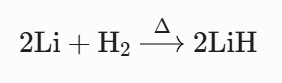
For the direct route, you heat up an alkali metal with hydrogen gas under high pressure. For example, if you want to make lithium hydride (LiH), you react pure lithium metal with hydrogen gas:
On the other hand, indirect synthesis might involve reacting a metal compound with an existing hydride or reducing agent to get what you need.
Once you form these ionic hydrides from synthesis and reactions of hydrides, they behave like classic salts. They form beautiful crystalline solids and have high melting points. While they won’t conduct electricity as a solid, the moment you melt them down, the ions can move freely, allowing them to conduct electricity efficiently.
And if you drop an ionic hydride like sodium hydride (NaH) into water, it reacts violently, pulling a proton from the water to create a massive release of hydrogen gas and leaving a basic solution behind:

Transition metals handle things differently in synthesis and reactions of hydrides. Metallic hydrides form when transition metals simply absorb hydrogen gas into the empty pockets of their metal structures. These materials still conduct electricity just like regular metals and are the ultimate candidates for safe hydrogen storage tech.
Advanced Materials and the Hydrogen Economy
When we talk about the future of clean energy, we are talking about the hydrogen economy. The synthesis and reactions of hydrides play a massive role in making this a reality.
Special hydrogen storage alloys, like TiFe orLaNi5, can safely store and release massive amounts of hydrogen gas at normal temperatures. As per synthesis and reactions of hydrides, This lets engineering teams design highly efficient hydrogen fueling stations and compact fuel cell systems. By storing the gas inside a solid metal lattice, we achieve incredible volumetric storage density without needing dangerously high-pressure gas tanks.
In the world of catalysis in synthesis and reactions of hydrides, complex hydrides are excellent chemical carriers. Take sodium borohydride (NaBH4) again—it acts as a predictable, safe donor of hydrogen for turning unsaturated organic bonds (like aldehydes or ketones) into clean alcohols through hydrogenation.
On top of that, material scientists are now using metal hydrides as stepping stones to build advanced nanostructures. For instance, they use titanium hydride (TiH2) as a starting material to synthesize high-purity titanium dioxide nanoparticles, which are used in solar panels and cutting-edge electronics.
Final Thoughts
Mastering the synthesis and reactions of hydrides comes down to recognizing patterns rather than raw memorization. Once you can connect the type of chemical bonding to how a hydride behaves in the lab, predicting products and identifying periodic trends becomes second nature. Based on synthesis and reactions of hydrides, these concepts are the building blocks of real-world green energy technologies and advanced materials. Keep working through practice problems, stay consistent with your revision, and don’t hesitate to lean on expert resources. At VedPrep, we are always here to help you clear up any confusion and turn tricky inorganic chemistry topics into your biggest scoring strengths on exam day.
To know more in detail from our faculty, watch our YouTube video:
Frequently Asked Questions
How does the thermal stability of covalent hydrides change down a group?
It decreases drastically. As you move down a group (like Group 15 from NH3 to BiH3), the central atom gets much larger. Because the atom is so big, its orbital overlap with the tiny 1s orbital of hydrogen becomes incredibly weak. A weaker bond means it takes far less heat to break it apart.
Why is {LiH} exceptionally stable compared to other alkali metal hydrides?
It boils down to lattice energy. Both lithium (Li+) and hydride (H-) ions are exceptionally small. Because they are similar in size, they pack together incredibly tightly in a crystal lattice. This high lattice energy makes LiH stable up to nearly 900°C before it decomposes.
Can metallic hydrides conduct electricity as well as the parent metals?
Yes, they can! Because hydrogen atoms sit inside the interstitial gaps of the transition metal lattice without disrupting the mobile "sea of electrons," metallic hydrides maintain excellent electronic conductivity. Sometimes, the absorption of hydrogen even alters the magnetic properties of the metal.
Why do ionic hydrides liberate hydrogen gas at the anode during electrolysis?
In a molten ionic hydride, hydrogen exists as the negatively charged hydride ion (H-). When you pass an electric current through the melt, these negative ions migrate toward the positive electrode (the anode), where they lose electrons (get oxidized) and pair up to form H2 gas.
How does the reducing power of group 16 hydrides vary?
Reducing power increases down the group: H2O < H2S < H2Se < H2Te. Because the M-H bond strength plummets as the central atom gets larger, it becomes much easier for the molecule to give up its hydrogen atoms to reduce something else.
Are there any covalent hydrides that act as Lewis acids?
es, elements from Group 13 form electron-deficient covalent hydrides. Borane (BH3) and alane (AlH3) don't have a full octet of valence electrons around their central atoms, which makes them eager to accept electron pairs from Lewis bases like ammonia or ethers.
Why are transition metal hydrides used for hydrogen storage rather than ionic hydrides?
Ionic hydrides react irreversibly with moisture and require chemical destruction to get the hydrogen back. Transition metal alloys (like LaNi5), however, act like a physical sponge. They absorb hydrogen gas at mild pressures and release it cleanly when you slightly raise the temperature or lower the pressure, making them perfectly reusable.
What is the main product when silane {SiH4) is exposed to air?
Silane is pyrophoric, meaning it spontaneously bursts into flames when it hits the air. It reacts rapidly with oxygen to form solid silicon dioxide (SiO2) and water vapor, a stark contrast to methane (CH4), which requires an ignition source to burn.
How do you prepare sodium hydride {NaH) in an industrial setting?
It is prepared via direct synthesis. Molten sodium metal is reacted directly with pure hydrogen gas at temperatures around 300°C to 400°C under high pressure to force the formation of the ionic solid lattice.
Can VedPrep materials help me predict structural anomalies in complex hydrides?
At VedPrep, we break down molecular orbital theory and periodic trends using clean visualization tools. We don't just ask you to memorize structures like diborane or lithium borohydride—we show you the electron density maps and symmetry principles so you can intuitively predict shapes and reactivity patterns on your exam.
How can you distinguish between {NaH} and {HCl} gas reactions with water?
Both reactions look energetic, but they yield opposite chemical environments. NaH reacts with water to give a strong base and hydrogen gas (NaH + H2O →NaOH + H2). HCl gas simply dissolves in water to form highly acidic hydrochloric acid (H3O+ + Cl-) without producing H2 gas.