
Synthesis and reactions of oxides involve various chemical processes to form and transform oxides, which are crucial for IIT JAM, requiring a deep understanding of redox reactions, thermodynamics, and kinetics.
Syllabus: Inorganic Chemistry (Part A): Oxides and Hydroxides
Preparing for competitive exams like IIT JAM can feel like trying to climb a mountain while covering key topics like Synthesis and reactions of oxides. One of those massive peaks you need to conquer is the inorganic chemistry section, specifically the Synthesis and reactions of Oxides.
If you look at the official syllabus under Unit 3 (Inorganic Chemistry – Part A), Synthesis and reactions of oxides take center stage. To get a real grip on this, standard textbooks like Atkins’ Physical Chemistry and Inorganic Chemistry by Catherine E. Housecroft are your best bets. They break down the deep-seated thermodynamics, properties, and reactions you will face on exam day.
Overview: Synthesis and reactions of Oxides For IIT JAM
At its core of Synthesis and reactions of oxides, an oxide is just oxygen hanging out with another element. We generally split them into three camps: ionic, covalent, and metallic oxides.
-
Ionic oxides: These form when oxygen pairs up with highly electropositive metals, mostly from Group 1 and Group 2. Think of sodium or calcium giving up electrons to oxygen.
-
Covalent oxides: Here, oxygen shares electrons with non-metals and metalloids.
When we talk about making these compounds, redox reactions do a lot of the heavy lifting. You have one element losing electrons (getting oxidized) and another gaining them (getting reduced). Take a simple example: burning carbon in oxygen to get carbon dioxide (C + O₂ → CO₂). Carbon loses electrons, oxygen grabs them, and boom—you have a covalent oxide.
These compounds are everywhere in Synthesis and reactions of oxides. Metallic oxides are the backbone of ceramics, glass, and refractories. Meanwhile, covalent oxides like silicon dioxide (SiO2) are what keep our concrete roads and cement buildings standing. Because these materials are so critical to the real world, examiners love testing you on how they behave.
Importance: Synthesis and reactions of Oxides For IIT JAM
One classic trick is thermal decomposition. This is a fancy way of saying “blasting a compound with enough heat until it breaks apart into simpler pieces.” We do this all the time with metal carbonates, hydroxides, and nitrates.
You can also create them directly through redox reactions. If you burn a metal in oxygen, you usually end up with a basic oxide (like magnesium ribbon burning with a blinding white light to form MgO). If you burn a non-metal, you get an acidic oxide, like sulfur reacting to form sulfur trioxide (SO₃).
Another route is hydrolysis, where you let a compound react with water to yield an oxide or hydroxide. For instance, throwing certain metal halides or sulfates into water will kickstart a reaction that leaves you with a metal oxide. Mastering these pathways is a non-negotiable part of your preparation toolkit.
Worked Example: Synthesis of Zinc Oxide
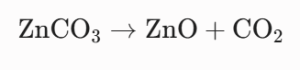
As per Synthesis and reactions of oxides, zinc oxide (ZnO) is a rockstar compound. It is in your beach sunscreen, blocking UV rays; in your cosmetics; and in industrial ceramics. A premier way to make high-purity ZnO with a controlled particle size is by heating zinc carbonate (ZnCO₃) to somewhere between 300°C and 400°C.
Here is a typical problem you might see on the test from Synthesis and reactions of oxides:
Question: A sample of zinc carbonate is heated to 350°C to produce zinc oxide. If 100 g of zinc carbonate (ZnCO₃, molar mass = 125.38 g/mol) breaks down completely, what mass of zinc oxide (ZnO, molar mass = 81.38 g/mol) do you get?
Solution:
First, let’s figure out how many moles of ZnCO₃ we are dealing with:

Looking at our balanced equation, 1 mole of ZnCO₃ gives us exactly 1 mole of ZnO. It is a 1:1 ratio. So, 0.798 mol of reactant will yield 0.798 mol of product.
Now, let’s convert those moles back into grams:
Common Misconceptions in Oxide Synthesis
Let’s clear up a few traps that trip students up every year in Synthesis and reactions of oxides.
-
“All oxides are ionic.” This is a huge myth. Don’t fall for it. You have to look at the electronegativity difference. Group 1 and 2 oxides? Very ionic. But look at something like sulfur dioxide (SO2) or dichlorine heptoxide (Cl₂O₇)—those are purely covalent.
-
Ignoring the redox nature. When you burn iron to get Fe2O3; it is a full-blown exchange of electrons. Missing the redox mechanics makes it incredibly tough to predict reaction products accurately.
-
Forgetting about pH during hydrolysis. Imagine a hypothetical lab scenario where a student tries to precipitate aluminum hydroxide, Al(OH)3, from an alumina (Al2O3) solution but keeps the pH completely unchecked. If the solution becomes too acidic or too basic, that amphoteric aluminum oxide will just dissolve away into ions instead of forming the solid they want. The pH dictates the entire outcome.
Industrial Applications of Oxide Synthesis
Oxide chemistry isn’t just something confined to dusty lab beakers; it runs the modern world.
| Oxide | Major Industrial Process / Application |
| Iron Oxides (Fe₂O₃, Fe₃O₄) | Reduced with carbon inside massive blast furnaces to manufacture steel. |
| Calcium Oxide (CaO / Lime) | Mixed with clay and heated to create the silicates and aluminates that make up building cement. |
| Titanium Dioxide (TiO₂). | Synthesized via the sulfate or chloride process for its extreme opacity and UV-blocking traits in white paints and sunscreens. |
| Alumina (Al₂O₃) | Extracted from bauxite ore using the famous Bayer Process, then melted down and electrolyzed to give us pure aluminum metal. |
When you understand the fundamental science behind these massive industrial operations, answering application-based questions becomes a breeze.
Exam Strategy: Focus on Thermodynamics and Kinetics
If you want to ace the Synthesis and reactions of Oxides, you need to look at it through two lenses: thermodynamics and kinetics.
1. Thermodynamics (The “Will it happen?” question)
Gibbs free energy (ΔG) is the ultimate judge of whether an oxide synthesis reaction will even happen spontaneously. You need to know how swinging the temperature or pressure up and down alters ΔG. For instance, Ellingham diagrams—which plot ΔG against temperature—are goldmines for exam questions. They visually tell you exactly when a metal oxide will decompose or when carbon can be used to reduce a metal oxide.
2. Kinetics (The “How fast?” question)
Just because thermodynamics says a reaction can happen doesn’t mean it happens quickly. That is where activation energy (Ea) comes in. Understanding the energy barriers in oxide formation helps you predict reaction rates and see why certain catalysts are used.
When you are mapping out your study plan, start by cementing your core thermodynamic and kinetic equations before moving to specific chemical families. We design our resources at VedPrep around this structured path so you don’t get overwhelmed. Keep a sharp eye out for these high-yield topics:
-
The thermodynamic stability profiles of transition metal oxides.
-
The step-by-step kinetics behind oxide decomposition.
-
The exact step-by-step mechanisms of how amphoteric oxides react with acids and bases.
Final Thoughts
Wrapping your head around the Synthesis and reactions of Oxides might feel like a lot to juggle, but mastering it is an absolute game-changer for your IIT JAM prep. Once you stop looking at these reactions as isolated equations to memorize and start seeing them through the lens of thermodynamics, kinetics, and real-world applications, everything clicks into place. It’s all about building that solid conceptual foundation so you can walk into the exam hall with total confidence.
To know more in detail from our faculty, watch our YouTube video:
Frequently Asked Questions
How can I look at a formula and instantly tell if an oxide is acidic, basic, or amphoteric?
As a general rule of thumb, look at the oxidation state and the position of the element in the periodic table. Oxides of electropositive metals in low oxidation states (like Na2O, CaO) are basic. Oxides of non-metals (like SO3, CO2) are acidic. Oxides of metalloids or metals near the border of the d-block in intermediate oxidation states (like Al2O3, ZnO) are amphoteric, meaning they can react with both acids and bases.
Are all metallic oxides basic in nature?
While low-oxidation-state metal oxides like CrO are basic, transition metals in high oxidation states pull electron density heavily away from oxygen. This gives them distinct covalent character and makes them acidic. For example, CrO3 and Mn2O7 are strongly acidic oxides, not basic.
What makes an oxide "neutral" and which ones should I memorize for IIT JAM?
Neutral oxides do not show any measurable acidic or basic properties when exposed to water, acids, or bases. The three classic examples you must remember for the exam are nitrous oxide (N2O), nitric oxide (NO), and carbon monoxide (CO).
What exactly happens during the thermal decomposition of a metal carbonate?
When you heat a metal carbonate, thermal energy vibrates the chemical bonds until the polyatomic carbonate ion (CO32-) breaks apart. It releases a stable carbon dioxide gas molecule (CO2), leaving behind a solid, stable metal oxide. The stability of the starting carbonate depends heavily on the size and charge of the metal cation.
Why do some metal nitrates yield oxides upon heating, while others don't?
Most transition and alkaline earth metal nitrates decompose on heating to give the metal oxide, nitrogen dioxide (NO2), and oxygen (O2). However, Group 1 nitrates (except lithium) are highly stable and only decompose to form metal nitrites (MNO2) and oxygen gas under standard laboratory heating.
How does the Fajans' rule help predict the thermal decomposition temperature of carbonates?
Fajans' rule states that smaller, highly charged cations have a higher polarizing power. If a metal cation heavily polarizes the oxygen atoms on a carbonate ion, it weakens the carbon-oxygen bonds within the carbonate group. This makes the compound unstable, meaning it will decompose into an oxide at a much lower temperature.
Can every metal oxide be prepared by directly burning the metal in oxygen?
While many metals like magnesium or iron react vigorously with oxygen to form oxides, noble metals like gold and platinum do not react with oxygen directly at all. Their oxides are thermodynamically unstable under normal conditions and have to be prepared via indirect chemical routes, such as precipitating hydroxides first.
What is the difference between hydrolysis and simple dissolution of an oxide?
Dissolution is a physical or basic chemical process where an oxide dissolves in a solvent. Hydrolysis involves a formal chemical reaction with water where water molecules are broken down (H+ and OH-), changing the pH of the solution and leading to the formation of a brand-new chemical species like a hydroxide or a hydrated complex.
Why are Ellingham diagrams considered essential for understanding oxide reactions?
An Ellingham diagram plots the standard Gibbs free energy of formation (ΔG°) of various oxides against temperature. It serves as a visual cheat sheet showing you which metals can reduce the oxides of other metals, and at exactly what temperature a specific oxide becomes thermodynamically unstable and decomposes.
How does lattice energy influence the thermodynamic stability of ionic oxides?
Lattice energy is the energy released when gaseous ions come together to form a solid ionic crystal. High lattice energy—driven by small, highly charged ions like Mg2+ or O2-—makes the resulting oxide crystal structure incredibly stable, giving it a high melting point and resistance to thermal decomposition.
In stoichiometry questions involving oxide synthesis, do I always need to balance the oxygen atoms?
While balancing the entire equation is the safest route, a pro exam tip used at VedPrep is the Principle of Atom Conservation (POAC). If all the metal atoms from your starting material end up in your final oxide, you can save valuable time by simply conserving the moles of that specific metal element, completely bypassing the need to balance tricky oxygen coefficients.
What role does sodium hydroxide play in the extraction of alumina via the Bayer process?
Alumina (Al₂O₃) is amphoteric, while the major impurities in bauxite ore (like Fe₂O₃) are basic. By digesting the ore with a concentrated, hot sodium hydroxide (NaOH) solution, the amphoteric alumina selectively dissolves to form soluble sodium aluminate, leaving the solid iron impurities behind to be easily filtered out.