

Jahn-Teller distortion For IIT JAM refers to the geometric distortion of molecules and ions due to electronic degeneracy, resulting in a system of lower symmetry and energy, acriticalconcept for IIT JAM and other competitive exams.
Jahn-Teller distortion For IIT JAM: Syllabus
Chemistry can sometimes feel like a collection of rules with way too many exceptions. But every now and then, you run into a concept that just clicks because it’s all about finding the lowest energy and maximum comfort—much like finding the perfect spot on the couch after a long day of classes. That is exactly what Jahn-Teller distortion is all about. For anyone eyeing the IIT JAM or other big competitive exams like CSIR NET and GATE, mastering this geometric twist is a total game-changer.
When you dive into Jahn-Teller distortion, you are essentially looking at how quantum mechanics plays out in real chemical systems. If you want to sync this up with the official syllabus, you will find it sitting comfortably under Unit 4 of Physical Chemistry (Section A).
If you want to read up on this the old-school way, standard textbooks are your best bet. Physical Chemistry by P.W. Atkins is a classic choice that covers the groundwork beautifully. Another fantastic backup is Physical Chemistry: A Molecular Approach by Donald A. McQuarrie and John D. Simon. While Atkins is usually the go-to reference for most professors, both books help you wrap your head around how symmetry and molecular orbitals dictate whether a molecule stays perfectly symmetrical or twists out of shape.
Jahn-Teller Distortion For IIT JAM: Definition and Mechanism
What is the actual deal with the Jahn-Teller distortion? In plain English, it is a structural change that happens in non-linear molecules—mostly transition metal complexes—to destroy what we call “electronic degeneracy.”
Imagine you and a friend are trying to sit on a single-seater chair at the exact same time. It’s unstable, crowded, and someone is bound to shift around to make things comfortable. Electronic degeneracy is a lot like that. It happens when two or more electronic states have the exact same energy level. Nature hates instability, so the molecule undergoes a quick symmetry-lowering change, like a stretch or a bend, to split those energy levels apart. Once the degeneracy is gone, the molecule hits a lower, much more stable energy state.
A classic example you will definitely see in IIT JAM questions is the octahedral copper complex, Cu2+ in [Cu(H2O)6]2+. Here, you have a central metal ion surrounded by six water molecules arranged in a neat octahedron. Because of how the electrons are packed, the molecule experiences a massive Jahn-Teller instability. To fix this, it usually undergoes a noticeable elongation (stretching out) or compression along its axes.
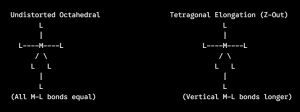
At VedPrep, we always tell our students that getting a firm grip on this mechanism is the secret weapon for predicting the geometry and stability of coordination complexes. Once you understand the “why” behind the twist, solving complex coordination chemistry problems becomes second nature.
Jahn-Teller Distortion For IIT JAM: Consequences and Implications
When a molecule decides to distort, it doesn’t just change its look; it completely rewires its properties. For instance, when [Cu(H2O)6]2+ elongates along one axis, it drops its high octahedral symmetry for a lower tetragonal symmetry.
As per Jahn-Teller distortion, by splitting those pesky degenerate orbitals, the molecule lets its electrons settle into lower energy pockets. This structural shift brings along a few major changes:
-
Reduced symmetry (e.g., dropping from Oh to D4h symmetry group).
-
Removal of orbital degeneracy so electrons aren’t fighting for the same energy space.
-
Changes in molecular stability and reactivity, which means a distorted molecule behaves quite differently than you might expect on paper.
Understanding this relationship between how a molecule is shaped and how its electrons behave is crucial. It lets you predict how complexes will react in different chemical environments without just memorizing facts.
Worked Example: Jahn-Teller Distortion
Let’s break down a classic exam-style problem together. Think about a hexacoordinate Cu2+ complex like [Cu(H2O)6]2+.
Copper(II) has a d9 electronic configuration. In a standard octahedral field, those five d orbitals split into two groups: the lower-energy t2g set and the higher-energy eg set. The t2g set takes up six electrons and is completely full. That leaves three electrons for the eg set. Following Hund’s rule, you put two electrons in one orbital (say, dx2-y2) and one electron in the other (dz2).
Because those two eg orbitals have the same energy but unequal electron distribution, you get a textbook case of Jahn-Teller instability. To shake things off, the complex typically undergoes a tetragonal elongation. This means the two water ligands on the z-axis push outward, making those bonds longer than the four bonds in the xy-plane.
As a result:
-
The dz2 orbital drops in energy because the ligands are further away, while the dx2-y2 orbital jumps up.
-
The two paired electrons happily sit in the lower-energy dz2 orbital, lowering the overall energy of the complex.
This isn’t just dry textbook theory, either. These copper(II) quirks show up in real biological systems all the time, helping us understand how specific metalloproteins bind and release molecules.
Common Misconceptions About Jahn-Teller Distortion For IIT JAM
When you are studying for a high-stakes exam, misconceptions can really trip you up while covering topics like Jahn-Teller distortion. Here are a few traps we often help students navigate at VedPrep:
Misconception 1: Jahn-Teller distortion only happens in transition metal complexes. The Reality: Not true! While transition metals are the most famous examples, this distortion can happen in any non-linear molecule or ion that has orbital degeneracy.
Misconception 2: Distortion and electronic degeneracy are the exact same thing. The Reality: Think of electronic degeneracy as the cause and distortion as the effect. Degeneracy is the unstable state of having equal energy options; the distortion is the physical movement the molecule makes to fix that problem.
Misconception 3: You can skip this topic for IIT JAM. The Reality: Skipping this is a huge mistake. Examiners love testing your grasp on coordination chemistry, and Jahn-Teller questions pop up constantly in JAM, CSIR NET, and GATE.
Jahn-Teller Distortion For IIT JAM in Real-World Applications
Believe it or not, this chemical quirk plays a massive role outside the lab. In the industrial world, the structural shifts caused by this effect help scientists design highly efficient catalysts by tweaking the stability of transition metal complexes.
In nature, it is a key player in keeping you alive. The oxygen-evolving complex in photosystem II—the biological engine behind photosynthesis—relies on these structural shifts to help split water molecules and create oxygen.
Even materials scientists use this phenomenon to design smart materials. For example, the distortion causes ferroelasticity in certain perovskite materials, which makes them perfect for building high-tech sensors and actuators.
Exam Strategy for Jahn-Teller Distortion For IIT JAM
If you want to ace this section in the IIT JAM, you need a solid game plan. You can’t just memorize the definition; you have to understand the interplay between electronic degeneracy and symmetry.
A great way to study this is to start with the absolute basics of Molecular Orbital Theory (MOT) and group theory symmetry elements. At VedPrep, we always bundle these concepts together in our study guides because they build on each other naturally.
When you are practicing questions, focus heavily on these areas:
┌──────────────────────────────────────────────────────────┐
│ JAHN-TELLER EXAM FOCUS AREAS │
├──────────────────────────────────────────────────────────┤
│ 1. Spotting the difference between weak and strong │
│ distortions (e.g., t2g vs eg unsymmetrical filling). │
│ │
│ 2. Predicting structural shapes (elongation vs │
│ compression). │
│ │
│ 3. Analyzing how distortions change magnetic properties │
│ and UV-Vis absorption spectra. │
└──────────────────────────────────────────────────────────┘
Key Takeaways and Summary
To wrap things up, just remember that the Jahn-Teller effect is nature’s way of relieving molecular stress. Whenever a non-linear molecule finds itself with partially filled degenerate orbitals, it distorts its own shape to lower its symmetry and drop to a more stable energy state. This twist can be static (locked in place) or dynamic (constantly changing), depending on the temperature and environment.
Mastering how this impacts molecular shapes, spectroscopic data, and magnetic behavior will give you a massive advantage. Keep practicing, revisit your fundamental orbital theories, and you will do great.
To know more in detail from our faculty, watch our YouTube video:
Frequently Asked Questions
Can Jahn-Teller distortion occur in linear molecules?
The Jahn-Teller theorem explicitly states that this phenomenon only applies to non-linear molecules. Linear molecules (like CO2 or [Ag(NH3)2]+) have different symmetry operations, and any degeneracy there is lifted by a different mechanism known as the Renner-Teller effect, which involves bending vibrations.
Does Jahn-Teller distortion happen in tetrahedral complexes?
Yes, it can, but it is much less common and typically very weak. In a tetrahedral field, the splitting is reversed (the e set is lower and the t2 set is higher), and the orbitals don't point directly at the ligands. Because of this geometry, any unsymmetrical filling only leads to very minor, weak distortions that are often difficult to observe experimentally.
How does Jahn-Teller distortion affect the UV-Vis spectrum of a complex?
Instead of seeing a single, clean absorption peak for a d → d transition, you will often see a broad peak with a distinct "shoulder" or even multiple split peaks. Because the distortion splits the degenerate energy levels, there are more possible energy gaps for an electron to jump across, which directly alters the complex's spectroscopic fingerprint.
What is the difference between static and dynamic Jahn-Teller distortion?
-
Static Distortion: The structural distortion is permanent and locked into place. If you take an X-ray crystal structure of the molecule, you will clearly see different bond lengths.
-
Dynamic Distortion: The molecule is rapidly fluctuating between different distorted shapes (e.g., elongating along the x-axis, then the y-axis, then the z-axis) because the thermal energy is high enough to let it skip between states. To an analytical instrument, it might look like an average, perfectly symmetrical molecule unless you cool it down significantly.
Is Jahn-Teller distortion limited only to transition metal complexes?
This is a classic exam trap. While transition metal complexes are the most common examples discussed in class, the Jahn-Teller theorem applies to any non-linear polyatomic molecule or radical with electronic degeneracy, including organic radical cations like the cyclopropane radical cation.
How does the point group changes when an octahedral complex undergoes Jahn-Teller elongation?
A perfect, undistorted octahedral complex belongs to the high-symmetry Oh point group. When it undergoes tetragonal elongation or compression, it loses some of its symmetry elements (like its three-fold axes) and drops down to the lower-symmetry D4h point group.
How do you identify if a given complex will show Jahn-Teller distortion in an exam?
At VedPrep, we recommend this quick 3-step checklist for exam questions:
-
Determine the oxidation state of the central metal ion.
-
Figure out its d-electron count and check if the ligands are strong-field or weak-field (to determine high-spin vs. low-spin).
-
Draw out the orbital filling. If either the t2g or eg set is unsymmetrically filled, it will show Jahn-Teller distortion. If the eg set is uneven, expect a strong distortion.
What are the magnetic consequences of Jahn-Teller distortion?
While it doesn’t typically change the number of unpaired electrons (so the overall paramagnetism remains similar), the splitting of energy levels can alter the orbital contribution to the magnetic moment (μeff). This causes the measured magnetic moment to deviate slightly from the theoretical spin-only formula value.
How does temperature affect Jahn-Teller distortion?
Temperature dictates whether a distortion behaves as dynamic or static. At very low temperatures near absolute zero, the molecule doesn't have enough thermal energy to bounce between states, locking it into a static, permanently distorted shape. As you heat it up, it gains the energy to rapidly switch orientations, causing it to manifest as a dynamic distortion.
Why are the equatorial bonds shorter than the axial bonds in a Z-out elongation?
When the complex elongates along the z-axis, the two axial ligands pull away from the metal center. This significantly reduces electron-electron repulsion along the z-axis, dropping the energy of the dz2 orbital. Because the repulsion drops vertically, the metal ion can pull the remaining four equatorial ligands in the xy-plane slightly closer, making those four bonds shorter and stronger.
Can we predict whether a complex will undergo elongation or compression?
Purely based on the Jahn-Teller theorem alone, you cannot predict whether a molecule will choose elongation or compression—the theorem only states that a distortion will happen. However, because elongation moves two ligands away (reducing steric hindrance) while compression crams two ligands closer to the metal, nature overwhelmingly favors elongation in almost all common transition metal complexes.
Why do we study Chevreul's salt or specific copper minerals when discussing this topic?
Minerals like Malachite or specific compounds like Chevreul's salt serve as excellent proof of this phenomenon. When scientists analyze their crystal structures, the copper environments are always heavily distorted rather than uniform. At VedPrep, we like bringing up these mineral examples because they prove that these geometric rules dictate how materials form naturally in the earth's crust.