
Nuclear fission and fusion are fundamental concepts in physics that deal with the splitting and merging of atomic nuclei, releasing vast amounts of energy in the process.
Preparing for the RPSC Assistant Professor exam can feel like a marathon, especially when you hit Unit 5 of the syllabus. Atomic and Nuclear Physics carries serious weight here. If you are diving into standard textbooks like BM Som’s Atomic and Nuclear Physics or Chopda’s Nuclear Physics, you know how easily the math can get dense.
Nuclear fission and fusion: Overview
At VedPrep, we like to strip away the textbook fluff and look at what is actually happening. At their core, nuclear reactions are just nature’s way of reshuffling an atom’s nucleus to find a more stable state. When that reshuffling happens, it drops an absolute mountain of energy.
[Heavy Nucleus] —-(Splits: Fission)—-> [Lighter Fragments] + Neutrons + Energy
[Light Nuclei] —-(Merges: Fusion)—–> [Heavier Nucleus] + Neutron + Energy
- Nuclear fission: Think of this as a heavy, unstable nucleus—like Uranium-235 or Plutonium-239—getting struck by a stray neutron. It swells up, gets unstable, and splits into lighter pieces. This splitting throws out extra neutrons and gamma radiation.
- Nuclear fusion: This is the exact opposite. Here, lightweight nuclei—usually hydrogen isotopes like deuterium and tritium—force themselves together to create a heavier nucleus like helium.
While both reactions yield massive amounts of energy, they require completely different setups to function, which is exactly where exam questions love to trip you up.
Mass Defect and Binding Energy
To grasp why these reactions release energy at all, you have to look at the scale. If you weigh an atomic nucleus, and then weigh all its individual protons and neutrons separately on a scale, you will find something bizarre: the assembled nucleus actually weighs less than its loose parts.
That missing mass is called the mass defect. It didn’t just vanish; it was converted entirely into the glue holding the nucleus together—the binding energy.
When you look at the binding energy per nucleon (the energy share per proton or neutron), it tells you how tightly bound and stable an atom is.
| Element | Binding Energy per Nucleon (MeV) |
| Iron-56 | 8.8 (Highly Stable) |
| Uranium-238 | 7.6 (Less Stable) |
Because Iron-56 sits right at the peak of the binding energy curve, nature always tries to move toward that mid-range stability. Heavy elements split down toward iron (fission), while light elements fuse up toward it (fusion).
Einstein’s Mass-Energy Equivalence (E=mc²)
As per Nuclear fission and fusion, Einstein’s famous equation is the bridge that explains this whole mass-to-energy conversion:
E = mc²
We all know the speed of light (c) is massive—roughly 299,792,458 m/s. When you square that number (c²), you get an astronomical multiplier:
c₂ ≈ 8.98755179 × 10¹⁶ m²/s²
Because that multiplier is so huge, destroying even a tiny fraction of a gram of matter releases a terrifying amount of energy. This is the exact math driving radioactive decay, nuclear transmutations, and the core problems you will face on exam day.
Nuclear fission and fusion For RPSC Assistant Professor: Solved Question
Let’s look at a typical numerical problem that frequently shows up in competitive exams like CSIR NET, GATE, and the RPSC screening test.
Question: A single Uranium-235 nucleus undergoes fission, releasing 200 MeV of energy. Calculate the total energy released in the fission of 1 kg of Uranium-235. (Assume the atomic mass of U-235 is 235 g/mol and Avogadro’s number is 6.023 × 10²³ nuclei/mol).
Step 1: Find the number of nuclei in 1 kg
First, find out how many moles are in 1 kg (1000 g) of Uranium:
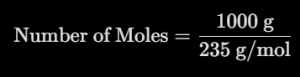
Now, multiply by Avogadro’s number to get the total number of individual nuclei:

Step 2: Convert the energy per nucleus from MeV to Joules
A single fission event gives you 200 MeV. Let’s convert that to SI units:
200 MeV = 200 × 106 eV
200 × 106 (1.602 × 10⁻¹⁹ J/eV}) = 3.204 × 10⁻¹¹ Joules
Step 3: Calculate total energy
Multiply the total number of nuclei by the energy released per single nucleus:
Total Energy = (2.563 × 1024) × (3.204 × 10⁻¹¹ J) = 8.21 × 10¹³ Joules
That is a staggering amount of energy from just one kilogram of material, which is why a single triggered reaction can easily spiral into a self-sustaining chain reaction if extra neutrons aren’t managed properly.
Nuclear fission and fusion For RPSC Assistant Professor: Misconception
A classic mistake people make when rushing through multiple-choice questions is treating Nuclear fission and fusion as minor variations of the same thing.
To keep them straight, imagine a purely fictional scenario involving marbles. Fission is like taking a massive, unstable clump of hundreds of sticky marbles and hitting it with one small marble so hard that the whole thing shatters into two smaller, stable clumps. Fusion, on the other hand, is like taking two tiny, individual marbles and slamming them together with so much speed that they overcome their natural repulsion and melt into a single, larger marble.
As per Nuclear fission and fusion, the environment required for each process is completely different:
- Fission can happen comfortably at routine, terrestrial temperatures and pressures inside a engineered reactor core.
- Fusion requires extreme temperatures (millions of degrees) and immense gravitational pressures—the kind you only find naturally in the hearts of active stars.
Nuclear fission and fusion For RPSC Assistant Professor: Application
We have successfully tamed nuclear fission for civilian use. Commercial nuclear power plants use controlled fission to generate heat, boil water into steam, and spin massive turbines to produce low-carbon electricity. The trick here is engineering materials and control rods that can throttle the neutron population to keep the reaction stable while safely isolating the radioactive waste products.
Nuclear fission and fusion remain our ultimate engineering goal. It is what powers the sun, but replicating that on Earth is incredibly difficult. Projects like ITER (International Thermonuclear Experimental Reactor) are attempting to show we can build a reactor that generates more energy from fusion than it takes to heat the fuel. If we crack it, we get a near-limitless power supply with zero long-lived radioactive waste.
Nuclear fission and fusion For RPSC Assistant Professor: Exam Strategy
When you are sitting in the exam hall, questions on Nuclear fission and fusion generally target three specific areas:
- Mass defect and binding energy calculations: Be ready to calculate binding energy per nucleon or determine if a specific reaction is exothermic based on mass values.
- Reaction types: Know your fast neutrons from thermal neutrons, and understand the specific steps of the Proton-Proton chain versus the Carbon-Nitrogen-Oxygen (CNO) cycle in stars.
- Reactor physics: Pay attention to terms like reproduction factor (k), moderator materials (like heavy water or graphite), and prompt vs. delayed neutrons.
We regularly put together detailed breakdowns and free video lectures at VedPrep to help make these tricky mathematical derivations simpler. Practicing mixed numerical sets is the absolute fastest way to build muscle memory for these topics.
Nuclear Fission and Fusion For RPSC Assistant Professor: Challenges and Opportunities
The career paths opening up for future assistant professors in this space are massive. Research in Nuclear fission and fusion essentially splits into two major domains:
- Materials science: We need to develop advanced containment structures that can survive high-energy neutron bombardment without weakening over time.
- Plasma physics: For fusion to work, we have to bottle up an ultra-hot plasma gas using powerful magnetic fields without letting it touch the reactor walls.
Final Thoughts
Conquering Nuclear fission and fusion of the RPSC syllabus isn’t about memorizing complex equations by rote—it’s about understanding the underlying balance of cosmic forces. Whether it’s the splitting of a heavy uranium atom or the crushing together of hydrogen isotopes, nature is always just trying to find its lowest, most stable energy state. Keeping that big-picture perspective in mind makes the tricky numericals and theoretical edge cases a lot easier to parse when you’re under pressure in the exam hall.
To learn more in detail from our faculty, watch our YouTube video:
Frequently Asked Questions
What is nuclear fusion?
Nuclear fusion is a process where two or more atomic nuclei combine to form a single, heavier nucleus. This process releases a significant amount of energy and is the fundamental reaction that powers stars, including our sun.
What is the difference between nuclear fission and fusion?
The primary difference between nuclear fission and fusion is the way energy is released. Fission involves the splitting of a heavy nucleus into lighter nuclei, while fusion involves the combining of light nuclei into a heavier nucleus.
What are the applications of nuclear fission?
Nuclear fission has several applications, including the generation of electricity in nuclear power plants, the production of radioisotopes for medical and industrial uses, and the creation of nuclear energy for propulsion in submarines and aircraft carriers.
What are the applications of nuclear fusion?
Nuclear fusion has potential applications in energy production, propulsion systems for spacecraft, and the creation of new radioactive isotopes. However, achieving controlled nuclear fusion has proven to be a significant technological challenge.
What is the role of neutron-induced reactions in nuclear fission?
Neutron-induced reactions play a crucial role in nuclear fission, as they can initiate and sustain the fission process. Neutrons collide with atomic nuclei, causing them to split and release more neutrons, which then go on to collide with other nuclei.
What is the significance of nuclear fusion in stars?
Nuclear fusion is the primary process by which stars generate energy. In the cores of stars, hydrogen nuclei fuse to form helium, releasing vast amounts of energy in the process.
What is the nuclear binding energy curve?
The nuclear binding energy curve is a graphical representation of the binding energy per nucleon as a function of atomic mass. It illustrates the stability of nuclei and is essential for understanding nuclear reactions, including fission and fusion.
What is the difference between nuclear chain reactions and nuclear fusion?
Nuclear chain reactions involve a series of nuclear fission reactions where neutrons released from one fission event cause subsequent fission events. Nuclear fusion, on the other hand, involves the combination of nuclei to form a heavier nucleus.
How is nuclear fission and fusion relevant to the RPSC Assistant Professor exam?
Nuclear fission and fusion are crucial topics in nuclear chemistry, which is relevant to the RPSC Assistant Professor exam. Questions on these topics may be asked in the context of inorganic and analytical chemistry.
What are the key concepts related to nuclear fission and fusion that I should know for the exam?
Key concepts related to nuclear fission and fusion include the processes of fission and fusion, energy release, types of nuclear reactions, and applications of nuclear chemistry.
How can I apply my knowledge of nuclear fission and fusion to analytical chemistry?
Knowledge of nuclear fission and fusion can be applied to analytical chemistry in the context of radiochemical analysis and the use of radioactive isotopes in analytical techniques.
What are common mistakes students make when understanding nuclear fission and fusion?
Common mistakes include confusing fission with fusion, not understanding the differences between nuclear reactions, and failing to recognize the applications and implications of each process.
What are some advanced concepts related to nuclear fission and fusion?
Advanced concepts include the role of neutron-induced reactions, the nuclear binding energy curve, and the challenges associated with achieving controlled nuclear fusion.
What are the challenges associated with achieving controlled nuclear fusion?
The challenges associated with achieving controlled nuclear fusion include achieving and sustaining high temperatures, confining and stabilizing the plasma state, and developing materials that can withstand the extreme conditions.