
Solvent extraction can feel like one of those topics you memorize for an exam and immediately forget. But if you are gearing up for the RPSC Assistant Professor exam, this is a core area where you can secure easy marks if you understand the actual mechanics behind the math.
Let’s break down everything you need to know for the syllabus, minus the overly dense textbook jargon. At VedPrep, we believe mastering these concepts comes down to seeing how they work in the real world.
Syllabus: Overview of the Relevant Unit
In the RPSC Assistant Professor chemistry syllabus, this topic sits squarely within Analytical Chemistry. This branch focuses on separating, identifying, and quantifying matter. While standard reference books like Analytical Chemistry by Bard and Principles of Analytical Chemistry by Skoog and West cover this in deep mathematical detail, the exam tests your conceptual grasp of how molecules behave when caught between two phases.
Solvent Extraction: Definition and Key Principles
At its core, solvent extraction is just a pulling contest between two liquids that do not mix (immiscible liquids), usually water and an organic solvent.
Imagine you dissolve a mixture of salt and organic compounds in water. If you shake that water with an organic solvent like hexane, the organic compounds will leave the water behind and jump into the hexane because they feel more “at home” there. This preference is driven by solubility—like dissolves like.
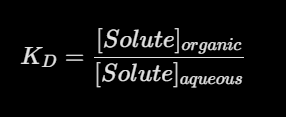
When you mix the phases, the solute distributes itself between them until it hits an equilibrium. How it splits is governed by the distribution coefficient (KD) or partition coefficient:
Choosing the Right Solvent
To make this work efficiently, your extracting Solvent extraction needs to follow a few rules:
- It must be completely or mostly immiscible with the original solvent.
- It should dissolve the target compound incredibly well.
- It should have a different density than the original phase so they separate into distinct layers easily.
- Common exam favorites include hexane, chloroform, and ethyl acetate.
Solvent Extraction: Methodology and Techniques
We generally divide Solvent extraction into liquid-liquid extraction and solid-liquid extraction. For competitive exams, liquid-liquid extraction gets the most spotlight.
Two massive operational factors alter your extraction efficiency:
- Phase Ratio: This is the volume ratio of your organic solvent to the aqueous phase. Instead of dumping all your organic solvent in at once, doing multiple extractions with smaller volumes yields a much higher recovery.
- pH Control: This is a classic RPSC question trap. If your solute is a weak acid or base, changing the pH alters its charge. A charged (ionized) molecule prefers water, while a neutral (un-ionized) molecule prefers the organic phase. By tweaking the pH, you can force a molecule to stay put or move phases.
Worked Example: Solved Question
Let’s look at a typical problem you might encounter on exam day.
Problem
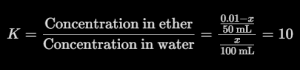
A 100 mL solution of 0.1 M benzoic acid in water is extracted with 50 mL of diethyl ether. The distribution coefficient (K) for benzoic acid between diethyl ether and water is 10. Calculate the amount of benzoic acid remaining in the aqueous phase after this single extraction.
Solution
Let’s track the moles.
- Initial moles of benzoic acid: 0.1 M × 0.1 L = 0.01 mol
- Let x be the moles of benzoic acid left in the water (aqueous phase).
- The moles transferred to the ether phase will be 0.01 – x.
Now we set up our equilibrium equation using the volumes of each phase:
Common Misconceptions: Solvent Extraction in Competitive Exams
A frequent mistake students make while prepping for exams like RPSC, CSIR NET, or GATE is assuming analytical chemistry questions are purely qualitative memory tests. They often skim past the mathematical relationship between the partition coefficient and extraction cycles.
Another misconception is that extraction always requires complex, automated industrial setups. In reality, the basic principle relies entirely on thermodynamics and simple laboratory glassware like a separatory funnel. If you understand equilibria, you understand extraction.
Real-World Application: Solvent Extraction in Pharmaceutical Industry
To see this in action, let’s look at how companies manufacture medicine. When synthesizing an Active Pharmaceutical Ingredient (API)—the actual chemical that treats an illness—the reaction mixture is often a messy soup of raw materials, side products, and catalysts.
Pharmaceutical chemical engineers use extraction to isolate the pure API. They select highly targeted solvents like ethyl acetate or methanol to pull the pure drug out of the crude reaction mixture. Because these processes must follow strict regulatory standards like cGMP (current Good Manufacturing Practice), the choice of solvent undergoes intense scrutiny regarding safety, boiling point (for easy evaporation later), and toxicity.
Exam Strategy: Study Tips and Important Subtopics
When you study this unit, do not just memorize formulas. Focus on the why.
- Derive the multiple extraction formula: Make sure you understand why extracting three times with 20 mL is vastly superior to extracting once with 60 mL.
- Master the pH effect: Be ready for questions where a mixture of an organic acid and an organic base must be separated using sequential pH adjustments.
If you want to test your speed on these types of problems, our team at VedPrep regularly maps out previous years’ question trends to help keep your practice targeted and efficient.
Solvent Extraction: Case Study
To see how vital Solvent extraction selection is, let’s create a hypothetical scenario to contrast how different industries use this chemistry.
Imagine a production plant trying to optimize three entirely different target molecules. They cannot use a single universal solvent because each molecule interacts uniquely with its environment based on its octanol-water partition coefficient (log Kow), which measures how hydrophobic a compound is.
| Industry | Target Compound | Chosen Solvent | Why it matters |
| Pharmaceuticals | Antibiotics | Ethyl acetate | High affinity for the complex organic molecular structure without destroying it. |
| Food Processing | Vegetable oils | Hexane | Low boiling point, non-polar, making it easy to completely strip away from the final edible product. |
| Petrochemicals | Aromatics/Fuels | Toluene | Excellent at dissolving targeted hydrocarbons out of crude oil fractions. |
Note: This comparison illustrates how varying chemical structures demand matching solvent properties to keep purity yields high.
Conclusion and Future Scope
Solvent extraction remains an indispensable technique across chemistry. The future of the field is moving rapidly toward “Green Chemistry”—finding ways to replace hazardous organic solvents with eco-friendly alternatives like supercritical CO₂ or ionic liquids.
For the RPSC Assistant Professor exam, keeping your fundamentals solid on partition coefficients, pH dependencies, and industrial uses ensures you are fully prepared for whatever questions show up on the paper.
To know more in detail from our faculty, watch our YouTube video:
Frequently Asked Questions
What are the types of solvent extraction?
There are several types of solvent extraction, including liquid-liquid extraction, solid-liquid extraction, and Soxhlet extraction. Each type is suited for specific applications and sample types.
What is the principle of solvent extraction?
The principle of solvent extraction is based on the difference in solubility of a substance in two immiscible solvents. The substance moves from one solvent to another based on its solubility and density.
What are the applications of solvent extraction?
Solvent extraction has various applications in analytical chemistry, including sample preparation for chromatography, isolation of analytes, and purification of substances.
What are the advantages of solvent extraction?
The advantages of solvent extraction include simplicity, low cost, and high efficiency. It is also a versatile technique that can be used for a wide range of samples and analytes.
What is the role of solvent extraction in inorganic chemistry?
Solvent extraction plays a crucial role in inorganic chemistry for the separation and purification of metal ions and inorganic compounds. It is used to isolate and identify inorganic species.
What are the factors affecting solvent extraction?
Factors affecting solvent extraction include solubility, density, and viscosity of solvents, as well as temperature, pH, and sample matrix. Optimizing these factors is crucial for efficient extraction.
How is solvent extraction used in RPSC Assistant Professor exams?
Solvent extraction is a key concept in inorganic and analytical chemistry, which are important topics for RPSC Assistant Professor exams. Questions may test understanding of principles, applications, and calculations related to solvent extraction.
What are some common exam questions on solvent extraction?
Common exam questions on solvent extraction include those on principles, types, applications, and calculations. Questions may also be based on analytical chemistry and inorganic chemistry.
How to solve solvent extraction problems in exams?
To solve solvent extraction problems in exams, understand the principles and formulas, practice numerical problems, and review applications in analytical chemistry and inorganic chemistry.
What are common mistakes in solvent extraction?
Common mistakes in solvent extraction include incorrect choice of solvent, inadequate shaking, and failure to separate phases properly. These mistakes can lead to poor recovery or contamination of samples.
How to avoid mistakes in solvent extraction?
To avoid mistakes in solvent extraction, carefully select solvents, ensure thorough shaking, and properly separate phases. Also, use suitable equipment and follow standard operating procedures.
What are some advanced techniques in solvent extraction?
Advanced techniques in solvent extraction include supercritical fluid extraction, microwave-assisted extraction, and ultrasound-assisted extraction. These techniques offer improved efficiency, selectivity, and reduced solvent usage.
How is solvent extraction used in analytical chemistry?
Solvent extraction is widely used in analytical chemistry for sample preparation, purification, and preconcentration of analytes. It is often used prior to chromatography or spectroscopy.
What are the future directions of solvent extraction?
Future directions of solvent extraction include development of green solvents, miniaturization of extraction techniques, and integration with other analytical techniques. These advancements aim to improve sustainability and efficiency.