
Preparing for the RPSC Assistant Professor exam is understanding core concepts, especially when you are balancing your post-grad revision with competitive exam strategies. If you look at past papers for Rajasthan public service exams or parallel tests like CSIR NET and IIT JAM, one topic consistently carries major weight: population ecology. In the CSIR NET syllabus, you will find this tucked under Unit 5 (Ecology), and for RPSC, it is a bedrock component of Environmental Science.
To really nail this section, standard reference books are your best friends. We at VedPrep usually recommend picking up Principles of Population Ecology by Barry W. Brookins or Ecology: The Economy of Nature by Robert E. Ricklefs and Gary A. Miller. These texts give you a clean breakdown of how a population—which is just a group of individuals of the same species living in a specific geographic area—behaves over time.
When you strip away the heavy academic jargon, population ecology boils down to three main pillars:
- Population growth models (the math behind how numbers spike or level off)
- Density-dependent and density-independent factors (what slows growth down versus what wipes out a population regardless of its size)
- Regulation of populations (how nature keeps things in check via carrying capacity)
Understanding Population Ecology (Growth, Density, Regulation) For RPSC Assistant Professor
At its heart, population ecology looks at the dynamic relationship between a species and its surroundings. Instead of looking at a single animal, we are looking at the big picture. What makes a group expand, shrink, or just stall? If you look closely at the data, it always comes down to simple moving pieces: birth rates, death rates, and migration (animals moving in or out).
Another big piece of the puzzle is population density, which tells us how crowded a specific area actually is. This is not just an abstract concept for researchers; it is a vital tool for real-world environmental management.
Nature regulates these numbers through a tug-of-war between two forces:
- Density-dependent factors: Think of these as internal brakes. Things like intense competition for food, or predators noticing a massive spike in prey, kick into high gear only when a population gets too thick.
- Density-independent factors: These are external shocks. A massive drought, a sudden cold snap, or a wildfire does not care if there are ten deer or ten thousand; it impacts the population all the same.
Population Size and Density in Population Ecology (Growth, Density, Regulation) For RPSC Assistant Professor
Let us break down two terms that sound similar but mean completely different things: population size and population density. Size is simply the raw head count. Density is how those individuals are spread out over a specific patch of land—like counting the number of trees per hectare or tigers per square kilometer.
The link between the two tells us a lot about how a population will behave:
- Population size and density are interrelated concepts.
- Population density directly shapes how a population grows and regulates itself.
Imagine a fictional scenario where a local wildlife department introduces fifty spotted deer into a small, fenced woodland reserve in Rajasthan. Initially, with plenty of forage, the population size grows. But because the space is locked at a fixed size, the density skyrockets. Soon, the deer are competing for every single bush, birth rates drop, and the growth rate grinds to a halt. This real-world balance is exactly what you need to keep in mind for the exam.
| Concept | Description |
| Population size | The total headcount of individuals in a population. |
| Population density | The number of individuals packed into a specific unit of area. |
Worked Example: Population Growth Curve in Population Ecology (Growth, Density, Regulation) For RPSC Assistant Professor
You can almost guarantee a numerical or graphical question on growth curves in the RPSC exam. Let us look at a standard problem featuring exponential growth, which happens when a population has infinite resources and zero stress.
Imagine a laboratory setting where a culture of bacteria is growing exponentially. You start with an initial count of 1,000 bacteria, and the population doubles every 2 hours. What does the population look like after 6 hours?
To track Population ecology, we use the standard exponential doubling equation:
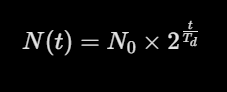
Where:
- N(t) = final population size
- N0 = initial population size (1,000)
- t = total time elapsed (6 hours)
- Td = doubling time (2 hours)
Let us lay out the timeline to see how this builds up step-by-step:
| Time (hours) | Population Size |
| 0 | 1,000 |
| 2 | 2,000 |
| 4 | 4,000 |
| 6 | 8,000 |
After 6 hours, your bacterial count hits 8,000. If you map this out on a graph, you get a classic, steep J-shaped curve. This rapid calculation is a favorite style for exam paper setters.
Population Ecology (Growth, Density, Regulation) For RPSC Assistant Professor: Misconceptions and Clarifications
A classic trap that many aspirants fall into is assuming that populations just keep growing exponentially forever. In reality, a J-curve is pretty rare in the wild because environments have limits. True exponential growth usually only happens for brief moments—like a pest outbreak during a rainy season—before reality sets in.
As a population grows, environmental resistance kicks in. Changes in ambient temperature or seasonal weather patterns interact directly with density-dependent factors (like disease spreading faster in a crowd) and density-independent factors (like a sudden monsoon flood). Recognizing that exponential growth is just a temporary phase helps you understand the more realistic logistic growth model, where numbers eventually flatten out into an S-shaped curve.
Real-World Application of Population Ecology (Growth, Density, Regulation) For RPSC Assistant Professor in Conservation Biology
Why do we spend so much time studying this? Because population ecology is the toolbox that allows conservationists to save endangered species from going extinct. By tracking birth and death trends, wildlife managers can pinpoint exactly when and why a species is struggling.
Take metapopulation theory, for instance. This framework looks at how isolated pockets of the same species interact across fragmented landscapes. If a highway cuts through a forest, it splits a population in two. By understanding gene flow and migration patterns, conservation groups can build wildlife corridors—like green overpasses—to link these separated groups back together. This protects genetic diversity and keeps the species viable.
For someone stepping into an Assistant Professor role, seeing how these theories apply directly to managing national parks or reintroducing species makes teaching the material a whole lot more grounded.
Exam Strategy: Tips For Population Ecology (Growth, Density, Regulation) For RPSC Assistant Professor
When you sit down to study Population ecology, do not just memorize definitions. The RPSC exam values conceptual clarity. Focus your energy on comparing exponential versus logistic growth models, understanding the nuances of carrying capacity (K), and identifying which factors belong in the density-dependent category.
Here is a quick checklist for your study sessions:
- Work through the mathematical derivations for growth rates (r).
- Practice interpreting graphs, especially how population curves react when they overshoot their carrying capacity.
- Look over past papers to see how situational questions are framed.
If you are looking for a bit of extra structure to sort through these models, we have put together a wealth of clear, no-nonsense study guides and papers at VedPrep to help you map out your preparation strategy without getting overwhelmed.
Population Regulation and Control in Population Ecology (Growth, Density, Regulation) For RPSC Assistant Professor
How does nature keep a population from expanding until it completely collapses its own environment? It relies on carrying capacity—the absolute ceiling of what a specific environment can support without degrading.
Think of carrying capacity like a hotel with a strict room limit. Once the rooms are full, you cannot safely add more guests without things breaking down. In nature, when a population overshoots this ceiling, resources like food and nesting space disappear, causing the death rate to skyrocket until the population shrinks back to a sustainable size.
Understanding how these natural checks and balances prevent overpopulation and environmental degradation is a core element of ecosystem management, and it is a theme that shows up regularly on competitive papers.
Lab Application: Population Dynamics Studies in Population Ecology (Growth, Density, Regulation) For RPSC Assistant Professor
To see these grand environmental laws in action without waiting decades, scientists bring nature into the lab. They use microcosm experiments—which are essentially mini, self-contained ecosystems like a small terrarium or a controlled flask of yeast—to see how populations interact under different conditions.
By tweaking variables like temperature or food supply one at a time, researchers can isolate exactly how intraspecific competition (members of the same species fighting for resources) or interspecific interactions (different species competing) change the growth curve. The data gathered from these tiny lab setups forms the exact mathematical foundation for the large-scale conservation plans used in massive wildlife reserves.
Population Ecology (Growth, Density, Regulation) For RPSC Assistant Professor in Conservation Biology: Future Directions
The field of population ecology is moving fast, especially with the integration of new technologies. Today, researchers are moving past basic pen-and-paper equations to build complex predictive models. By utilizing artificial intelligence and machine learning, ecologists can process massive climate and population datasets simultaneously to forecast how a species might respond to changing environments over the next fifty years.
There is also a massive push toward combining social factors with ecological data. Conservation does not happen in a vacuum; it involves local communities. Modern strategies prioritize local engagement to ensure that wildlife protection plans work with the people living nearby, making the conservation efforts stable for the long haul.
Final Thoughts
Preparing for the RPSC Assistant Professor exam is undoubtedly a marathon, but mastering a core pillar like population ecology gives you a massive advantage when exam day rolls around. At the end of the day, this topic is all about seeing the patterns in how nature balances itself—moving from simple raw numbers to the complex equations that dictate real-world conservation. If you can confidently navigate the shift from exponential spikes to logistic leveling, map out density factors, and handle the basic growth math, you are well on your way to securing those crucial marks.
To learn more in detail from our faculty, watch our YouTube video:
Frequently Asked Questions
What are the main factors affecting population growth?
The main factors affecting population growth are birth rate, death rate, immigration, and emigration. These factors interact to determine the rate of population growth or decline.
What is population density?
Population density refers to the number of individuals of a species per unit area or volume. It is an important factor in determining population dynamics and can be influenced by factors such as resource availability and predation.
How do populations regulate themselves?
Populations can regulate themselves through various mechanisms, including density-dependent factors such as predation, competition, and disease, as well as density-independent factors such as climate and habitat destruction.
What is the difference between ecology and ethology?
Ecology is the study of the relationships between organisms and their environment, while ethology is the study of animal behavior. While ecology focuses on the interactions between organisms and their environment, ethology focuses on the behavior of individual organisms.
What are the different types of population growth curves?
The different types of population growth curves are exponential, logistic, and sigmoidal. These curves describe how populations grow over time in response to different environmental conditions.
What is the role of ecology in understanding population dynamics?
Ecology plays a crucial role in understanding population dynamics by examining the interactions between populations and their environment. This knowledge can inform conservation efforts and management of populations.
What are the different types of population density measures?
The different types of population density measures are crude density, ecological density, and social density. These measures describe the number of individuals per unit area or volume in different ways.
How can population ecology concepts be applied to conservation biology?
Population ecology concepts can be applied to conservation biology by understanding the dynamics of populations and their interactions with the environment. This knowledge can inform conservation efforts, such as habitat restoration and species reintroduction.
What are some common population ecology questions in RPSC Assistant Professor exams?
Common population ecology questions in RPSC Assistant Professor exams include topics such as population growth models, density-dependent and density-independent factors, and conservation applications.
How can population ecology concepts be applied to human population dynamics?
Population ecology concepts can be applied to human population dynamics by understanding the factors that influence human population growth, such as birth rates, death rates, and migration.
What is a common mistake in understanding population growth rates?
A common mistake is to assume that population growth rates are constant over time. However, population growth rates can change due to various factors, such as changes in birth rates or death rates.
How can students avoid mistakes in applying population ecology concepts?
Students can avoid mistakes by carefully reading and understanding the questions, and by applying population ecology concepts in a logical and consistent manner.
What is the concept of metapopulation ecology?
Metapopulation ecology refers to the study of populations that are connected by migration. This concept is important for understanding the dynamics of populations in fragmented habitats.
How can population ecology inform management of invasive species?
Population ecology can inform management of invasive species by understanding the dynamics of invasive populations and their interactions with native species and the environment.