
Preparing for the RPSC Assistant Professor exam is a massive journey, and if you are eyeing the Botany or Zoology seats, you already know how crucial the Wildlife of India is. It is not just a random topic tossed into the syllabus; it is a scoring goldmine if you crack it right. While it pops up in exams like CSIR NET, IIT JAM, GATE, and CUET PG, the RPSC Assistant Professor exam tests your knowledge with a unique blend of national depth and local Rajasthan context.
Wildlife of India For RPSC Assistant Professor: Syllabus
The Wildlife of India sits comfortably under Unit 10: Ecology and Environment of the Life Sciences stream. Because the RPSC Assistant Professor syllabus shares a lot of DNA with CSIR NET, the prep strategy aligns beautifully.
Standard textbooks that cover Wildlife of India include the following:
- Ecology and Environment by Odum – a classic go-to for grasping broad ecological concepts.
- Wildlife Ecology and Management by Sinclair and Boyle – great for looking at the practical side of managing wildlife populations.
In the CSIR NET exam, this section usually brings in a moderate weightage of about 5-7 marks. For the RPSC Assistant Professor exam, you can expect a similar, if not higher, weightage. At VedPrep, we always remind our students that getting a grip on India’s ecosystems, biodiversity hotspots, and conservation history is what sets top rankers apart.
Core Principles of Wildlife of India For RPSC Assistant Professor
Let’s strip away the heavy jargon. When we say wildlife, we are talking about the entire cast of animals, plants, and microorganisms living out in nature, completely untouched by domestication. The Wildlife of India is mind-bogglingly diverse because our geography changes every few hundred kilometers—from hot deserts to soggy wetlands.
What decides where an animal lives? It is a constant dance between biotic (living things like food and predators) and abiotic (non-living things like rainfall and temperature) factors. When these factors balance out perfectly, we get ecological balance.
Here are three key terms you need to memorize for Wildlife of India:
- Biodiversity hotspot: Places bursting with unique life that is unfortunately under serious threat.
- Endemic species: Animals or plants that belong to one specific spot and nowhere else on Earth.
- Keystone species: The VIPs of an ecosystem. If you remove them, the whole system collapses.
To protect this heritage, India brought in the Wildlife (Protection) Act, 1972. It is the ultimate playbook for setting up national parks and stopping illegal poaching.
Key Concepts Explained
Think of an ecosystem as a busy neighborhood where living organisms and non-living elements interact 24/7. These can be terrestrial (like the Thar Desert) or aquatic (like the Chambal River).
Because India has everything from scorching plains to freezing peaks, our biodiversity is off the charts. Take tropical rainforests in the Western Ghats; they are warm, wet, and packed with dense canopy layers. On the flip side, the Himalayan temperate forests deal with colder weather and sport a mix of pine and oak trees.
To visualize how energy moves here, picture a simple food chain. Let’s create a fictional scenario to see this in action:
Imagine a peaceful grassland in a sanctuary. The grass (producer) traps sunlight. A grasshopper sprouts up to munch on the grass, only to get snapped up by a frog. A snake then dines on the frog, and finally, a peacock (carnivore) hunts down the snake. If a single link in this imaginary chain breaks, the whole neighborhood goes into chaos.
Theoretical Framework of Wildlife of India For RPSC Assistant Professor
Ecologists love using math to predict how wildlife populations change over time. One famous model is the metapopulation model, which looks at how fragmented animal groups stay connected by moving back and forth to share genes.
When resources are limited, populations do not just grow forever. They follow the logistic growth equation:
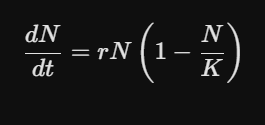
In this formula:
- $N$ is the current population size.
- $r$ is the intrinsic growth rate (how fast they multiply when times are good).
- $K$ is the carrying capacity (the maximum population the environment can support without running out of food or space).
Real-world issues like habitat fragmentation—where a highway cuts a forest into tiny pieces—mess with these numbers. It isolates animals, causes inbreeding, and shrinks genetic diversity.
Solved Problem: Wildlife of India For RPSC Assistant Professor
Here is a typical multiple-choice question that matches the toughness of the RPSC and CSIR NET exams:
Question: What is the primary reason for the historical decline in the population of the Asiatic lion in India’s Gir Forest?
- A) Habitat fragmentation due to agriculture
- B) Prey base depletion due to overhunting
- C) Human-wildlife conflict due to encroachment
- D) Disease transmission from domestic livestock
Step-by-step solution:
The Asiatic lion is a classic conservation story. While they face multiple modern pressures like habitat loss and conflict with local herders, the major historical driver that originally pushed them to the brink of extinction was the massive loss of their prey base (like chinkara, sambar, and wild boar) due to rampant overhunting in the past. Without food, predator numbers crash fast.
Correct answer: B) Prey base depletion due to overhunting
Common Misconceptions
A lot of aspirants assume that because the Indian Rhinoceros is highly protected under the Wildlife Protection Act, you can find them scattered all over India’s wetlands. This is a trap!
The truth is, rhinos are incredibly picky about their home. They need very specific tall grasslands and savannas found in the Terai region.
| Species | Specific Habitat | Key Strongholds |
| Indian Rhinoceros | Terai region grasslands and savannas | Kaziranga, Manas, and Pobitora (Assam) |
Thinking their distribution is uniform can cost you marks. They are heavily concentrated in just a few pockets, which makes them highly vulnerable to localized threats like floods or poaching.
Real-World Applications
We do not just study the Wildlife of India to pass exams; this science saves species. Today, labs run advanced genetic analysis on fecal or hair samples to track tiger gene flow without ever touching the animal.
Teams at the Indian Institute of Science and the Wildlife Institute of India are regularly working on non-invasive monitoring tools. Think of camera traps that snap photos of elusive leopards or sensor grids that track elephant movements. This data helps state governments redraw boundaries for protected areas and figure out where wildlife corridors should go to prevent animals from wandering into human villages.
Preparing Wildlife of India For RPSC Assistant Professor for Your Exam
When you are diving into this topic for the RPSC exam, you need a smart roadmap. Do not just read blindly. Focus on high-yield areas: know your National Parks (especially the ones in Rajasthan like Ranthambore, Sariska, and Keoladeo), memorize endangered species lists, and understand the legal clauses of conservation acts.
We recommend tracking the flora and fauna according to geographic zones. For a helping hand, VedPrep offers a bunch of accessible resources, including well-structured video lectures and comprehensive study notes designed to break down tough ecological concepts. You can check out our free VedPrep lecture on Wildlife of India For RPSC Assistant Professor to see exactly how we map out the exam trends. Don’t forget to practice past papers to get comfortable with how twisting these questions can be.
Conclusion
Mastering the Wildlife of India is a surefire way to boost your score in the RPSC Assistant Professor exam. Once you understand how ecosystems tick, how equations model real-world populations, and how laws safeguard our natural spaces, the questions become much easier to tackle.
To know more in detail from our faculty, watch our YouTube video:
Frequently Asked Questions
What are the major threats to Indian wildlife?
Habitat loss, poaching, human-wildlife conflict, pollution, and climate change are major threats to Indian wildlife, affecting species survival and ecosystem health.
What is the role of ecology in understanding wildlife?
Ecology helps understand the interactions between organisms and their environment, crucial for managing and conserving wildlife populations and their habitats.
What is ethology and its relevance to wildlife?
Ethology, the study of animal behavior, helps understand species' social structures, habitats, and adaptations, essential for effective wildlife conservation and management.
How does ecology relate to wildlife conservation?
Ecology informs conservation efforts by understanding species' ecological roles, habitat requirements, and population dynamics, ensuring sustainable conservation practices.
What are the biodiversity hotspots in India?
India has several biodiversity hotspots, including the Himalayas, Western Ghats, and Eastern Ghats, which support a rich variety of flora and fauna.
What is the role of wildlife corridors in conservation?
Wildlife corridors connect fragmented habitats, allowing species migration, genetic exchange, and maintaining ecosystem services, crucial for long-term conservation.
How do ecological factors influence wildlife distribution?
Ecological factors like climate, vegetation, and topography influence wildlife distribution, shaping species' habitats and population dynamics.
What are the conservation implications of wildlife ecology?
Understanding wildlife ecology informs conservation efforts, ensuring that management practices are grounded in ecological principles and effective in maintaining biodiversity.
How to approach wildlife-related questions in RPSC Assistant Professor exam?
Focus on understanding ecological and ethological concepts, conservation strategies, and India's biodiversity hotspots to tackle wildlife-related questions effectively.
What are the key wildlife conservation initiatives in India?
India has implemented various initiatives like Project Tiger, Wildlife Protection Act, and conservation efforts for specific species like the Indian elephant and rhino.
How to integrate ecology and ethology in answering exam questions?
Apply ecological and ethological principles to understand species' behavior, habitat requirements, and conservation needs, demonstrating comprehensive knowledge.
What common mistakes should be avoided in understanding wildlife ecology?
Avoid oversimplifying complex ecological relationships and neglecting human impact on wildlife habitats and populations.
What is the impact of climate change on Indian wildlife?
Climate change alters ecosystems, disrupts species' habitats and migration patterns, and affects population dynamics, necessitating adaptive conservation strategies.
How does human-wildlife conflict affect wildlife populations?
Human-wildlife conflict leads to habitat fragmentation, population decline, and species extinction, emphasizing the need for effective conflict mitigation strategies.