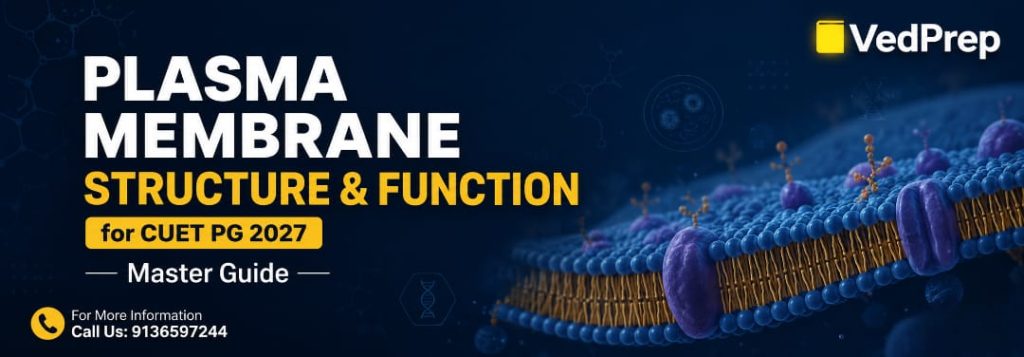

Plasma Membrane Structure and Function for CUET PG Zoology 2027
Plasma membrane structure and function for CUET PG Zoology 2027 is an important topic of cell biology that describes how cells keep internal equilibrium, transport substances, communicate with neighbouring tissues, and control metabolic activities. The plasma membrane is a phospholipid bilayer with proteins, carbohydrates and cholesterol organized in a pattern consistent with the fluid mosaic hypothesis.
Importance of Plasma Membrane Structure and Function in CUET PG Zoology 2027
Plasma membrane structure and function is one of the most requested sections in cell biology for CUET PG Zoology examinations. The subject is the basis for understanding membrane transport, signalling cascades, immunity, osmoregulation, cell communication, and organelle interactions. Questions are frequently conceptual and relate to physiology, molecular biology and biochemistry.
The plasma membrane is the interface between the intracellular and extracellular environments. The membrane doesn’t act like a passive cover. The membrane is instead regulating transit, identifying signals and assisting cell organization.
For CUET PG Zoology preparation, students should concentrate on:
- Fluid Mosaic Model
- Phospholipid bilayer structure
- Membrane protein function
- Permeability Selective
- Passive and active transitions
- Role of carbohydrate and cholesterol
- Membrane receptors and cell signalling
Many competitive exams increasingly evaluate analytical comprehension, rather than straight memorization. In general, students who can relate membrane structure to biological function tend to perform higher in CUET PG Zoology entry tests.
Overall structure of the plasma membrane
The ordered arrangement of lipids, proteins and carbohydrates determines the shape and function of the plasma membrane. The molecular composition and fluid arrangement of the membrane render it flexible, dynamic and selectively permeable.
The plasma membrane is made up mostly of:
- Phospholipids
- Protein
- Cholesterol
- Carbohydrate
The membrane structural framework consists of phospholipids. Each phospholipid is made up of a hydrophilic phosphate head and hydrophobic fatty acid tails. In water, phospholipids organize into a bilayer with their hydrophobic tails facing inwards.
Membrane proteins are embedded in or connected to the bilayer. Some proteins go all the way through the membrane. Others are just connected to the surface.
Carbohydrates exist as glycolipids and glycoproteins on the surface of the outer membrane. These chemicals help with cell identification and signalling.
Cholesterol molecules are also important in stabilizing the membrane and regulating its fluidity. The proper balance of membrane rigidity and flexibility is crucial for normal cellular function.
The plasma membrane is about 7-10 nanometres thick, and can only be clearly seen under electron microscopes.
Fluid Mosaic Model and Membrane Organization
Fluid mosaic model is a better description of plasma membrane structure and function than any previous membrane theories. The concept proposed by Singer and Nicolson in 1972 characterizes the membrane as a fluid phospholipid bilayer with proteins embedded in a mosaic fashion.
The term “fluid” describes the lateral mobility of lipids and proteins in the membrane. The phrase “mosaic” refers to the random distribution of proteins embedded in the lipid bilayer.
Membrane fluidity is biologically significant because cells are continually changing form, transporting materials and interacting with other cells. A stiff membrane would not be an efficient support for such activities.
The fluid mosaic concept also accounts for:
- Selective permeability
- Elasticity of membranes
- Mobility of proteins
- Signaling Pathways
- Vesicle production
Earlier membrane theories suggested that proteins formed contiguous outer layers. Later electron imaging and biochemical studies demonstrated that proteins were embedded in the bilayer rather than forming stiff coats.
Further research has enhanced the fluid mosaic model with the identification of lipid rafts and cytoskeletal interactions. But the underlying architecture remains central to cell biology and CUET PG zoology preparation.
Biological Significance of Phospholipid Bilayer
The phospholipid bilayer is the main structural component that defines the structure and function of the plasma membrane. The bilayer functions as a semipermeable barrier between the inside of the cell and the exterior environment.
Each phospholipid molecule consists of:
- A hydrophilic head polar
- Two hydrophobic tails (nonpolar)
The phospholipids are amphipathic and spontaneously form bilayers in aqueous solutions. The hydrophobic tails are buried in the membrane while the hydrophilic heads interact with the surrounding aqueous media.
The bilayer does not let ions or polar molecules travel freely. Smaller non-polar molecules such as oxygen and carbon dioxide diffuse more easily.
Fatty acid composition is an important determinant of membrane fluidity. Unsaturated fatty acids promote flexibility because the double bonds induce kinks in the hydrocarbon chains. Saturated fatty acids can cluster together more tightly and impair membrane mobility.
Membrane behavior is also temperature-dependent. At lower temperatures, membranes are less fluid. Phospholipid mobility increases with temperature.
CUET PG Zoology students need to know that the structure of the membrane is directly related to membrane transport, receptor functions and cell communication.
Membrane Proteins and Their Functions
Membrane proteins are significant for plasma membrane shape and function since they control transport, signalling, enzymatic processes, and cell recognition. Proteins provide most of the functional specificity of the membrane.
The membrane proteins are grouped into:
- Integral proteins
- Peripheral Proteins
Integral proteins are still contained in the phospholipid bilayer. Many integral proteins span the membrane and serve as transport channels or receptors.
Peripheral proteins are freely linked to the surfaces of membranes. Such proteins are frequently linked to the cytoskeleton and intracellular signaling pathways.
Membrane proteins have important functions:
- Transport of molecules and ions
- Hormone receptor activity
- Catalysis by enzymes
- Cell adhesion
- Transmit signal
Carrier proteins and channel proteins regulate selective transport across membranes. Receptor proteins recognise substances (including hormones and neurotransmitters ) in the extracellular space.
CUET PG Zoology aspirants should clearly differentiate between channel proteins, carrier proteins, receptor proteins and enzymatic proteins, as these categories are usually asked in comparison-type questions in the examinations.
Cholesterol and plasma membrane stability
Cholesterol is a key structural component of animal cell membranes and plays a major role in plasma membrane structure and function. Cholesterol molecules govern the membrane fluidity, permeability and stability under changing environmental conditions.
Cholesterol is embedded in the bilayer among phospholipids. Cholesterol prevents the over-movement of phospholipids and inhibits membranes from becoming overly fluid at high temperatures.
Cholesterol prevents tight phospholipid packing at low temperatures and lowers membrane stiffness. This two-fold action helps cells to keep the membrane function constant over a range of temperatures.
Cholesterol also decreases permeability to water-soluble molecules. The molecule serves to organize the membrane and maintain controlled interior cellular conditions.
A common misconception among students is that cholesterol promotes membrane stiffness exclusively. Cholesterol, in fact, balances the fluidity and stiffness of membranes and stabilizes them.
Plant cell membranes, instead, are made of similar chemicals called phytosterols. Bacterial membranes are normally devoid of cholesterol.
Membrane stability is directly related to transport, signalling and adaptation. Thus, questions on cholesterol are frequently asked in CUET PG Zoology exams.
Membrane Transport and Selective Permeability
Selective permeability is one of the most essential characteristics of plasma membrane structure and function. The plasma membrane is a semipermeable membrane that enables some chemicals to pass through while restricting others, allowing cells to maintain internal equilibrium and metabolic regulation.
Transport occurs by two main mechanisms:
- Passive diffusion
- Active transport
Energy is not needed for passive transfer. Substances flow from high concentration to low concentration along concentration gradients.
examples:
- Simple diffusion
- Facilitated diffusion
- Osmosis
Active transport needs ATP because molecules are moving against a concentration gradient. A key example of an active transport system is the sodium-potassium pump.
Large particles enter or exit a cell by:
- Pinocytosis
- Exocitoz
Transport proteins are quite specialised. Glucose transporters, ion channels and proton pumps are active in response to cellular requirements and modulate mobility.
A real-life example from the nerve cells. Correct transmission of impulses depends upon the selective transport of sodium and potassium ions across membranes.
For CUET PG zoology preparation, students should correlate transport mechanisms with membrane structure instead of studying transport as an independent topic.
Carbohydrates of the Membrane and Cell Recognition
Carbohydrates of the membrane are involved in the construction and function of the plasma membrane by participating in cell recognition, adhesion and immunological interactions. Carbohydrates continue to be covalently linked to proteins and lipids at the outer membrane surface.
Membrane carbohydrates are mainly:
- Glycoproteins
- Glycolipids
The outer carbohydrate-rich layer is called the glycocalyx. The glycocalyx is protective for the cells, physically and chemically, and plays a role in communication between cells.
The carbohydrates on membranes are important for cell identification. The surface glycoproteins allow the immune cells to recognize foreign species. Blood group antigens are another type of membrane carbohydrate indicator.
Membrane carbohydrates serve as:
- Cell adhesion
- Immunity
- Signal detection
- Organization of tissue
An example of clinical importance is organ transplantation. Immune rejection occurs when recipient immune cells recognise foreign membrane antigens.
Students generally focus mainly on phospholipids and proteins, while overlooking membrane carbohydrates. There is an emerging trend of asking an integrated type of question in competitive exams to assess your entire comprehension of membrane composition and function.
Importance of the Plasma Membrane in Cellular Functions
The structure and function of the plasma membrane affect almost every major cellular process. The membrane is not only a physical barrier but also an active interface between the cell and its surroundings.
The main roles of the plasma membrane are:
- Transport regulation
- Signal transduction
- Homeostasis maintenance
- Protection of the cells’ contents
- Cell identification
- Stabilization of cytoskeletal structures
Membrane receptors recognize external signals such as hormones, neurotransmitters and growth factors. Recognition of signals triggers intracellular pathways that govern metabolism and gene expression.
Also, the plasma membrane helps to maintain structural organization. Membrane proteins are attached to cytoskeletal proteins responsible for the maintenance of cell structure.
In multicellular animals, membrane proteins assist neighbouring cells in sticking together to form tissues. Tight junctions, desmosomes, and gap junctions all depend on specialized membrane proteins.
The membranes may malfunction and lead to serious disorders. Channelopathies are diseases caused by defective ion channels. Abnormalities of receptors influence hormone signalling and metabolism.
Membrane function in real biological systems helps conceptual clarity and problem-solving skills in CUET PG Zoology.
<h2>Experimental evidence for plasma membrane models</h2> The scientific knowledge of the plasma membrane structure and function has been developed from experimental data and not only from theoretical assumptions. Modern membrane organization was supported by several major experiments.
Freeze-fracture electron microscopy demonstrated irregular particles of protein embedded in membranes. These findings were inconsistent with earlier sandwich models involving continuous protein coats.
Fluorescent markers were used in cell fusion experiments to show the lateral mobility of membrane proteins. Proteins from merged cells slowly diffused across the surface of the membrane, indicating membrane fluidity.
Permeability tests demonstrated that lipid-soluble molecules passed through membranes more easily than charged particles. Such data were consistent with the phospholipid bilayer notion.
Biochemical investigations have also shown differences in the composition of membranes of different types of cells and organelles. Different ratios of proteins and lipids are found in mitochondrial, lysosomal and plasma membranes depending on their functional requirements.
Older textbooks sometimes oversimplified the organisation of membranes as a static pattern. Today, cell biology views membranes as dynamic systems with controlled protein traffic, signalling regions and structural asymmetry.
Analytical questions based on experimental evidence are becoming more and more essential in CUET PG Zoology entrance tests.
Critical view of membrane models and misconceptions
The fluid mosaic model is still the accepted model of plasma membrane structure and function, although contemporary research suggests that the organization of the membrane is more complex than first suggested. Students who know their limitations can give correct answers to higher-order conceptual questions.
One misperception is that membrane proteins are freely diffusing throughout the bilayer. In fact, many proteins are still partially bound to the cytoskeletal elements and are slightly mobile.
Another simplification is membrane homogeneity. Lipid rafts are now recognized by modern studies as specialized microdomains that are enriched in cholesterol and signalling chemicals.
Students sometimes mistakenly think that membrane fluidity usually enhances the efficiency of the cell. Very high fluidity can disrupt membranes and cause transport proteins to malfunction. Hence, cells manage lipid composition with care.
The fluid mosaic paradigm should not be thrown aside because there are refinements. As technology develops, scientific models change. The basic assumptions of Singer and Nicolson still hold and are fundamental.
Competitive examinations are moving away from rote learning and more towards critical interpretation. Usually, students with a good understanding of the merits and limits of membrane models are better prepared to answer advanced CUET PG Zoology questions.
Plasma membrane biology in medicine and biotechnology: applications
Knowledge of the structure and function of the plasma membrane has important applications in medicine, pharmacology, biotechnology and disease research. Membrane biology has direct consequences for medication action, immunological response and pathogen interactions.
Many drugs are designed to target membrane proteins such receptors, transporters and ion channels. For instance, calcium channel blockers control ion flow when treating cardiovascular diseases.
Viruses interact with membranes to enter host cells. Before infecting immune cells, the human immunodeficiency virus connects to particular membrane receptors. Understanding how the membrane is recognised is important for anti-viral research.
Altered membrane proteins and aberrant signalling pathways are common features of cancer cells. Membrane biomarkers are used by researchers for the diagnosis of cancer and targeted therapy.
Artificial membranes are also of importance in biotechnology. Scientists employ liposomes and artificial membranes for medicine delivery and laboratory studies.
Antibiotic resistance can also be explained by membrane transport processes. Some bacteria pump medications out of the cell using membrane transport proteins.
VedPrep has been guiding applicants studying for CUET PG Zoology, CSIR NET, IIT JAM, GATE, UPSC Geochemist, and Assistant Professor exams in Biology, Chemistry, Mathematics and Physics. The toppers and AIR holders continue to be supported every year with strong conceptual understanding and application-based preparation.
Frequently Asked Questions
2. What is the structure of the plasma membrane?
The plasma membrane consists primarily of a phospholipid bilayer with embedded proteins, cholesterol, and carbohydrate molecules. The hydrophilic heads of phospholipids face outward, while hydrophobic tails face inward. This arrangement creates a selectively permeable barrier essential for cellular activities and communication.
3. Why is the plasma membrane called selectively permeable?
The plasma membrane is called selectively permeable because it allows only certain substances to pass through while restricting others. Small nonpolar molecules can diffuse easily, whereas ions and large molecules require transport proteins. This selective transport helps maintain cellular homeostasis and proper metabolic balance.
4. What are phospholipids in the plasma membrane?
Phospholipids are amphipathic molecules containing a hydrophilic phosphate head and hydrophobic fatty acid tails. They form the bilayer structure of the plasma membrane. Their arrangement provides flexibility, stability, and selective permeability, which are essential for normal cellular functioning and molecular transport.
5. What is the function of membrane proteins?
Membrane proteins perform various functions, including transport, signaling, enzymatic activity, and structural support. Some proteins act as channels or carriers for molecules, while others function as receptors that receive signals from the environment. These proteins are crucial for communication and transport processes in cells.
6. What role does cholesterol play in the plasma membrane?
Cholesterol helps maintain membrane fluidity and stability. It prevents the membrane from becoming too rigid at low temperatures and too fluid at high temperatures. Cholesterol also reduces membrane permeability and supports the structural integrity of animal cell membranes.
7. What are glycoproteins and glycolipids?
Glycoproteins and glycolipids are membrane components containing carbohydrate chains attached to proteins or lipids. They are mainly present on the outer surface of the plasma membrane and play important roles in cell recognition, immune response, cell signaling, and adhesion between cells.
8. How does diffusion occur through the plasma membrane?
Diffusion occurs when molecules move from an area of higher concentration to lower concentration across the plasma membrane. Small molecules like oxygen and carbon dioxide pass directly through the lipid bilayer without requiring energy. This passive movement continues until equilibrium is achieved.
9. What is facilitated diffusion in the plasma membrane?
Facilitated diffusion is the movement of substances across the plasma membrane through specific transport proteins. It does not require cellular energy because molecules move along the concentration gradient. Glucose and ions commonly use channel proteins or carrier proteins for facilitated diffusion.
10. What is active transport in the plasma membrane?
Active transport is the movement of molecules against their concentration gradient using cellular energy in the form of ATP. Specialized transport proteins pump substances across the membrane. Examples include sodium-potassium pumps that help maintain ion balance and electrical potential in cells.
11. How does osmosis relate to the plasma membrane?
Osmosis is the movement of water molecules through a selectively permeable plasma membrane from a region of higher water concentration to lower water concentration. This process regulates water balance in cells and is essential for maintaining cell shape and internal pressure.
12. What is endocytosis in the plasma membrane?
Endocytosis is a process in which the plasma membrane folds inward to engulf substances and form vesicles inside the cell. It allows cells to take in nutrients, fluids, and large particles that cannot pass directly through the membrane by diffusion or transport proteins.