

Mendelism For CSIR NET refers to the application of Gregor Mendel’s laws of inheritance to solve numerical problems and theoretical questions in the CSIR NET Life Sciences examination.
Mendelism For CSIR NET
Preparing for the CSIR NET Life Sciences exam can feel like trying to climb a mountain in a single day. When you look at Unit 8 (Inheritance Biology), the absolute bedrock of your preparation is Mendelism. If you can confidently crack the numerical questions and theoretical twists that the examiners throw at you from this section, you are already well on your way to securing those crucial Part B and Part C marks.
Let’s break down exactly what you need to know about Mendelism to ace the CSIR NET exam, keeping things simple, clear, and focused on how questions actually appear on the test paper.
Understanding Mendel’s Laws of Inheritance
At its core, Mendelism relies on two famous laws that Gregor Mendel figured out while breeding pea plants in his monastery garden. For the CSIR NET exam, you need to understand how these laws operate at the cellular level during meiosis (the cell division that creates sperm and eggs).
1. The Law of Segregation
As per Mendelism , this law states that an organism carries two alleles (versions) for each gene, but these alleles separate during gamete formation. Each gamete gets only one allele.
Think of it like this: Imagine you have a pair of identical socks, one blue and one red, mixed together in a drawer. When you reach in to pull out a single sock to pack in a travel bag, you can only pick one. You can’t pick both at the same time. In the same way, a heterozygous plant (Gg) splits its alleles up so that 50% of its gametes get the G allele and 50% get the g allele.
2. The Law of Independent Assortment
This rule applies when you are tracking two or more different traits at the same time. It states that the alleles of one gene sort into gametes completely independently of the alleles of another gene.
Imagine you are packing for a trip and choosing a shirt (either blue or red) and a pair of shoes (either sneakers or boots). Choosing the red shirt doesn’t force you to pick the sneakers; you can mix and match them however you like.
For CSIR NET, remember this major catch: this law only works perfectly if the genes are located on entirely different chromosomes or are very far apart on the same chromosome. If they are close together, they break this rule due to genetic linkage—a favorite trap for CSIR NET examiners
Mendelism For CSIR NET: Worked Example
Let’s look at a classic setup to see how Mendelism works in practice. Suppose we are looking at pod color in pea plants, where green pods (G) are completely dominant over yellow pods (g).
Imagine an experiment where a scientist crosses a plant showing the dominant green phenotype with a plant showing the recessive yellow phenotype (gg). Because the green plant could be homozygous dominant (GG) or heterozygous (Gg), we have to look at the offspring to figure out the parent’s true genotype.
-
Scenario A: If the green parent is $Gg$ and we cross it with a yellow parent (gg), the resulting offspring will show a 1:1 ratio of green (Gg) to yellow (gg) pods. This is a classic test cross.
-
Scenario B: Now, what if the problem states that crossing two green-podded parents results in a 3:1 phenotypic ratio (three green plants for every one yellow plant) among the offspring? This tells you instantly that both parents must be heterozygous (Gg × Gg).
When you map out this Gg × Gg cross using a Punnett square, you get a clear look at the underlying genetic ratios:
| G | g | |
| G | GG (Green) | Gg (Green) |
| g | Gg (Green) | gg (Yellow) |
-
Genotypic Ratio: 1 GG : 2 Gg : 1 gg (or 1:2:1)
-
Phenotypic Ratio: 3 Green : 1 Yellow (the classic 3:1 ratio)
Mendelism For CSIR NET: Numerical Problems
When it comes to the actual CSIR NET exam paper, you won’t just get asked to define these laws. You will need to use them to solve probability puzzles, especially in Part C.
To solve these quickly without drawing massive, time-consuming Punnett squares during the exam, you should use the product rule and the sum rule of probability.
The Product Rule (The “AND” Rule)
If two genetic events are independent, the probability of them happening together is the probability of the first event multiplied by the probability of the second event.
Example: If you cross two dihybrid plants (AaBb × AaBb), what is the probability of getting an offspring with the genotype $aabb$?
-
Break it down by individual genes. The chance of getting $aa$ from an Aa × Aa cross is 1/4.
-
The chance of getting bb from a Bb × Bb cross is also 1/4.
-
Multiply them together: 1/4 × 1/4 = 1/16.
The Sum Rule (The “OR” Rule)
If an outcome can happen in more than one mutually exclusive way, you add the individual probabilities together.
At VedPrep, we always remind our students that practicing these mathematical shortcut methods saves you precious minutes during the exam. Mastering the art of breaking down a complex dihybrid or trihybrid cross into simple, independent monohybrid crosses makes handling these numerical problems much less intimidating.
Common Misconceptions in Mendelian Genetics
A frequent trap that candidates fall into is assuming that every single genetics problem will neatly resolve into a 3:1 or a 9:3:3:1 ratio. The CSIR NET examiners love to test the exceptions to classical Mendelism.
Keep these variations in mind when reading exam questions:
-
Incomplete Dominance: The heterozygote displays a blending of traits (like a red flower and a white flower producing a pink offspring), turning the phenotypic ratio into 1:2:1.
-
Codominance: Both alleles are expressed fully at the same time (like human AB blood types).
-
Lethal Alleles: If a certain homozygous genotype causes death early in development, that group disappears from your observations entirely, shifting a standard 1:2:1 genotypic ratio into a 2:1 ratio among surviving offspring.
-
Dihybrid Modifications: Classic 9:3:3:1 ratios alter dramatically when genes interact with each other. This is called epistasis, which can create ratios like 9:7, 12:3:1, or 15:1 depending on whether the genes are complementary, dominant, or recessive maskers.
Real-World Applications of Mendelian Genetics
While we spend a lot of time calculating ratios on paper, Mendelism forms the working framework for several major applied sciences.
Agriculture & Plant Breeding
Crop breeders rely heavily on these principles to design high-yielding, disease-resistant plant varieties. By tracking how specific traits are inherited, agricultural scientists can strategically introduce genes for drought tolerance or pest resistance into commercial crops, ensuring better food security.
Medicine & Human Genetics
In medical genetics, understanding these simple inheritance patterns allows counselors to calculate the probability of a couple passing down single-gene disorders, such as cystic fibrosis, sickle cell anemia, or Huntington’s disease, to their children.
Exam Strategy: Mastering Mendelian Genetics for CSIR NET
To get top marks in this section, you need a structured study strategy. We suggest organizing your revision around these specific steps:
-
Master Pedigree Analysis: Expect at least one major question in Part C featuring a family tree diagram. Learn the distinct clues that separate autosomal dominant, autosomal recessive, X-linked dominant, and X-linked recessive traits.
-
Combine Probability with Genetics: Get comfortable with binomial expansions for questions like, “What is the probability that a carrier couple will have three affected and two unaffected children?”
-
Analyze Past Papers: Go back through the last ten years of CSIR NET papers and pull out every single question from Unit 8. You will quickly notice that while the stories in the questions change, the core mathematical logic stays the same.
We map out clear, step-by-step shortcuts for these exact problems in our study programs at VedPrep , helping you cut through the exam anxiety and spot the patterns hidden in wordy Part C questions.
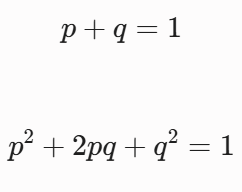
Where p represents the frequency of the dominant allele, q is the frequency of the recessive allele, p2 represents homozygous dominant individuals, 2pq represents heterozygotes, and q2 represents homozygous recessive individuals.
Linkage and Crossing Over
As we mentioned earlier, genes located close together on the same chromosome travel into gametes as a package deal, directly defying Mendel’s Law of Independent Assortment. However, during prophase I of meiosis, homologous chromosomes can swap segments through crossing over.
The frequency of this genetic recombination tells you how far apart the genes are. You can use this percentage data to map out the physical linear order of genes along a chromosome—another high-yield topic for CSIR NET questions.
Key Takeaways: Mendelian Genetics for CSIR NET through Mendelism For CSIR NET
-
Nail the Basics: Do not look past the Law of Segregation and the Law of Independent Assortment. Make sure you understand their mechanical basis in meiosis.
-
Watch for Deviations: Be ready for epistasis, linkage, and organelle inheritance (mitochondrial or chloroplast DNA) that alter classic ratios.
-
Focus on Logic over Memorization: Memorizing ratios only gets you so far. Learn how to derive the numbers using basic probability rules so you can handle any custom scenario the examiners create.
Final Thoughts
Frequently Asked Questions
What is Mendelism?
Mendelism refers to the principles of heredity and variation discovered by Gregor Mendel, including the laws of segregation and independent assortment.
What are the three laws of Mendel?
Mendel's three laws are: the Law of Segregation, the Law of Independent Assortment, and the Law of Dominance. These laws explain how genes are inherited and expressed.
What is the significance of Mendel's work?
Mendel's work laid the foundation for modern genetics and evolutionary biology, enabling us to understand the mechanisms of heredity and variation.
How did Mendel conduct his experiments?
Mendel conducted experiments on pea plants, studying the inheritance of traits such as flower color, seed shape, and plant height, and analyzed the data to derive his laws.
What is the role of Mendelism in understanding behavior?
Mendelism helps understand the genetic basis of behavior, as it explains how genetic factors contribute to behavioral traits and how they are inherited.
How does Mendelism relate to the emergence of evolutionary thoughts?
Mendelism laid the groundwork for the development of modern evolutionary theory, as it provided a mechanistic understanding of heredity and variation, allowing for the evolution of evolutionary thoughts.
How does Mendelism relate to modern genetics?
Mendelism provides the foundation for modern genetics, as it explains the basic principles of inheritance and variation, which are essential for understanding genetic phenomena.
How is Mendelism relevant to CSIR NET?
Mendelism is a crucial topic in the CSIR NET exam, as it forms the basis of genetics and evolutionary biology, and questions are frequently asked on the laws and applications of Mendelism.
What type of questions can be expected on Mendelism in CSIR NET?
CSIR NET questions on Mendelism may include: applying Mendel's laws to predict genotypes and phenotypes, analyzing pedigree charts, and understanding the molecular basis of inheritance.
What are some important questions on evolution and behavior in CSIR NET?
CSIR NET questions on evolution and behavior may include: the role of genetics in behavior, the evolution of behavioral traits, and the application of evolutionary principles to understand behavior.
What are common mistakes in understanding Mendel's laws?
Common mistakes include misunderstanding the Law of Segregation, misapplying the Law of Independent Assortment, and failing to recognize the limitations of Mendel's laws.
What is the relationship between Mendelism and evolution?
Mendelism provides the genetic basis for understanding evolution, as the laws of inheritance explain how genetic variation arises and is transmitted, allowing for natural selection to act.
How has Mendelism influenced modern biology?
Mendelism has had a profound impact on modern biology, influencing fields such as genetics, genomics, and evolutionary biology, and continues to shape our understanding of the biological world.
What are some recent advances in Mendelism and evolution?
Recent advances include the integration of Mendelism with molecular biology, the discovery of epigenetic inheritance, and the development of new evolutionary theories, such as evolutionary developmental biology.