
Thermodynamic potentials are state functions that describe a system’s equilibrium behavior as a function of natural variables, crucial for RPSC Assistant Professor exams like CSIR NET, IIT JAM, CUET PG, GATE.
Thermodynamic Potentials For RPSC Assistant Professor Syllabus
If you are eyeing the RPSC Assistant Professor post, you already know that the Thermodynamic potentials and Statistical Mechanics section can make or break your score. It is a major chunk of the Physical Sciences curriculum, not just for RPSC but also for hitting the mark in CSIR NET, IIT JAM, and GATE.
When you dig into standard textbooks like C. J. Adkins’ Thermodynamics or R. K. Pathria’s Statistical Mechanics, the math can look daunting. At VedPrep, we always tell our students: don’t let the dense equations scare you. Once you strip away the heavy academic jargon, you are essentially looking at a clever bookkeeping system for energy. Mastering thermodynamic potentials is your ticket to predicting whether a reaction happens on its own or where a changing system will finally settle down.
Thermodynamic Potentials For RPSC Assistant Professor: A Comprehensive Introduction
Let’s skip the textbook definitions for a second. Think of a state function like the altitude tracker on your phone during a mountain hike. It doesn’t care if you took the steep rocky shortcut or the long winding path; it only cares about exactly where you are standing right now. That is what a state function does—it depends entirely on the current state of the system.
Thermodynamic potentials are just specialized state functions. The magic lies in their “natural variables.” If you pick the right variables, you can extract almost any other property of the system—like temperature, pressure, or entropy—through straightforward partial differentiation.
The big four you need to know inside out are:
- Internal Energy (U): The grand total of all microscopic energy inside the system.
- Enthalpy (H): Internal energy plus the room the system needs to push back its surroundings (U + pV).
- Helmholtz Free Energy (A or F): The energy left over to do useful work when temperature and volume are kept locked.
- Gibbs Free Energy (G): The gold standard for chemists, measuring available work at constant temperature and pressure.
Thermodynamic Potentials For RPSC Assistant Professor: Worked Example
RPSC loves throwing a curveball by switching from standard gas systems (p, V, T) to magnetic or dielectric systems. Let’s look at how this works.
Imagine a fictional laboratory setup where we are testing a magnetic material. Instead of pushing a piston (mechanical work -p dV), our work input involves tweaking an external magnetic field to change the material’s magnetization. The work term transforms into -B dM, where B is the magnetic field and M is the magnetization.
Our fundamental equation for internal energy shifts to:
dU = T dS – B dM
Now, say the exam question asks you to find the equilibrium behavior when temperature (T) and magnetization (M) are your controllable handles. You need a potential that uses T and M as its natural variables. Let’s define a modified Helmholtz free energy, F = U – TS.
Taking the differential:
dF = dU – T dS – S dT
Substitute our dU expression into this, and look at how cleanly it simplifies:
dF = (T dS – B dM) – T dS – S dT
dF = -S dT – B dM
Just like that, you can see that the natural variables for this new potential are indeed T and M. If you keep temperature constant (dT = 0), the magnetic field is simply the derivative of F with respect to magnetization:
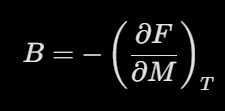
This is a classic exam favorite. If you can track the variables, you can solve any system they throw at you.
Thermodynamic Potentials For RPSC Assistant Professor: Common Misconceptions
As per Thermodynamic potentials, a very common trap that catches bright students off guard is treating internal energy (U) as just another generic thermodynamic potential without context. You will sometimes see the absolute wrong assumption written as U = TS. That is a huge red flag! It completely misrepresents how these variables interact.
The actual relationship is differential: dU = ΔQ – ΔW. Internal energy only acts as a true thermodynamic potential when it is written specifically as a function of its natural variables: entropy (S) and volume (V).
To keep these straight, the team at VedPrep highly recommends memorizing the classic Thermodynamic Born Square. It is a simple visual tool that acts as a cheat sheet for exam day:
V ——- A ——- T
| |
| |
U G
| |
| |
S ——- H ——- P
Here is how you read it at a glance:
- The potentials (A, G, H, U) sit on the sides.
- The natural variables for any potential are the two corners flanking it. For example, G sits between T and P, meaning G = G(T, P).
- U sits between S and V, meaning U = U(S, V).
If you try to write internal energy in terms of temperature and pressure without a massive transformation, it loses its power to easily give you the rest of the system’s properties.
Thermodynamic Potentials For RPSC Assistant Professor Applications in Power Plant Design
Let’s ground this in reality. Why do engineers care so much about Thermodynamic potentials? Look at how a steam power plant operates.
Imagine a fictional, simplified power station. Water enters a massive boiler, turns to high-pressure steam, spins a giant turbine to generate electricity, and then cools back down in a condenser.
[ Boiler ] —> ( High-Enthalpy Steam ) —> [ Turbine ] —> ( Electricity )
^ |
| v
[ Pump ] <— ( Low-Enthalpy Liquid ) <— [ Condenser ]
To find out exactly how much electricity we can squeeze out of that turbine, engineers don’t look at internal energy alone. Because the steam is moving through pipes under immense pressure and changing its volume drastically, they map out the Enthalpy (H = U + pV) at every single stage.
By measuring the drop in enthalpy from the moment the steam hits the turbine blades to the moment it leaves, engineers calculate the maximum possible efficiency. If the enthalpy drop isn’t big enough, energy is being wasted as stray heat, signaling that the system needs optimization.
Thermodynamic Potentials For RPSC Assistant Professor Exam Strategy: Tips for Solving Thermodynamic Potentials Questions
When you are sitting in the exam hall, time is your scarcest resource. Here is a straightforward roadmap to tackle these questions calmly:
- Identify the Constraints First: Look at what the question keeps constant. Is it an isolated system (constant U, V)? Is it at constant temperature and pressure (constant T, P)?
- Match the Potential: Match the constants to the natural variables of your potentials. If the problem states an experiment happens at constant T and V, immediately switch your brain to Helmholtz free energy (A).
- Deploy Maxwell’s Relations: Use the partial derivatives from your Born square to swap out hard-to-measure properties (like entropy) with easy-to-measure ones (like thermal expansion or heat capacity).
We have put together a quick-reference table to keep these locked in your memory:
| Thermodynamic Potential | Formula | Natural Variables | Equilibrium Condition (At Constants) |
| Internal Energy (U) | dU = TdS – pdV | S, V | Minimized at constant S, V |
| Enthalpy (H) | H = U + pV | S, P | Minimized at constant S, P |
| Helmholtz Free Energy (A) | A = U – TS | T, V | Minimized at constant T, V |
| Gibbs Free Energy (G) | G = H – TS | T, P | Minimized at constant T, P |
If you want to see these derivations done live, you can check out the free VedPrep video lectures online where we break down the calculus step-by-step without the fluff.
Thermodynamic Potentials For RPSC Assistant Professor Additional Resources: VedPrep Study Materials
Getting a solid grip on equations of state and thermodynamic systems takes practice. It is one thing to read through a table, and another to apply it when the clock is ticking down in a competitive exam.
To help smooth out that learning curve, VedPrep offers a curated set of study notes, targeted question banks, and video walk-throughs designed specifically around the recurring patterns of the RPSC syllabus. We focus squarely on the core areas that examiners love to test, giving you a clear path to build up your speed and accuracy.
Final Thoughts
Wrapping your head around thermodynamic potentials doesn’t have to feel like decoding an ancient language. At the end of the day, these functions are just highly efficient tools designed to help you map out energy changes without getting lost in the microscopic weeds. As you push forward with your RPSC Assistant Professor preparation, focus on mastering the natural variables and leaning on visual aids like the Born Square to keep your derivations straight.
To know more in detail from our faculty, watch our YouTube video:
Frequently Asked Questions
What is internal energy?
Internal energy is the total energy within an isolated system, including kinetic energy, potential energy, and other forms of energy. It is a thermodynamic potential.
What is the difference between enthalpy and internal energy?
Enthalpy and internal energy differ by the product of pressure and volume. Enthalpy includes the energy required to expand or contract a system against an external pressure.
What is Helmholtz free energy?
Helmholtz free energy is a thermodynamic potential that measures the maximum work that can be extracted from a system at constant temperature and volume.
What is Gibbs free energy?
Gibbs free energy is a thermodynamic potential that measures the maximum work that can be extracted from a system at constant temperature and pressure.
What are the units of thermodynamic potentials?
The units of thermodynamic potentials are typically joules (J) or calories (cal).
How are thermodynamic potentials applied in RPSC Assistant Professor exams?
Thermodynamic potentials are crucial in solving problems related to energy changes in systems, which are common in RPSC Assistant Professor exams.
What types of problems involving thermodynamic potentials can I expect in the exam?
Expect problems involving calculations of internal energy, enthalpy, Helmholtz free energy, and Gibbs free energy under various conditions.
How do I solve thermodynamic potential problems?
Solving these problems involves applying definitions, equations of state, and Maxwell relations to find the required thermodynamic potential.
What are common mistakes when working with thermodynamic potentials?
Common mistakes include confusing the definitions of different potentials, misapplying equations of state, and neglecting to account for all energy changes.
How can I avoid mistakes in thermodynamic potential calculations?
Carefully identify the given conditions, choose the appropriate potential, and ensure correct unit conversions.
What is a common misconception about Gibbs free energy?
A common misconception is that Gibbs free energy is a measure of energy available to do work; it actually measures the maximum work at constant temperature and pressure.
What are the implications of thermodynamic potentials in non-equilibrium systems?
In non-equilibrium systems, thermodynamic potentials can help predict the direction of spontaneous processes and the stability of systems.
How do thermodynamic potentials relate to statistical mechanics?
Thermodynamic potentials can be derived from statistical mechanics, providing a bridge between microscopic and macroscopic descriptions of systems.
What is the role of thermodynamic potentials in phase transitions?
Thermodynamic potentials help describe and predict phase transitions by identifying the conditions under which phases are stable or metastable.