

Cracking the RPSC Assistant Professor exam isn’t just about memorizing formulas; it’s about mastering how to slice through complex problems under time pressure. In the physical chemistry section (specifically Unit 2: Thermodynamics), Maxwell’s relations stand out as a major scoring area.
If you look at the official syllabus, this isn’t just a minor topic—it is a cornerstone that bridges the gap between abstract mathematical derivatives and measurable laboratory data. For an in-depth study, standard textbooks like Atkins’ Physical Chemistry by Peter Atkins and Julio de Paula, or Thermodynamics: Principles and Applications by C. H. Sonntag and F. J. Van Wylen are excellent companions. Here at VedPrep, we often see students get overwhelmed by these equations, but once you see the pattern, they become your quickest path to solid marks.
Understanding Maxwell’s relations is vital for competitive exams like CSIR NET, IIT JAM, CUET PG, and GATE. These four equations relate the second partial derivatives of fundamental properties like internal energy, entropy, pressure, volume, and temperature. Let’s break down exactly how they work and how you can ace them on exam day.
Understanding Maxwell’s Relations For RPSC Assistant Professor
At their core, Maxwell’s relations are a set of four thermodynamic equations derived from the calculus of exact differentials. Because thermodynamic state functions like internal energy (U) are mathematically “well-behaved,” the order in which you take partial second derivatives doesn’t matter (Euler’s reciprocity relation).
The four fundamental Maxwell’s relations are:
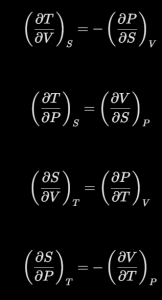
The physical significance of these equations lies in their power to swap out hard-to-measure quantities for things we can actually track in a lab. Imagine trying to measure the change in entropy (S) as a gas expands at a constant temperature. There is no “entropy meter” you can just plug into a beaker. But by using the third relation, you can substitute that mystery value with the change in pressure over a change in temperature at a constant volume—two things you can easily measure with a basic pressure gauge and thermometer.
Maxwell’s Relations Worked Example For RPSC Assistant Professor
Let’s see how this works in practice with a classic exam-style problem.
Problem:
A thermodynamic system follows the ideal gas equation of state, pV = RT. The entropy S is a function of T and V. Find the expression for (∂S/∂V)T using Maxwell’s relations.
Solution:
If we write out the total differential for entropy as a function of temperature and volume, we get:
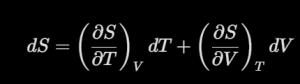
Looking at our Maxwell’s relations, we know that:
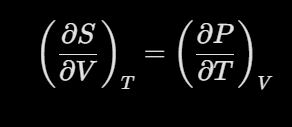
Now, let’s use our equation of state, p = RT/V. If we differentiate this with respect to T while keeping V constant, we get:
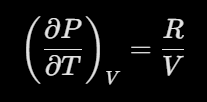
We know from the ideal gas law that R = pV/T. Let’s plug that back in:
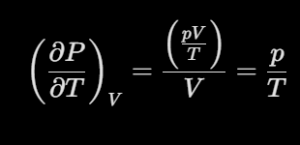
So, our final answer is:
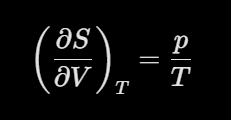
By matching the theoretical Maxwell relation with a standard equation of state, we easily solved the derivative without any guesswork.
Common Misconceptions
A huge trap that trips up many aspirants is treating these four equations as interchangeable. It is easy to look at a complicated problem and randomly throw a Maxwell relation at it, hoping something sticks.
This mix-up usually happens when we forget where these equations come from. Each Maxwell relation is born from a specific thermodynamic potential:
- Internal Energy (U): From dU = TdS – PdV
- Enthalpy (H): From dH = TdS + VdP
- Helmholtz Free Energy (A or F): From dA = -SdT – PdV
- Gibbs Free Energy (G): From dG = -SdT + VdP
The Fix: Don’t memorize the relations in isolation. Use a memory aid like the thermodynamic square (Max Born square) to remember which variables belong together. If a problem is held at constant temperature and volume, you are dealing with Helmholtz free energy, meaning only the third relation will do the trick.
Application of Maxwell’s Relations In RPSC Assistant Professor
To make these equations stick, it helps to see how they operate out in the real world. Let’s look at a couple of areas where these equations are used:
- Refrigeration and Air Conditioning: Imagine a team designing an eco-friendly cooling system. They need to know how a new refrigerant gas drops in temperature when it passes through an expansion valve under constant entropy (isentropic expansion). Instead of running dangerous, expensive trial-and-error tests at extreme pressures, they use the second Maxwell relation to calculate the exact cooling efficiency using basic volume and entropy data.
- Thermoelectric Phenomena: Researchers studying the Seebeck or Peltier effects rely on these exact partial derivatives to analyze how electrical currents and temperature gradients interact within a material, leading to the development of highly efficient solar cells or solid-state cooling devices.
For a future RPSC Assistant Professor, mastering these connections is essential. Not only will it help you clear your own exams, but it will also give you the depth of knowledge you need to explain these tricky concepts to your future university students.
Key Takeaways
- Maxwell’s relations turn abstract properties like entropy into manageable, measurable laboratory data.
- Each of the four equations belongs to a specific thermodynamic potential (U, H, A, G); they cannot be used randomly.
- These mathematical tools are fundamental for analyzing everything from industrial heat pumps to phase transitions in materials science.
Additional Resources
If you want to add some depth to your preparation, classic reference books are a fantastic place to start. Enrico Fermi’s Thermodynamics offers a beautifully clear, classic look at these principles, while Thermodynamics: An Interactive Introduction by Ben Schroeder provides great conceptual visuals.
If you are looking for structured guidance to tie it all together, we at VedPrep offer a variety of self-paced study materials, topic-wise practice questions, and direct video breakdowns of past paper problems to help you build confidence for the RPSC exam.
Final Thoughts
Conquering Maxwell’s relations is less about brutal memorization and more about recognizing the elegant symmetry underlying thermodynamics. Once you stop viewing these equations as isolated formulas and start seeing them as interchangeable keys designed to unlock hidden experimental data, your problem-solving speed will skyrocket. It is exactly this kind of conceptual clarity that sets successful candidates apart in high-stakes competitive exams. Keep practicing the derivations, lean on your memory shortcuts during mock tests, and remember that mastering these fundamentals now will not only secure your marks on exam day but will also lay a rock-solid foundation for your future career as an educator.
To know more in detail from our faculty, watch our YouTube video:
Frequently Asked Questions
Why are Maxwell's relations important?
Maxwell's relations are crucial in thermodynamics as they enable the calculation of difficult-to-measure quantities from more easily measured ones. They also help in deriving various thermodynamic equations and are fundamental to understanding the behavior of physical systems.
What are the four Maxwell's relations?
The four Maxwell's relations are: (∂T/∂V)S = -(∂P/∂S)V, (∂T/∂P)S = (∂V/∂S)P, (∂S/∂V)T = (∂P/∂T)V, and (∂S/∂P)T = -(∂V/∂T)P. These relate temperature, volume, pressure, and entropy.
How are Maxwell's relations derived?
Maxwell's relations are derived from the differential forms of thermodynamic potentials and the symmetry of second partial derivatives. This involves using the definitions of internal energy, enthalpy, Helmholtz free energy, and Gibbs free energy.
What is the basis of Maxwell's relations?
The basis of Maxwell's relations is the concept that the order of taking partial derivatives does not affect the result. This mathematical principle is applied to thermodynamic properties to derive the relations.
What are the implications of Maxwell's relations in thermodynamics?
Maxwell's relations have significant implications in thermodynamics as they provide a powerful tool for deriving relationships between different thermodynamic properties. This enhances our ability to predict and analyze the behavior of physical and chemical systems.
How do Maxwell's relations relate to symmetry in physics?
Maxwell's relations reflect a deeper symmetry in physics, specifically the symmetry of second derivatives. This symmetry is a fundamental property that underlies many physical laws and is crucial for the formulation of thermodynamic theories.
How to apply Maxwell's relations in RPSC Assistant Professor exam?
In the RPSC Assistant Professor exam, Maxwell's relations can be applied to solve problems related to thermodynamic systems. Understanding how to derive and use these relations is essential for answering both theoretical and numerical questions accurately.
What type of questions are asked from Maxwell's relations in exams?
Questions from Maxwell's relations in exams like RPSC Assistant Professor typically include deriving the relations, applying them to find specific thermodynamic properties, and understanding their implications in various physical and chemical processes.
How to solve problems using Maxwell's relations?
To solve problems using Maxwell's relations, one should start by identifying the given information and what needs to be found. Then, apply the appropriate Maxwell's relation to relate the known and unknown quantities, and solve for the required property.
What are common mistakes in using Maxwell's relations?
Common mistakes include incorrect derivation of the relations, misapplication in solving problems, and confusion between different thermodynamic potentials. It's also crucial to ensure the correct signs and partial derivatives are used.
How to avoid errors in Maxwell's relations?
To avoid errors, one should have a clear understanding of thermodynamic principles, carefully derive each relation, and consistently apply them in problem-solving. Practice with a variety of problems is also essential.
How do Maxwell's relations apply to physical and organic systems?
Maxwell's relations have wide applications in both physical and organic systems, particularly in understanding phase transitions, chemical equilibria, and the behavior of materials under different conditions. They are fundamental to advanced studies in thermodynamics.
Can Maxwell's relations be used in non-equilibrium thermodynamics?
While Maxwell's relations are traditionally derived for equilibrium thermodynamics, their application and generalization to non-equilibrium conditions are areas of active research. They provide a foundation for understanding more complex thermodynamic phenomena.
What are the limitations of Maxwell's relations?
The limitations of Maxwell's relations include their derivation based on equilibrium conditions and their applicability to systems where thermodynamic properties are continuous and well-defined. They may not directly apply to systems far from equilibrium or with complex internal structures.