




Mastering Lipids for CSIR NET Life Sciences 2026: Comprehensive Guide to Structure, Metabolism, and Clinical Biochemistry
The CSIR NET Life Sciences examination is the most prestigious gateway for aspiring researchers and lecturers in India. As we approach the 2026 examination cycle, candidates must adopt a highly strategic approach to Unit 1: Molecules and their Interaction Relevant to Biology. Among the various biomacromolecules, the biochemistry of hydrophobic cellular components often poses a unique challenge. Unlike proteins or nucleic acids, which are linear polymers of defined monomers, this class of molecules represents a highly diverse group of compounds defined primarily by their insolubility in water.
For the CSIR NET 2026 aspirant, superficial knowledge is no longer sufficient. The National Testing Agency (NTA) has shifted its focus towards deep, analytical questions in Part C, requiring a thorough understanding of membrane thermodynamics, complex metabolic cascades, and clinical pathologies. This exhaustive 3000-word guide is meticulously crafted to cover every dimension of these essential biomolecules, ensuring you are fully equipped to tackle both memory-based Part B questions and complex experimental scenarios in Part C.
Understanding the Foundational Classification for CSIR NET
To master the advanced biochemical concepts tested in the exam, one must first establish a solid framework of classification. Historically, Bloor (1943) classified these hydrophobic compounds into three primary categories: simple, compound, and derived. While modern biochemistry has expanded on this, Bloor’s framework remains a foundational concept for competitive exams.
Simple Esters: The Energy Storehouses
[Image of triglyceride chemical structure]
Simple forms of these molecules are defined structurally as esters of fatty acids and alcohol without any additional group. This category encompasses diverse biological structures, including true fats, wax, cutin, and suberin.
The most prominent members of this group are the true fats, also known as neutral fats or triglycerides. Biochemically, these are esters of fatty acids linked to the 3-carbon trihydric alcohol, glycerol (also known as glycerine). They are the commonest forms found in nature and are further classified as either fats or oils, depending entirely on whether they exist as solid (fats) or liquid (oils) at a standard room temperature of 20°C.
The state of matter is dictated by the chemical nature of the hydrocarbon chains. The higher the proportion of unsaturated fatty acids, the more likely they are to be liquid at a given temperature. For example, butter and its clarified form, ghee, remain semi-solid at room temperature due to the presence of a higher concentration of short-chain fatty acids. Conversely, vegetable ghee is manufactured as a hard fat through an industrial process; this is achieved by the conversion of unsaturated fatty acids into saturated ones during the hydrogenation of oil.
A critical chemical property of triglycerides is their lack of polarity. Because triglycerides are completely non-polar, they do not form hydrogen bonds with water molecules and therefore do not dissolve in water. This extreme hydrophobicity makes them the perfect anhydrous storage medium for cellular energy, a concept frequently tested in CSIR NET bioenergetics questions.
Compound (Conjugated) Biomolecules: The Structural Pioneers
Compound or conjugated forms contain additional functional groups in addition to fatty acids and alcohol. This addition of polar or charged groups fundamentally alters their physical properties, giving them an amphipathic nature (having both hydrophilic and hydrophobic regions).
This category includes some of the most biologically significant molecules, such as phospholipids, sphingomyelins, glycolipids, sulpholipids, and lipoproteins. Because of their amphipathic geometry, these conjugated molecules spontaneously self-assemble into bilayers in aqueous environments, forming the fundamental structural basis of all cellular membranes.
Derived Forms and Neutral Molecules
The third classical category comprises derived molecules, which are essentially derivatives of the parent substances or molecules that exhibit similar solubility characteristics. This vast group includes steroids and sterols like cholesterol, fat-soluble vitamins, fat-soluble hormones, terpenes, and prostaglandins.
In biochemical terms, true fats, cholesterol, and other uncharged hydrophobic molecules are collectively referred to as neutral molecules.
Deep Dive into Fatty Acids: The Building Blocks
Fatty acids are the fundamental hydrocarbon chains that serve as the building blocks for more complex cellular structures. For the 2026 examination, candidates must be highly proficient in fatty acid nomenclature and the physical consequences of their chemical structures.
Nomenclature and Structure
A fatty acid consists of a hydrocarbon chain terminating in a carboxylic acid group. The standard nomenclature (e.g., 18:1Δ9) provides immense structural information. The first number represents the total number of carbon atoms (18), the second indicates the number of double bonds (1), and the delta (Δ) symbol specifies the exact carbon atom where the double bond begins (carbon 9).
CSIR NET frequently tests the distinction between naturally occurring cis-double bonds and industrial trans-double bonds. In biological systems, almost all unsaturated fatty acids possess double bonds in the cis configuration, which introduces a rigid 30-degree “kink” or bend in the hydrocarbon chain.
Melting Points and Physical State
The melting point of a fatty acid is a recurring theme in Part B matching questions. Two primary rules dictate the melting point:
- Chain Length: As the hydrocarbon chain length increases, the van der Waals interactions between adjacent chains increase, thereby raising the melting point.
- Degree of Unsaturation: This is the dominant factor. The introduction of cis double bonds creates kinks that prevent the molecules from packing tightly together in a crystalline array. Consequently, unsaturated fatty acids have significantly lower melting points than their saturated counterparts of the same length.
Membrane Architecture: The Fluid Mosaic Dynamics
[Image of fluid mosaic model of cell membrane]
For the CSIR NET exam, membrane biology is a high-yield zone. The cell membrane is not a static barrier but a highly dynamic, two-dimensional liquid. The structural backbone of this barrier is formed by conjugated biomolecules, primarily glycerophospholipids and sphingolipids.
Glycerophospholipids
These are the most abundant constituents of cell membranes. They consist of a glycerol-3-phosphate backbone esterified to two fatty acids at the C1 and C2 positions, with a highly polar head group attached via a phosphodiester linkage.
The nature of the head group defines the specific identity and function of the molecule:
- Phosphatidylcholine (PC) and Phosphatidylethanolamine (PE): The major structural components of eukaryotic membranes.
- Phosphatidylserine (PS): Typically restricted to the inner (cytosolic) leaflet of the plasma membrane. Its externalization to the outer leaflet serves as an “eat me” signal for macrophages during apoptosis, a highly testable concept in developmental biology and immunology.
- Phosphatidylinositol (PI): Present in minor quantities but plays a massive role in intracellular signaling. Upon cleavage by Phospholipase C, PI(4,5)P2 yields Inositol triphosphate (IP3) and Diacylglycerol (DAG), triggering calcium release and cellular activation.
Sphingolipids
Unlike glycerophospholipids, sphingolipids do not contain glycerol. Instead, their backbone is formed by sphingosine, a long-chain amino alcohol. When a fatty acid is attached to the amino group of sphingosine via an amide linkage, it forms a ceramide—the structural parent of all sphingolipids.
Sphingomyelins are a prominent subclass that play a critical structural role; they are heavily concentrated in the myelin sheath surrounding nerve cell axons, facilitating rapid saltatory conduction of nerve impulses.
Cholesterol and Steroid Derivatives: The Master Regulators
[Image of cholesterol chemical structure]
Cholesterol is a critical derived molecule that plays a staggering number of biological roles. NTA frequently targets the physiological functions and pathological consequences of cholesterol metabolism in Part C data interpretation questions.
Structural and Physiological Functions
Cholesterol is an indispensable component of cell membranes in animals and wall-less bacteria called mycoplasma. Its unique fused-ring structure acts as a bidirectional regulator of membrane fluidity: at high temperatures, it restricts the movement of hydrocarbon chains (decreasing fluidity), while at low temperatures, it prevents tight packing (increasing fluidity).
Beyond its structural role, cholesterol is the essential biochemical precursor for a vast array of critical molecules. It helps in the formation of bile salts and bile acids, which are required for the emulsification and digestion of dietary fats in the intestine. It plays a critical role in cellular stability, as it prevents the premature breakdown of erythrocytes.
Furthermore, the precursor molecules of cholesterol are converted to form vitamin D near the surface of irradiated skin under the influence of ultraviolet sunlight. It also indirectly promotes the absorption of fatty acids in the digestive tract.
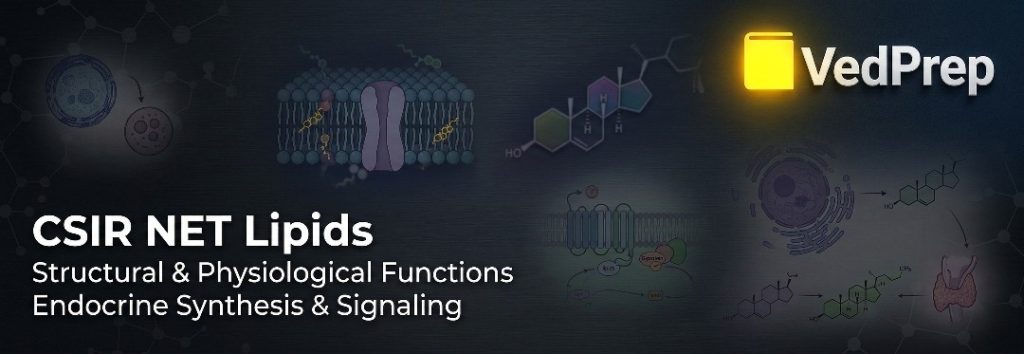
Endocrine Synthesis and Signaling
The endocrine system relies entirely on cholesterol for the synthesis of steroid hormones. In the adrenal glands, it forms vital steroid hormones, viz. cortisol (the primary stress hormone), cortisone, and aldosterone (which regulates sodium and blood pressure). In the gonads, it acts as the precursor to produce sex hormones including progesterone, estrogen (the primary female sex hormones), and testosterone (the primary male sex hormone).
The evolutionary conservation of cholesterol as a signaling precursor extends beyond vertebrates. In insects, for example, the crucial moulting hormone ecdysone is formed directly from cholesterol.
Pathological Consequences of Cholesterol
When cholesterol homeostasis goes awry, it leads to severe clinical pathologies, a favorite topic for CSIR NET applied biology sections. Due to its extreme insolubility, cholesterol sometimes crystallizes in the gall bladder and produces painful gall stones.
More severely, in the cardiovascular system, upon combination with a saturated fatty acid, cholesterol forms yellowish plaques in the walls of large and medium-sized arteries. Over time, these arterial walls become thick, fibrotic, and calcified. This dangerous pathophysiological phenomenon is called atherosclerosis, which physically narrows the lumen of arteries, resulting in a significantly reduced flow of blood.
Lipoproteins: The Macromolecular Transport Vehicles
Because hydrophobic molecules cannot dissolve in the aqueous environment of the bloodstream, they require specialized transport vehicles. These transporters are complex biomolecules formed of triglycerides, phospholipids, cholesterol, and specific apolipoproteins. These macromolecular assemblies ensure that dietary and synthesized fats are transported in blood plasma and lymph in the form of lipoproteins. Furthermore, all cellular membranes also incorporate elements of lipoprotein structure within their dynamic architecture.
Classification of Lipoproteins
For the CSIR NET 2026 exam, you must clearly distinguish between the four primary types of lipoproteins based on their density, lipid cargo, and physiological function:
- Chylomicrons: These are the largest and least dense of the lipoproteins. They are synthesized in the intestinal mucosa and exclusively transport dietary (exogenous) triglycerides to peripheral tissues like muscle and adipose tissue.
- Very Low-Density Lipoproteins (VLDL): Synthesized in the liver, VLDL is responsible for transporting endogenous (liver-synthesized) triglycerides to peripheral tissues.
- Low-Density Lipoproteins (LDL): Formed in the bloodstream from the remnants of VLDL. LDL is the primary carrier of cholesterol to extrahepatic tissues. Elevated levels of LDL are highly atherogenic (plaque-forming).
- High-Density Lipoproteins (HDL): Synthesized in the liver and intestine, HDL performs “reverse cholesterol transport.” It scavenges excess cholesterol from peripheral tissues and atherosclerotic plaques, returning it to the liver for excretion as bile acids. Thus, HDL is clinically considered the “good” carrier.
A crucial function of these vehicles is that they transport fat to the liver for systemic metabolism.
Core Metabolic Pathways for CSIR NET 2026
The bioenergetics of fat breakdown and the enzymology of fat synthesis are central to the biochemistry syllabus. You must be prepared for numerical calculations regarding ATP yield and enzyme regulation scenarios.
Beta-Oxidation of Fatty Acids
Fatty acids are the most energy-dense macromolecules in the human body. Their breakdown occurs strictly within the mitochondrial matrix via a cyclic process known as β-oxidation.
Before entering the mitochondria, the fatty acid must be “activated” in the cytosol by attachment to Coenzyme A, forming Acyl-CoA (consuming the equivalent of 2 ATP). Because the inner mitochondrial membrane is impermeable to long-chain Acyl-CoA, the molecule must be shuttled across via the Carnitine Shuttle. This transport step is the rate-limiting, committed step of fat oxidation and is highly regulated (inhibited by Malonyl-CoA).
Once inside, the β-oxidation cycle proceeds in four recurring enzymatic steps:
- Oxidation by Acyl-CoA dehydrogenase (generates FADH2).
- Hydration by Enoyl-CoA hydratase.
- Oxidation by β-hydroxyacyl-CoA dehydrogenase (generates NADH).
- Thiolysis by Thiolase (cleaves off a 2-carbon Acetyl-CoA).
Biosynthesis of Fatty Acids
Unlike breakdown, which occurs in the mitochondria, the biosynthesis of these chains occurs in the cytosol. It is not merely the reversal of β-oxidation; it uses a completely different set of enzymes and coenzymes.
The process begins with Acetyl-CoA, which is exported from the mitochondria to the cytosol via the Citrate Shuttle. The committed, rate-limiting step is the carboxylation of Acetyl-CoA to Malonyl-CoA, catalyzed by the enzyme Acetyl-CoA Carboxylase (ACC). ACC is highly regulated: it is activated by citrate and insulin, and inhibited by palmitoyl-CoA, glucagon, and epinephrine.
The actual assembly of the carbon chain is performed by a massive multi-enzyme complex called Fatty Acid Synthase (FAS), which sequentially adds two-carbon units from Malonyl-CoA to the growing chain, utilizing NADPH as the reducing agent.
Eicosanoids: The Paracrine Signaling Molecules
Eicosanoids are a highly specialized class of derived signaling molecules produced from the 20-carbon polyunsaturated essential fatty acid, arachidonic acid. Unlike endocrine hormones that travel through the blood, eicosanoids act as paracrine hormones, exerting profound effects on tissues immediately surrounding their site of synthesis.
The CSIR NET exam frequently tests the enzymatic pathways that generate these molecules:
- Prostaglandins: Synthesized via the Cyclooxygenase (COX) pathway. They regulate inflammation, pain, fever, and the sleep-wake cycle. Non-Steroidal Anti-Inflammatory Drugs (NSAIDs) like aspirin and ibuprofen exert their effects by irreversibly or reversibly inhibiting the COX enzyme.
- Thromboxanes: Also synthesized via the COX pathway, these molecules are produced primarily by platelets. They act as potent vasoconstrictors and facilitate platelet aggregation during blood clotting.
- Leukotrienes: Synthesized via the Lipoxygenase pathway. These are powerful biological signals that induce smooth muscle contraction in the airways lining the lungs. Overproduction of leukotrienes is a major underlying cause of severe asthmatic attacks.
Clinical Biochemistry: Sphingolipid Storage Diseases
In Part C of the CSIR NET, examiners love to present clinical case studies. A high-yield topic involves genetic defects in the lysosomal enzymes responsible for the degradation of complex membrane structures, specifically sphingolipids. When these specific hydrolase enzymes are mutated or absent, the precursor molecules accumulate to toxic levels inside the lysosomes, leading to severe neurodegenerative disorders collectively known as Sphingolipidoses.
For 2026, candidates must memorize the specific enzyme deficiency associated with each disease:
- Tay-Sachs Disease: Caused by a deficiency in the enzyme Hexosaminidase A. This leads to a massive accumulation of Ganglioside GM2 in the brain, resulting in progressive neurodegeneration, blindness, and early childhood death. A classic clinical sign is a “cherry-red spot” on the macula of the retina.
- Niemann-Pick Disease: Caused by a genetic defect in the enzyme Sphingomyelinase. This results in the toxic accumulation of sphingomyelin in the brain, spleen, and liver, causing severe mental retardation and hepatosplenomegaly.
- Gaucher’s Disease: The most common lysosomal storage disorder, caused by a defect in Glucocerebrosidase. This leads to the accumulation of glucocerebrosides. Unlike Tay-Sachs, Gaucher’s can present in adults and often involves severe bone pain and enlarged abdominal organs.
- Krabbe’s Disease: Caused by a deficiency in Glucocerebrosidase, leading to the accumulation of Glucocerebrosidase, severely impacting the myelin sheaths of the nervous system.
Propel Your Academic Career with VedPrep
The sheer depth and breadth of the CSIR NET Life Sciences syllabus can feel overwhelming. From the thermodynamic calculations of membrane fluidity to the intricate regulatory mechanisms of cholesterol biosynthesis, self-study alone often leaves critical conceptual gaps. This is precisely where VedPrep steps in as your ultimate academic catalyst for the 2026 examination cycle.
At VedPrep, we do not believe in rote memorization. We understand that the CSIR NET demands profound analytical thinking and experimental reasoning. Our elite faculty, comprising top rankers and seasoned academicians, meticulously breaks down complex biochemical pathways into intuitive, logical frameworks.
Why Choose VedPrep for CSIR NET 2026?
- Hyper-Targeted Curriculum: Our study materials and live interactive lectures are specifically curated around the latest shifting trends of the NTA, ensuring you spend time only on high-yield, exam-relevant concepts.
- Part C Mastery: We specialize in experimental biology and data interpretation. Through rigorous scenario-based problem-solving sessions, we train your brain to approach questions exactly like a research scientist.
- Simulated Mock Tests: Our All-India Test Series perfectly mirrors the exact interface, difficulty gradient, and negative marking scheme of the actual CSIR NET exam, providing you with real-time, AI-driven analytics to identify and eliminate your weak areas.
- 24/7 Mentorship: From doubt clearance at midnight to personalized psychological counseling to manage exam anxiety, our mentors stand by you throughout your preparation journey.
Don’t leave your Junior Research Fellowship dreams to chance. Partner with VedPrep today, refine your scientific strategy, and confidently secure your rank in India’s premier research institutes.
Conclusion
The study of hydrophobic biomolecules is a fascinating journey that stretches from the simple physical chemistry of hydrocarbon chains to the incredibly complex orchestration of cellular signaling, energy metabolism, and human disease. For the CSIR NET 2026 aspirant, mastering this topic is an absolute non-negotiable requirement.
Success in this unit requires a dual-pronged strategy: meticulous memorization of specific structures, enzyme names, and transporter classifications, paired seamlessly with the analytical ability to interpret complex experimental data involving membrane dynamics and metabolic blocks. By understanding the evolutionary “why” behind these biochemical processes rather than just the “what,” you will develop the scientific intuition required to excel in the most challenging sections of the exam.
Stay deeply consistent in your revision, practice previous years’ experimental questions rigorously, and trust your preparation strategy. The world-class laboratories of India’s top research and development institutes are waiting for brilliant, analytical minds like yours. Focus your efforts, leverage expert guidance, and conquer the CSIR NET Life Sciences 2026 exam!
Frequently Asked Questions (FAQs)
Why is lipid biochemistry a critical topic for the CSIR NET 2026 exam?
Ans: The National Testing Agency (NTA) has shifted its focus toward deep, analytical questions in Part C. Candidates need a thorough understanding of membrane thermodynamics, metabolic cascades, and clinical pathologies of these hydrophobic components rather than just superficial knowledge.
How are lipids fundamentally classified?
Ans: Historically, Bloor (1943) classified these hydrophobic compounds into three primary categories: simple, compound, and derived.
What determines if a simple lipid is a solid fat or a liquid oil at room temperature?
Ans: The state of matter is entirely dictated by the chemical nature of the hydrocarbon chains. The higher the proportion of unsaturated fatty acids, the more likely the substance is to be liquid at a given temperature.
How does a cis-double bond affect the physical structure of a fatty acid?
Ans: In biological systems, unsaturated fatty acids typically have cis-double bonds, which introduce a rigid 30-degree "kink" or bend in the hydrocarbon chain. This kink prevents tight packing and significantly lowers the melting point.
What role does Phosphatidylserine (PS) play in cellular apoptosis?
Ans: Phosphatidylserine is typically restricted to the inner (cytosolic) leaflet of the plasma membrane. When a cell undergoes apoptosis, PS externalizes to the outer leaflet, serving as an "eat me" signal for macrophages.
How does cholesterol act as a "master regulator" of membrane fluidity?
Ans: Cholesterol's unique fused-ring structure acts as a bidirectional regulator. At high temperatures, it decreases fluidity by restricting the movement of hydrocarbon chains, while at low temperatures, it prevents tight packing to increase fluidity.
What is the difference between LDL and HDL lipoproteins?
Ans: Low-Density Lipoproteins (LDL) carry cholesterol to extrahepatic tissues and are highly atherogenic (plaque-forming). High-Density Lipoproteins (HDL) perform "reverse cholesterol transport" by scavenging excess cholesterol from peripheral tissues and returning it to the liver for excretion, making it the "good" carrier.
Where does the breakdown of fatty acids occur in the cell?
Ans: The breakdown of fatty acids occurs strictly within the mitochondrial matrix via a cyclic process known as $\beta$-oxidation. The fatty acid is shuttled across the inner mitochondrial membrane via the Carnitine Shuttle.
What is the net ATP yield from the complete $\beta$-oxidation of Palmitic acid?
Ans: The breakdown of the 16-carbon Palmitic acid yields a net of 106 ATP. This accounts for 8 Acetyl-CoA, 7 NADH, and 7 FADH2 processed through the TCA cycle and Oxidative Phosphorylation, minus the 2 ATP used for initial activation.
Is fatty acid biosynthesis just the reverse of $\beta$-oxidation?
Ans: No, it is not merely the reversal. While breakdown occurs in the mitochondria, biosynthesis occurs in the cytosol using a completely different set of enzymes and coenzymes.