





The Fourier Series expresses a periodic function as an unending total of sinusoids and cosines. This analytical instrument breaks down intricate wave motions into their basic frequency elements. It remains a central area within Mathematical Physics for the RPSC Assistant Professor Physics Paper II, facilitating the resolution of partial differential equations and signal processing.
Foundations of Fourier Series in Mathematical Methods of Physics
The Fourier Series offers the mathematical structure for examining recurring events. Employing this technique allows you to resolve any piecewise smooth periodic function into a sum of basic sinusoidal components. This breakdown proves crucial in Mathematical Physics techniques as it eases the investigation of phenomena like wave propagation and thermal transfer. For the RPSC Assistant Professor Physics Paper II, grasping the Dirichlet criteria is vital, as they guarantee a function can be properly represented by such a series. These prerequisites demand that the function be uniquely defined, have a limited quantity of peaks and troughs, and exhibit a finite number of jumps in value over a single cycle.
The typical way to show a function f(x) that repeats every 2π involves certain values. You determine these values by utilizing the unique relationship between sine and cosine functions. This method shifts a signal from its time or location perspective into its frequency makeup. For those studying for the RPSC Assistant Professor test, knowing how these values act for symmetrical (even) and mirror-image (odd) functions cuts down on the work needed. Even functions lead to a series made of cosines, whereas odd functions yield a series composed of sines.
Calculating Fourier Coefficients and General Formulas
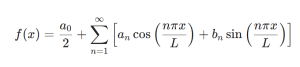
Physics Mathematical Techniques depend on exact integration to find the magnitude of every frequency part. The Fourier Series for a function f(x) across the range (c, c + 2L) requires an endless summation. You compute the fixed term and the multipliers for the regular oscillation terms by integrating the product of the function and the fundamental functions across a single complete cycle. Precision in these calculations is crucial for achieving good marks in the RPSC Assistant Professor Physics Paper II examination. The key formulas for the Fourier Series you must recall are presented in the table below.
For a function f(x) defined over an interval [c, c + 2L] with a period of T = 2L, the mathematical expression is:
Fourier Coefficients
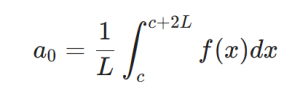
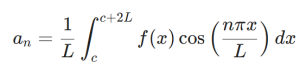
The constants a0, an, and bn are known as Fourier coefficients. You calculate them using the following integrals:
The average value (a0):
Cosine amplitudes (an):
Sine amplitudes (bn):
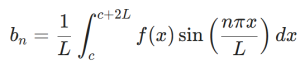
Convergence and Dirichlet Conditions for Physics Exams
A Fourier Series does not always converge to the value of the function at every point. In Mathematical Methods of Physics, you study the behavior of the series at points of discontinuity. If a function f(x) has a jump discontinuity at x = x0, the Fourier Series converges to the average value of the left hand and right hand limits. This phenomenon is a frequent topic in RPSC Assistant Professor Physics Paper II. You must recognize that while the series represents the function, the convergence is not necessarily uniform near these jumps. This leads to the Gibbs phenomenon where oscillations appear near the discontinuity.
The Dirichlet conditions serve as the gatekeeper for Fourier Series expansion. You need to verify that f(x) is absolutely integrable over a period. If the function is not square integrable, Parseval’s identity might not hold. In advanced Mathematical Methods of Physics, these conditions are relaxed using distribution theory, but for RPSC Assistant Professor Physics Paper II, the classical conditions remain the standard. Ensuring the function is periodic is the first step before applying any coefficient formulas. Without periodicity, you would use Fourier Transforms instead of a Fourier Series.
Practical Application: The Square Wave Expansion
Think about a square wave function frequently encountered in Mathematical Physics problems. A square wave, f(x) , takes the value of0 < x < π and -1 for -π < x < 0. Because this function is odd, the $a_0$ and $a_n$ terms vanish. Therefore, one only needs to determine the bn coefficients. The ensuing Fourier Series is composed solely of sine terms with odd integer multiples of the fundamental frequency. This particular instance is a common feature in the RPSC Assistant Professor Physics Paper II because it illustrates how summing an infinite series of odd frequency components constructs an abrupt, non-sinusoidal profile. The amplitude of these harmonics diminishes proportionally to 1/n, illustrating that higher frequencies contribute less to the final waveform’s appearance.
This extension demonstrates the main objective of Fourier Series: constructing intricate signals starting from basic components. Within the RPSC Assistant Professor Physics Paper II, you may need to determine the magnitude of this series at a particular location or employ it to obtain specific numerical values. VedPrep students often use these standard results to skip lengthy integrations during time pressured exams.
Complex Form of Fourier Series
The complex exponential form offers a more compact way to handle Fourier Series in Mathematical Methods of Physics. By using Euler’s formula, you replace sines and cosines with complex exponentials. This version uses a single coefficient, cn, which ranges from negative infinity to positive infinity. Physics problems involving quantum mechanics or electromagnetic theory frequently use this notation for its algebraic simplicity. For RPSC Assistant Professor Physics Paper II, you should be comfortable converting between the real trigonometric form and the complex exponential form. The complex coefficient cn relates directly to an and bn.
This form is particularly useful when dealing with phase shifts and power spectrum analysis. In Mathematical Methods of Physics, the square of the absolute value of cn represents the power in the nth harmonic. Understanding this relationship helps you solve energy related problems in RPSC Assistant Professor Physics Paper II more efficiently than using trigonometric identities.
Limitations and the Gibbs Phenomenon
A common mistake in applying Fourier Series is assuming perfect reconstruction of functions with sharp edges. In Mathematical Methods of Physics, you encounter the Gibbs phenomenon where the series overshoots the function value at a jump discontinuity by approximately 9 percent. No matter how many terms you add, this overshoot persists. This constraint is a crucial idea for the RPSC Assistant Professor Physics Paper II. It shows that although the Fourier Series converges in the mean square sense, it does not converge at the points of discontinuity. Recognizing this difference is essential when creating models for physical systems that involve abrupt shifts.
A further constraint arises when a function lacks periodicity. Trying to apply a Fourier Series to such a function necessitates artificially extending it. This extrapolation might introduce inaccuracies if the endpoints are managed improperly. Within Mathematical Methods of Physics, you address this by choosing the appropriate range for the expansion. If you choose an interval that does not match the physical constraints of the problem, the resulting Fourier Series will not represent the true physical state. VedPrep coaching emphasizes checking boundary conditions before starting any Fourier Series expansion for RPSC Assistant Professor Physics Paper II.
Application in RPSC Assistant Professor Physics Paper II
Candidates must also be prepared for problems involving Half Range Series. When dealing with these situations, function extension over the interval $(0, L)$ is done using either an all-sine or all-cosine expansion. This decision hinges on the physical constraints at the edges, like when a string is secured on both sides. The principles taught in Mathematical Methods of Physics dictate that a sine expansion is appropriate for fixed edges, whereas a cosine expansion is suitable for free ones. Recognizing these patterns allows you to solve RPSC Assistant Professor Physics Paper II questions with high speed and accuracy. VedPrep has a track record of producing AIR 1s by focusing on these high yield exam patterns.
Numerical Example: Expansion of x2
Let us examine the Fourier Series for f(x) = x2 in the interval (-π, π). This is an even function, so bn = 0. You calculate a0 as 2π2/3. The an coefficients involve integration by parts, resulting in 4(-1)n/n2. The series becomes  . This specific example is important because it allows you to derive the sum of famous series. For instance, by setting x = π, you can prove that the sum of 1/n2 equals π2/6. Such derivations are frequent in Mathematical Methods of Physics and RPSC Assistant Professor Physics Paper II.
This example demonstrates how the Fourier Series smooths out the function. Even with a small number of terms, the series provides a close approximation to the parabolic shape. For the RPSC Assistant Professor Physics Paper II, you might encounter questions requiring you to pinpoint coefficients or determine the value of a resulting numerical sequence. Working through these common expansions aids in developing the necessary feel for Mathematical Methods in Physics. VedPrep furnishes pupils with excellent materials to excel in these computations for physics entrance tests.
Conclusion
Grasping the Fourier Series is essential for success on the RPSC Assistant Professor Physics Paper II. This mathematical structure enables you to connect intricate, repeating signals with their basic sinusoidal parts, offering the insight needed to tackle sophisticated challenges in both wave mechanics and thermodynamics. Through understanding the Dirichlet criteria, calculating the coefficients, and recognizing the implications of the Gibbs phenomenon, you establish a strong basis for the academic competition ahead. VedPrep delivers thorough instruction and specialist materials to aid your command of these Mathematical Methods of Physics and secure a high position in the RPSC Assistant Professor selection process.
To learn more in detail from our expert faculty, watch our YouTube video:
Frequently Asked Questions (FAQs)
Why is periodicity required for Fourier Series?
Fourier Series relies on the repetition of values over a fixed interval. The sines and cosines used in the expansion are periodic by nature. Without a defined period, the integration used to find coefficients would not yield discrete frequency components. Non periodic functions require Fourier Transforms instead.
What are the Dirichlet conditions?
Dirichlet conditions are criteria a function must meet to have a valid Fourier Series. The function must be periodic and single valued. It should have a finite number of maxima, minima, and finite discontinuities within one period. Meeting these ensures the series converges to the function value.
What is the role of orthogonality in Fourier Series?
Orthogonality ensures that the integral of the product of two different basis functions over a period is zero. This property allows you to isolate and calculate individual coefficients an and bn. It simplifies complex mathematical methods of physics into manageable independent components for exam calculations.
How does Fourier Series assist in solving the heat equation?
The Fourier Series decomposes initial temperature distributions into harmonic modes. Since the heat equation is linear, you solve for each mode separately. Combining these solutions provides the total temperature profile over time. This technique is a high weightage topic for RPSC Assistant Professor aspirants.
What is a Half Range Fourier Series?
A Half Range Series expands a function defined on an interval (0, L) into either a pure sine or cosine series. You achieve this by creating an artificial even or odd extension of the function. This method is standard for solving boundary value problems in physics.
What is the complex form of the Fourier Series?
The complex form uses exponential basis functions einx instead of trigonometric functions. It provides a compact representation using a single complex coefficient cn. This version is often preferred in quantum mechanics and advanced mathematical methods of physics for its algebraic efficiency.
Why does the Fourier Series overshoot at jump discontinuities?
This overshoot is known as the Gibbs phenomenon. The series fails to converge point wise at the exact location of a sharp transition. Even as you add more terms, a persistent 9 percent oscillation remains. You must account for this when modeling physical square waves.
What happens if a function is not absolutely integrable?
If a function is not absolutely integrable over its period, the Fourier coefficients may not exist. The integral for an or bn would fail to converge. Such functions do not satisfy Dirichlet conditions and cannot be represented by a standard Fourier Series in physics.
Why are my Fourier coefficients zero?
Coefficients often become zero due to function symmetry. If you integrate an odd function over a symmetric interval, the result is zero. Check if your function is even or odd before starting the integration process to avoid redundant work in competitive exams.
What is Parseval's Identity in Fourier Series?
Parseval's Identity relates the average power of a periodic signal to the sum of the squares of its Fourier coefficients. It proves that the total energy in the spatial domain equals the total energy in the frequency domain. This is a vital conservation law in physics.
How is the Fourier Series used in quantum mechanics?
Physicists use Fourier Series to represent wave functions in periodic potentials, such as electrons in a crystal lattice. This application leads to Bloch's Theorem. Understanding this connection is essential for the RPSC Assistant Professor Physics Paper II solid state section.
What is the relationship between Fourier Series and Hilbert Space?
Fourier Series viewing periodic functions as vectors in an infinite dimensional Hilbert Space. The sine and cosine functions act as an orthogonal basis. The coefficients are the projections of the function onto these basis vectors. This provides a geometric interpretation of physics.
Can you represent a delta function using Fourier Series?
Yes, a periodic train of Dirac delta functions can be expanded into a Fourier Series. The coefficients remain constant for all $n$, meaning the series contains all frequencies with equal weight. This is a fundamental concept in signal processing and impulse response analysis.