
Chirality and optical activity For CSIR NET exams refer to the ability of certain compounds to rotate plane-polarized light due to their non-superimposable mirror images, a concept critical for stereochemistry and organic chemistry.
Syllabus – Stereochemistry: Chirality and optical activity For CSIR NET
If you are gearing up for the CSIR NET exam, you already know that Unit 8 (Stereochemistry) is a massive goldmine for marks. This isn’t just a topic you can memorize the night before; Chirality and optical activity is also highly relevant for IIT JAM (Section D) and GATE.
Stereochemistry is all about studying molecules in three dimensions, specifically focusing on those that have non-superimposable mirror images. To score well in these competitive exams, you need to deeply understand how these molecules behave.
For an in-depth look, standard textbooks like Advanced Organic Chemistry by Jerry March and Michael Smith, or even classics like Lehninger for the biochemical side, are excellent resources. But let’s be honest—sometimes those heavy texts feel a bit dense when you are trying to figure out how a molecule actually spins in space. Here at VedPrep, we love breaking these tough concepts down into ideas that actually stick. Getting a grip on this topic can completely transform your organic chemistry score, especially when dealing with the tricky multi-step synthesis questions in Part C.
Chirality and Optical Activity: A Key Concept
Let’s start with the basics of chirality and optical activity. Chirality and optical activity is just a fancy word for asymmetry. A molecule is chiral if it cannot be superimposed on its own mirror image.
Think of it like your hands. If you look at your left hand in the mirror, it looks exactly like your right hand. But try placing your left hand directly on top of your right hand with both palms facing down. Your thumbs point in opposite directions. They don’t match up. That is exactly what chirality is at a molecular level, and it plays a huge role in how molecules interact in a 3D environment.
Now, how does this link to light? Optical activity is a molecule’s ability to take plane-polarized light—which is just light filtering through a single plane—and rotate it. This happens because of chiral centers (or stereocenters), which are usually carbon atoms bonded to four entirely different chemical groups. When polarized light passes through a collection of these asymmetric centers, it gets deflected.
Worked Example: Determining the Optical Activity of a Compound with Chirality and optical activity For CSIR NET
Let’s look at a classic exam favorite: 2-bromobutane.
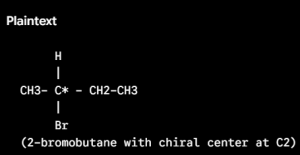
The second carbon in this molecule is attached to four distinct groups: a hydrogen atom (-H), a methyl group (-CH3), an ethyl group (-CH2CH3), and a bromine atom (-Br). This makes it a certified chiral center.
To figure out what this molecule does to light, we use the Cahn-Ingold-Prelog (CIP) priority rules. You rank the groups by atomic number, point the lowest priority group (usually hydrogen) to the back, and trace the path from priority 1 to 2 to 3.
| Configuration | Optical Rotation |
| R (Rectus / Clockwise) | Dextrorotatory (+) |
| S (Sinister / Counter-clockwise) | Levorotatory (–) |
For a specific pure sample of (R)-2-bromobutane, scientists have measured the specific rotation as:
Common Misconceptions About Chirality and Optical Activity
Here is a trap that trips up a lot of students during the exam. People often use “chiral” and “optically active” as if they mean the exact same thing. They don’t.
While it is true that a sample must contain chiral molecules to be optically active, not every chiral sample will rotate light. > The Racemic Mixture Trap: Imagine you create a fictional scenario where you mix exactly 50kf of the (R)-enantiomer and 50kf of the (S)-enantiomer of our 2-bromobutane in a flask. Every time a beam of light hits an R molecule and gets nudged clockwise, it hits an S molecule and gets nudged right back counter-clockwise. The net rotation ends up being zero.
This 1:1 mix is a racemic mixture. The individual molecules inside are still completely chiral, but the bulk solution shows zero optical activity because the rotations cancel each other out. Keep an eye out for this distinction in Part B of the CSIR NET.
Real-World Applications of Chirality and Optical Activity
Why do examiners care so much about this? Because nature is inherently chiral. Our enzymes, DNA, and receptors are all built from single-handed building blocks (like L-amino acids).
This becomes incredibly important in pharmacology. A famous, tragic historical example is the drug thalidomide, which was prescribed in the mid-20th century. One enantiomer successfully relieved morning sickness in pregnant women, while the other mirror-image version caused severe birth defects. The human body treated the two mirror images as completely different keys fitting into different locks.
In modern labs, measuring specific rotation using a polarimeter is a non-negotiable step to verify drug purity. Even a tiny shift in enantiomeric excess can completely alter how a drug behaves in the human body.
Exam Strategy: Mastering Chirality and Optical Activity for CSIR NET Exams
To crack the stereochemistry questions without breaking a sweat, you need to build strong visual habits.
-
Master the CIP Rules: Do not guess the R/S configuration. Practice swapping groups on paper so you can confidently assign configurations in Fischer, Newman, and Wedge-Dash projections.
-
Look for Symmetry Elements: Always check for a plane of symmetry (σ) or a center of inversion (i). If a molecule has chiral centers but also possesses an internal plane of symmetry, it is a meso compound and will be optically inactive due to internal compensation.
-
Visualize in 3D: Try to picture the molecules lifting off the flat paper.
Important Subtopics in Chirality and Optical Activity
As you dive deeper into your preparation, make sure you spend time on chiral recognition and asymmetric synthesis to coverChirality and optical activity.
Chiral recognition happens when a specific chiral molecule selectively interacts with just one enantiomer out of a mixture—much like how your right shoe only fits your right foot. This principle is what allows pharmaceutical companies to separate racemic mixtures into pure, safe drug components. Understanding how chiral catalysts guide a chemical reaction to yield only the R or S product is a high-yielding topic that regularly shows up in the advanced sections of the exam.
Key Takeaways on Chirality and optical activity For CSIR NET Exams
-
Chirality means a molecule has a non-superimposable mirror image, usually because of a carbon bonded to four different groups.
-
Optical activity is the physical manifestation of chirality, where a solution rotates plane-polarized light.
-
Enantiomers rotate light by equal magnitudes but in opposite directions (+ vs –).
-
Racemic mixtures (1:1 ratio) and meso compounds (internal symmetry) show zero net optical activity.
Final Thoughts
Mastering this topic isn’t about memorizing definitions; it’s about training your eyes to see molecular geometry in three dimensions. Once you learn to spot stereocenters, apply the CIP rules correctly, and recognize the difference between a racemic mix and a meso compound, you will stop losing silly marks in Parts B and C.
If you ever feel stuck trying to visualize these structures or want to practice high-yield exam problems, our team at VedPrep provides clear, structured guidance and resources designed to help you build that exact mental framework.
To know more in detail from our faculty, watch our YouTube video:
Frequently Asked Questions
What causes optical activity in molecules?
Optical activity is caused by the presence of chirality in molecules. When a molecule and its mirror image are not superimposable, they can rotate plane-polarized light in opposite directions, leading to optical activity.
How is chirality different from achirality?
Chirality and achirality are terms that describe the symmetry of a molecule. A chiral molecule has a non-superimposable mirror image, while an achiral molecule does not. Achiral molecules either have a superimposable mirror image or are superimposable on their mirror image.
What are enantiomers?
Enantiomers are pairs of molecules that are non-superimposable mirror images of each other. They have the same physical and chemical properties except for their ability to rotate plane-polarized light in opposite directions.
What is the significance of chirality in biochemistry?
In biochemistry, chirality plays a crucial role because most biological molecules, such as amino acids and sugars, are chiral. The specific chirality of these molecules is essential for their biological function and interaction with other chiral molecules.
How do you determine if a molecule is chiral?
To determine if a molecule is chiral, look for a center of asymmetry, typically a carbon atom bonded to four different groups. If such a center exists and the molecule has no plane of symmetry, it is likely to be chiral.
What is a racemic mixture?
A racemic mixture is an equimolar mixture of two enantiomers. It does not exhibit optical activity because the rotations caused by each enantiomer cancel each other out.
What are diastereomers?
Diastereomers are stereoisomers that are not mirror images of each other. Unlike enantiomers, diastereomers have different physical and chemical properties and are not required to have equal and opposite optical rotations.
How is chirality and optical activity tested in CSIR NET?
In the CSIR NET exam, questions on chirality and optical activity often involve identifying chiral centers, predicting optical activity, and understanding the implications of chirality on molecular properties. Questions may also require the application of concepts to predict the behavior of molecules in different scenarios.
What types of questions can I expect on chirality in the CSIR NET organic chemistry section?
You can expect questions that test your understanding of chiral centers, enantiomers, diastereomers, and the physical and chemical properties of chiral molecules. Questions may also focus on the application of chirality concepts to solve problems related to organic chemistry reactions and mechanisms.
What is a common mistake made when identifying chiral centers?
A common mistake is failing to consider all substituents around a carbon atom or misinterpreting the presence of a plane of symmetry. It's essential to systematically evaluate each carbon atom in a molecule to accurately identify chiral centers.
How can students mistakenly approach problems on optical activity?
Students might mistakenly assume that all molecules with chiral centers are optically active or fail to consider the presence of a racemic mixture. It's crucial to apply concepts accurately and consider all factors influencing optical activity.
What is the relationship between chirality and HPLC?
High-Performance Liquid Chromatography (HPLC) can be used to separate enantiomers by using a chiral stationary phase. This technique takes advantage of the different interactions between each enantiomer and the chiral stationary phase, allowing for the resolution of racemic mixtures.
How does chirality influence drug design?
Chirality plays a critical role in drug design because the biological activity of a drug can be highly dependent on its chirality. One enantiomer of a drug may be therapeutically active while the other may be inactive or even toxic. Therefore, understanding and controlling chirality is essential in pharmaceutical development.
What are some challenges in studying chiral molecules?
Challenges in studying chiral molecules include their synthesis, separation, and analysis. Chiral molecules can have identical physical and chemical properties, making their separation and identification challenging. Additionally, the synthesis of chiral molecules often requires specialized techniques to ensure enantiomeric purity.