
Curtius rearrangement For CSIR NET is a critical organic reaction mechanism where an acyl azide undergoes rearrangement to form an isocyanate, isocyanate derivative, or a primary amine, which is vital to understand for CSIR NET and other competitive exams.
Curtius Rearrangement For CSIR NET : A Key Concept
The Curtius rearrangement is one of those classic name reactions that you simply cannot skip if you are eyeing a top rank in the CSIR NET Chemical Sciences exam. Tucked neatly inside the Aliphatic and Aromatic Compounds unit of the syllabus, this mechanism is a favorite for question setters. Whether you are prepping for CSIR NET, IIT JAM, CUET PG, or GATE, you will often spot questions centered around acyl azide degradation.
If you look through standard textbooks like Organic Chemistry by Clayden, Carey, or the classic Morrison & Boyd, you will find detailed breakdowns of how this degradation works. These resources are great for building your theory, but when you are in the exam hall, you need to know how the reaction behaves when paired with tricky modern reagents or complex cyclic rings.
At its core, the reaction transforms an acyl azide into an amine, chopping off a carbon atom along the way in the form of nitrogen gas and carbon dioxide. Think of it as a clean molecular structural edit. It is a vital tool for organic synthesis, and getting a firm grip on it will save you a lot of overthinking during the exam.
Curtius Rearrangement For CSIR NET Mechanism and Importance
As per Curtius rearrangement, sometimes called the Curtius-Smidt reaction, this process is essentially a one-pot rearrangement. Heating an acyl azide triggers a shift where the alkyl or aryl group migrates right onto the neighboring nitrogen atom, kicking out N2 gas. The direct product of this migration is an isocyanate. Once you have that isocyanate, it acts like an electrophilic sponge, ready to react with whatever nucleophile you throw into the flask.
Here is the actual step-by-step molecular dance:
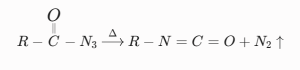
Now, let’s address a bit of a debate in the organic chemistry community regarding the mechanism. You might read in some older texts about the formation of a free nitrene intermediate after nitrogen leaves, which then rearranges. However, modern evidence heavily favors a concerted pathway. This means the group migration and the departure of the nitrogen gas happen at the exact same time. Why does this matter for CSIR NET? Because a concerted mechanism means there is absolutely no time for a chiral carbon to flip its configuration. You get strict retention of configuration at the migrating center.
This reaction is highly valued because it gives you a direct, reliable path to pure isocyanates and primary amines. While industries use bulk isocyanates to manufacture polyurethane foams, academic exam papers care about how you can use this clean nitrogen-loss pathway to build intricate, sterically hindered framework structures.
Worked Example: Curtius Rearrangement For CSIR NET
Let’s look at a straightforward problem to see how this plays out on paper. Imagine you are given phenylacetyl azide, PhCH2CON3, and asked to predict what happens when you heat it up.
Here is how you trace the path:
The carbonyl group is attached to a benzyl group (PhCH2–).
Upon heating, the PhCH2– group migrates directly to the adjacent nitrogen atom as nitrogen gas escapes.
This gives you benzyl isocyanate, PhCH2NCO.
If you leave the reaction there in an inert solvent, your final product is the isocyanate. But if the question includes a follow-up step—like adding water—that isocyanate will hydrolyze into a primary amine, giving you benzylamine (PhCH2–NH2).
Common Misconception – Curtius Rearrangement For CSIR NET
As per Curtius rearrangement, a frequent trap for students is looking at the long overall transformation (Carboxylic acid → Acyl Chloride → Acyl Azide → Isocyanate $\rightarrow$ Amine) and assuming the actual rearrangement step is a slow, multi-stage process with multiple isolated intermediates.
In reality, the acyl azide degradation itself is a single, concerted step. The molecule doesn’t sit around waiting as a free nitrene; the alkyl or aryl group shifts over at the exact same moment the nitrogen molecule detaches.
The confusion usually happens because synthesizing the starting acyl azide requires a few steps beforehand, and breaking down the resulting isocyanate takes another step afterward. The actual rearrangement is fast and clean. Keeping this single-step migration in mind helps you avoid overcomplicating mechanism questions or drawing unstable, non-existent intermediates on your scratch pad.
Real-World Application: Curtius Rearrangement For CSIR NET in Polymers
To see why this reaction matters outside of exam papers, let’s step into an industrial scenario. Imagine a manufacturing design team trying to create a specialized, ultra-durable coating for high-end sports cars. They need a polyurethane material that can resist scratches and extreme weather, but they are working with highly complex, sensitive polymer building blocks that break down under harsh acid or base conditions.
By using a mild thermal variant of this rearrangement, chemical engineers can generate the required polyisocyanates right inside the mixture under neutral conditions. Once formed, these react smoothly with polyols to build the urethane linkages without damaging the rest of the material’s delicate structure.
Construction Industry: Used to create high-insulation spray foams and weather-resistant sealants.
Automotive Industry: Essential for compounding high-gloss, durable coatings and flexible interior adhesives.
Seeing how these structural changes work in a factory setting helps make those abstract exam structures feel a lot more practical and easier to remember.
Exam Strategy: Curtius Rearrangement For CSIR NET
When you are mapping out your study plan, don’t just memorize the name of the reaction. Focus heavily on the exact reaction conditions and how this mechanism stacks up against its structural cousins: the Hofmann, Lossen, and Schmidt rearrangements. They all end up taking a trip to the exact same destination (an isocyanate intermediate), but they start with different passengers.
| Reaction | Starting Material | Reagents / Conditions |
| Curtius | Acyl Azide | Heat (Δ) or Light (ν) |
| Hofmann | Primary Amide | Br2 + NaOH |
| Lossen | Hydroxamic Acid Derivative | Base or Heat |
| Schmidt | Carboxylic Acid | HN3 + H2SO4 |
For effective preparation, students are recommended to review key textbooks and study materials for CSIR NET that cover Curtius rearrangement For CSIR NET. VedPrep offers expert guidance and comprehensive study resources, including Acyl Azide Degradation For CSIR NET, to help students achieve their goals in mastering Curtius rearrangement For CSIR NET.
To get comfortable with this topic, try practicing a wide variety of problems. Look for questions that mix reagent selection, temperature changes, and stereo-centers.
Whenever we work through these mechanism pathways with students at VedPrep , we emphasize analyzing the structural integrity of the migrating group first. Keep an eye out for:
The overall reaction mechanism and exact thermal conditions.
The pros and cons of using azides versus amides or hydroxamic acids.
How to strategically use this migration in multi-step total synthesis.
Staying consistent with a structured practice routine makes it much easier to spot these patterns quickly when the clock is ticking during the exam.
Variations of Curtius Rearrangement For CSIR NET
One of the best things about this rearrangement is its adaptability. By changing the solvent or adding a specific trapping agent to the flask, you can steer the reactive isocyanate intermediate toward entirely different chemical families.
In an inert solvent (like benzene or toluene): The reaction stops cleanly at the isocyanate (R-NCO).
With an alcohol (R’-OH): The isocyanate is trapped to form a carbamate (urethane linkage, R-NHCOOR’).
With an amine (R’-NH2): The intermediate reacts to yield a substituted urea (R-NHCONHR’).
With water (H2O): The unstable carbamic acid rapidly loses CO2, leaving you with a clean primary amine (R-NH2).
Importance of Curtius Rearrangement For CSIR NET in Organic Synthesis
The ability to swap out a carboxylic acid group for a clean primary amino group—while preserving the exact spatial arrangement of the attached carbon ring or chain—is incredibly useful for building complex molecules. This makes the reaction a vital tool when synthesising pharmaceuticals, complex natural products, and agrochemicals.
In the context of advanced exam problems, you will occasionally see this reaction discussed alongside pericyclic processes because of its highly organized, concerted transition state. Knowing exactly how the group migrates without losing its stereochemical identity is the key to successfully solving those high-weightage, 4-mark stereochemistry questions in Part C of the CSIR NET exam.
Challenges in Curtius Rearrangement For CSIR NET
Despite being an incredibly elegant reaction on paper, working with it in a physical lab comes with serious practical hurdles. The main issue? Acyl azides can be highly unstable, sensitive to shock, and prone to sudden decomposition. Handling large quantities of low-molecular-weight azides can be quite dangerous.
Because of this instability, running the reaction successfully requires precise control over your heating elements and solvent choices. If the temperature spikes too fast, side reactions can take over, or the starting material can degrade unpredictably. Chemists often get around this by generating the acyl azide in situ—making it and using it immediately in the same flask without isolating the dangerous intermediate.
When you encounter a multi-step synthesis question on your exam, keeping these safety and stability factors in mind will help you logically eliminate impractical reaction routes and select the most sensible, stable pathway.
Final Thoughts
Mastering the Curtius rearrangement is less about brute-force memorization and more about appreciating the smart, elegant ways molecules shift their architecture to build amines and isocyanates. While handling unstable azides takes some care in the lab, the clean, single-step concerted nature of the migration makes it an invaluable strategy for both synthetic chemistry and industrial polymer design.
As you dive deeper into your preparation, treat Curtius rearrangement as a core pillar of your nitrogen-containing functional group strategies. If you ever want an extra set of eyes on these tricky mechanisms or need a structured way to practice complex name reactions, our team at VedPrep is always here to help break down the concepts.
To know more in detail from our expert faculty, watch our YouTube video:
Frequently Asked Questions
What is the general mechanism of Curtius rearrangement?
The general mechanism involves the formation of an acyl azide intermediate, which then undergoes a concerted rearrangement, resulting in the formation of an isocyanate. The isocyanate then reacts with a nucleophile to form the final amine product.
What are the key conditions required for Curtius rearrangement?
The key conditions required for Curtius rearrangement include the presence of an acyl azide, a suitable solvent, and a nucleophile. The reaction typically occurs under mild conditions, with temperatures ranging from 0°C to 50°C.
What are the advantages of Curtius rearrangement?
The advantages of Curtius rearrangement include its high efficiency, mild reaction conditions, and the ability to form a wide range of amines. Additionally, the reaction can be performed on a variety of substrates, including complex molecules.
What are the limitations of Curtius rearrangement?
The limitations of Curtius rearrangement include the requirement for an acyl azide intermediate, which can be difficult to synthesize. Additionally, the reaction may not be suitable for all types of substrates, and the yields can vary depending on the conditions.
What is the role of the acyl azide in Curtius rearrangement?
The acyl azide plays a crucial role in Curtius rearrangement, serving as the intermediate that undergoes the concerted rearrangement to form the isocyanate.
How does the solvent affect Curtius rearrangement?
The solvent can affect the rate and efficiency of Curtius rearrangement, with some solvents facilitating the reaction and others hindering it. The choice of solvent depends on the specific substrate and reaction conditions.
What is the historical significance of Curtius rearrangement?
Curtius rearrangement was first discovered by Theodor Curtius in the late 19th century and has since become a fundamental reaction in organic chemistry. Its development has had a significant impact on the field of organic synthesis.
What is the relationship between Curtius rearrangement and Organic Chemistry?
Curtius rearrangement is a fundamental reaction in Organic Chemistry, demonstrating key concepts such as reaction mechanisms, intermediates, and selectivity. Understanding Curtius rearrangement is essential for mastering Organic Chemistry.
How is Curtius rearrangement applied in CSIR NET?
Curtius rearrangement is an important reaction in organic chemistry and is frequently asked in CSIR NET. Understanding the mechanism, conditions, and applications of this reaction is crucial for success in the exam.
What types of questions are typically asked about Curtius rearrangement in CSIR NET?
Typically, questions about Curtius rearrangement in CSIR NET include identifying the products of the reaction, understanding the mechanism, and applying the reaction to different substrates. Additionally, questions may be asked about the advantages and limitations of the reaction.
What are common mistakes made when writing the mechanism of Curtius rearrangement?
Common mistakes include incorrect representation of the concerted rearrangement step and failure to account for the loss of nitrogen gas. Additionally, mistakes may be made in identifying the products of the reaction or in applying the reaction to different substrates.
What are some recent developments in Curtius rearrangement?
Recent developments include the use of new catalysts and conditions to improve the efficiency and selectivity of the reaction. Additionally, researchers have explored the application of Curtius rearrangement to complex molecules and biologically active compounds.
How does Curtius rearrangement relate to other organic reactions?
Curtius rearrangement is related to other organic reactions, such as the Hofmann rearrangement and the Schmidt reaction. Understanding the similarities and differences between these reactions can provide valuable insights into their mechanisms and applications.
How can Curtius rearrangement be used in green chemistry?
Curtius rearrangement can be used in green chemistry by employing environmentally friendly solvents and conditions. Additionally, the reaction's high efficiency and selectivity can help minimize waste and reduce the environmental impact of chemical synthesis.