

Debye-Huckel theory For CSIR NET is an electrostatic theory that explains the behavior of ions in solution, providing a mathematical framework for understanding ionic interactions and deviations from ideal behavior.
Syllabus – Physical Chemistry
If you are gearing up for the CSIR NET exam, you already know that Electrochemistry isn’t just about memorizing the Nernst equation and calling it a day. When you dive into Unit 5 of the Physical Chemistry syllabus, you run straight into the Debye-Huckel theory.
At its core, this theory is an electrostatic framework designed to explain why ions in a solution don’t behave ideally. If you look at standard textbooks like Atkins’ Physical Chemistry or McQuarrie & Simon’s Physical Chemistry: A Molecular Approach, you will find deep math on the theory of electrolyte solutions. But let’s break down the actual physics of what is happening without getting buried in the text right away.
In an ideal solution, particles ignore each other. But ions have charges, and charges create electric potentials. In a real electrolyte solution, an ion isn’t floating in a vacuum; it is surrounded by a cloud of other ions. The Debye-Huckel theory gives us a way to calculate how this crowded environment modifies the electric potential.
To make the math trackable, Peter Debye and Erich Hückel had to make a few big assumptions:
-
The solution is very dilute (low ion concentrations).
-
The ions are treated as point charges with central symmetry.
Debye-Huckel Theory For CSIR NET: Poisson-Boltzmann Equation and Its Significance
To get to the famous limiting law, we have to marry two different concepts: electrostatics and statistical mechanics. This is where the Poisson-Boltzmann equation comes in.
First, we take the Poisson equation from physics, which relates electric potential (φ) to charge density (ρ):
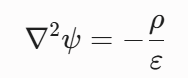
Here, ε is the permittivity of the solution. Then, we use the Boltzmann distribution to describe how ions pack around each other based on thermal energy (kB T) and electrostatic attraction:
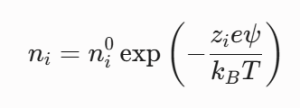
When you combine these two, you get the Poisson-Boltzmann equation. By linearizing it (assuming the electrical energy is much smaller than the thermal energy), we can solve for the potential and map out the “ionic atmosphere.”
Think of it like a popular celebrity walking into a party. The celebrity (our central ion) naturally attracts a crowd of fans (oppositely charged counter-ions) who swarm around them. The crowd shields the celebrity from people further away in the room. The Poisson-Boltzmann equation mathematically describes how dense that crowd is and how far its influence reaches.
As per Debye-Huckel theory, understanding this distribution is essential for tracking ion transport, electrode kinetics, and biological systems. At VedPrep, we often remind our students that visualizing this “crowd control” makes deriving the actual equations much more intuitive.
Misconception: Common Errors in Applying Debye-Huckel Theory For CSIR NET
One of the biggest traps CSIR NET aspirants fall into is totally ignoring the solvent’s dielectric constant (ε). On a scratch pad during a timed exam, it is easy to accidentally treat ε as 1 (like a vacuum) or completely forget it is in the denominator.
This oversight will ruin your calculation. The dielectric constant represents how well the solvent can screen the forces between the ions. Water has a high dielectric constant (around 80 at room temperature), which means it acts like a buffer, reducing the electrostatic attraction between positive and negative ions so they can break free and move around. If you change the solvent to something like ethanol, the dielectric constant drops, the ions feel each other’s pull much more strongly, and the activity coefficient shifts dramatically.
When you forget the solvent’s role, you end up assuming ideal behavior where it absolutely does not exist. Here is what goes wrong when you neglect these non-ideal effects:
-
You get completely wrong values for the mean ionic activity coefficient (λ±).
-
Your predictions for how the solution behaves fall apart.
Catching these subtle details is exactly what separates a qualifying scorecard from a top rank.
Debye-Huckel theory For CSIR NET and Its Applications
Why do we care so much about these activity coefficients? Because they dictate how real electrochemical systems operate in the lab and in industry.
Take electrolysis and electrode reactions. When ions rush toward an electrode, their speed and reactivity depend heavily on that cloud of counter-ions holding them back. The Debye-Huckel theory lets us predict activity coefficients so we can accurately calculate electrode kinetics.
The same principles apply to battery and capacitor performance. If you are designing a better lithium-ion battery, you need to know exactly how the ions interact within the electrolyte. Their conductivity—and therefore how fast the battery charges or discharges—is tied directly to these electrostatic interactions.
Even corrosion and passivation rely on this theory. When a metal pipe rusts, it is reacting with ions in its environment. By understanding how ions behave near the metal surface, engineers can design better protective coatings to stop corrosion before it starts.
Just keep in mind that the basic theory only works for dilute solutions. When things get crowded, we have to modify the equations.
Key Concepts in Debye-Huckel theory For CSIR NET
If you want to score full marks on this topic in CSIR NET, GATE, or IIT JAM, you should focus on three main pillars:
-
Ionic Strength (I): Knowing how to calculate I = 1/2∑ ci zi2 quickly for different electrolyte types (like 1:1, 2:1, or 3:1).
-
The Debye length (κ-1): This is the characteristic thickness of the ionic atmosphere.
-
The Debye-Huckel-Onsager Equation: This extends the theory to explain how conductivity changes with concentration.
Imagine you are trying to navigate a crowded subway station. If there are only a few people (low ionic strength), you can walk straight through without bumping into anyone. But as the station fills up (high ionic strength), you constantly have to slow down, twist, and turn because of the people around you. That is exactly what happens to an ion trying to conduct electricity in a concentrated solution.
To master Debye-Huckel theory, we highly recommend working through practice problems that force you to apply the limiting law to real numbers. Our team at VedPrep focuses heavily on these exam-style problems to help you build the speed you need for the exam room.
Debye-Huckel theory For CSIR NET: Problem Solving
When you sit down to practice, do not just stare at the derivations. Focus on the core problem of Debye-Huckel theory:
-
Calculating the mean ionic activity coefficient using log γ± = -A |z_+ z_-| √I.
-
Finding the thickness of the ionic cloud (Debye length) under different temperatures and solvent conditions.
-
Identifying the exact concentration limits where the basic theory fails and the extended Debye-Huckel equation needs to take over.
Try applying the equations to different setups—like simple salt solutions, protein mixtures, or colloidal suspensions. Testing your limits on varying difficulty levels is the best way to ensure no surprises pop up on exam day.
Debye-Huckel theory For CSIR NET: Study Materials
Getting a grip on physical chemistry requires a solid mix of theory and active problem-solving. While classic textbooks give you the background, navigating the specific shortcuts and tricks needed for a competitive exam can be tough on your own.
At VedPrep, we put together structured study materials, video lectures, and curated question banks designed specifically around the current trends of the CSIR NET, GATE, and IIT JAM exams. We focus on breaking down tough topics like the primitive model and the linearized Poisson-Boltzmann equation into manageable steps so you can study efficiently.
Final Thoughts
Mastering the Debye-Huckel Theory for the upcoming exam is about more than just memorizing the square root of ionic strength. It is about building a physical intuition for how ions shield one another in a solution.
As you move from the math of the Poisson-Boltzmann equation to calculating real-world activity coefficients, pay close attention to the details—especially the limitations of the theory and the role of the solvent’s dielectric constant.
Frequently Asked Questions
Who developed the Debye-Huckel theory?
The Debye-Huckel theory was developed by Peter Debye and Erich Huckel in the 1920s. They proposed this theory to explain the behavior of electrolyte solutions, which was a significant contribution to the field of physical chemistry.
What are the key assumptions of the Debye-Huckel theory?
The Debye-Huckel theory assumes that ions are spherical and have a uniform charge distribution, and that the solvent is a continuous medium with a uniform dielectric constant. It also assumes that the ions are not strongly interacting with each other.
What is the significance of the Debye length?
The Debye length, also known as the Debye-Huckel length, is a critical parameter in the Debye-Huckel theory. It represents the distance over which the electric field of an ion is screened by the surrounding solvent and other ions.
How does the Debye-Huckel theory explain ion-ion interactions?
The Debye-Huckel theory explains ion-ion interactions by considering the electrostatic attraction and repulsion between ions. It takes into account the shielding effect of the solvent and other ions on the electric field of an ion.
What is the role of the Debye-Huckel theory in electrochemistry?
The Debye-Huckel theory plays a crucial role in electrochemistry by providing a framework for understanding the behavior of electrolyte solutions, which is essential for understanding electrochemical reactions and processes.
What are the limitations of the Debye-Huckel theory?
The Debye-Huckel theory has several limitations, including its assumption of a continuous solvent and neglect of ion-ion interactions. It is also limited to dilute solutions and moderate temperatures.
How does the Debye-Huckel theory explain the behavior of electrolyte solutions?
The Debye-Huckel theory explains the behavior of electrolyte solutions by considering the interactions between ions and the surrounding solvent. It provides a framework for understanding the conductivity and thermodynamic properties of electrolyte solutions.
How is the Debye-Huckel theory applied in CSIR NET?
The Debye-Huckel theory is a fundamental concept in physical chemistry and is often tested in CSIR NET. Questions may be asked about the assumptions, limitations, and applications of the theory, as well as its relevance to electrolyte solutions and electrochemistry.
What are some common exam questions related to the Debye-Huckel theory?
Common exam questions related to the Debye-Huckel theory include calculating the Debye length, understanding the assumptions and limitations of the theory, and applying the theory to explain the behavior of electrolyte solutions.
What are some common mistakes students make when applying the Debye-Huckel theory?
Common mistakes students make when applying the Debye-Huckel theory include neglecting the assumptions and limitations of the theory, incorrect calculation of the Debye length, and failing to consider the shielding effect of the solvent and other ions.
How can students avoid mistakes when solving problems related to the Debye-Huckel theory?
To avoid mistakes, students should carefully read and understand the assumptions and limitations of the Debye-Huckel theory, and ensure that they are applying the theory correctly to the problem at hand.
What are some advanced applications of the Debye-Huckel theory?
Advanced applications of the Debye-Huckel theory include its use in understanding the behavior of complex electrolyte solutions, such as those with multiple ions and solvents, and its application to biological systems, such as protein-ligand interactions.
How does the Debye-Huckel theory relate to other areas of physical chemistry?
The Debye-Huckel theory is closely related to other areas of physical chemistry, such as electrochemistry, thermodynamics, and statistical mechanics. It provides a fundamental framework for understanding the behavior of electrolyte solutions and has far-reaching implications for many fields.
How does the Debye-Huckel theory relate to current research in physical chemistry?
The Debye-Huckel theory continues to be relevant to current research in physical chemistry, particularly in the areas of electrochemistry, materials science, and biophysics. Researchers are continually developing new theories and models that build upon the Debye-Huckel theory.