



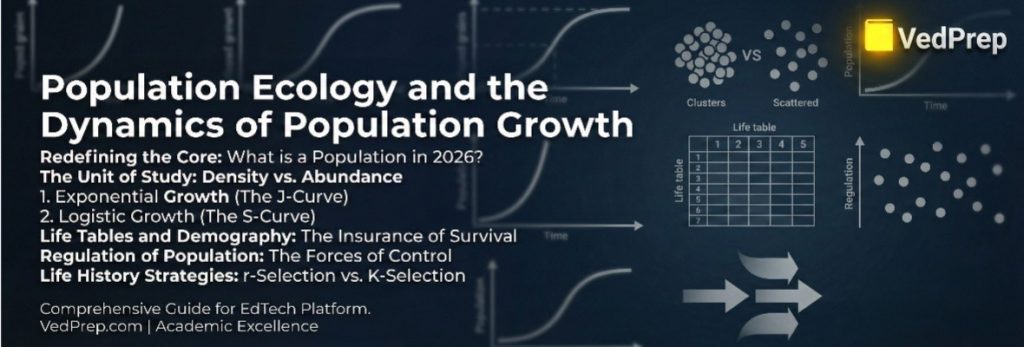

Population Ecology and the Dynamics of Population Growth: A 2026 Perspective on Survival and Sustainability
Welcome to 2026. As the global human population inches past 8.2 billion and biodiversity faces unprecedented climate pressures, the study of Population of Dynamic Ecology has shifted from theoretical textbooks to urgent, real-world application. It is no longer just about counting deer in a forest; it is about predicting migration patterns of climate refugees, modeling the spread of next-gen zoonotic diseases, and ensuring food security in a resource-constrained world.
Population Ecology is the mathematical and biological study of how populations change over time and space. But in 2026, it is also the science of resilience. From the collapse of bee colonies to the explosion of urban rat populations, understanding the “why” and “how” of growth and decline is the key to our survival.
For students preparing for competitive exams like CSIR NET, GATE, or CUET PG, and for environmental policy-makers, this field is the new battleground. In this extensive guide, we will move beyond the basic “births minus deaths” models found in competitor blogs. We will explore the complex feedback loops of density dependence, the modern “Allee Effects” in fragmented habitats, and how Artificial Intelligence is rewriting the laws of Population of Dynamic Ecology.
Redefining the Core: What is a Population in 2026?
Classically, a population is defined as a group of individuals of the same species living in the same area at the same time. However, in 2026, this definition has expanded.
- The Metapopulation Reality: Habitat fragmentation has turned continuous populations into scattered “islands.” We now study Metapopulations—groups of spatially separated populations of the same species which interact at some level. The dynamics of “Source” (stable) and “Sink” (declining) populations are critical for conservation.
- The Genetic Dimension: A Population of Dynamic Ecology is now defined not just by geography but by gene flow. With rapid sequencing, we identify “cryptic populations” that look identical but are genetically distinct and require separate management.
The Unit of Study: Density vs. Abundance for population of dynamic ecology
- Abundance ($N$): The total number of individuals. Good for counting elephants.
- Density ($D$): The number of individuals per unit area or volume. Crucial for bacteria or plankton.
- Ecological Density: The density per unit of habitable space. In 2026, as habitable land shrinks due to climate change, this metric is far more valuable than crude density.
The Mathematics of Growth: Models that Rule the World
Population growth isn’t random; it follows mathematical laws. Understanding these models is the backbone of Population of Dynamic Ecology.
1. Exponential Growth (The J-Curve)
This is the “unlimited resources” model.
- The Formula: $dN/dt = rN$
- $r$ = Intrinsic rate of increase (Births – Deaths)
- $N$ = Population size
- The Reality: We see this in bacterial blooms or invasive species like the Lionfish in the Atlantic. It is explosive but unsustainable. In 2026, we use this model to predict the early spread of pandemics before interventions kick in.
2. Logistic Growth (The S-Curve)
This is the “reality check” model. Nature has limits.
- The Formula: $dN/dt = rN [(K-N)/K]$
- $K$ = Carrying Capacity (The maximum population the environment can support).
- The Mechanism: As $N$ approaches $K$, the term $(K-N)/K$ approaches zero, slowing growth. This “environmental resistance” is the core of Population of Dynamic Ecology.
- 2026 Update: Climate change is making $K$ dynamic. A region’s carrying capacity for wheat might drop by 20% in a drought year. Modern models treat $K$ not as a constant, but as a fluctuating variable dependent on climate data.
Life Tables and Demography: The Insurance of Survival
To predict the future of a Population of Dynamic Ecology, we need to know who is living and who is dying.
Survivorship Curves
- Type I (Late Loss): High survival until old age (Humans, Elephants). Strategies involve heavy investment in few offspring.
- Type II (Constant Loss): Probability of death is constant at any age (Birds, Reptiles).
- Type III (Early Loss): Massive death rate for the young, but survivors live long (Fish, Trees, Insects).
- 2026 Insight: We are seeing a shift. Climate stress is pushing some Type I species towards Type II dynamics, as extreme weather events kill indiscriminately regardless of age.
The Net Reproductive Rate ($R_0$)
This metric tells us if a female is replacing herself.
- $R_0 = \sum l_x m_x$
- $l_x$ = Proportion surviving to age $x$
- $m_x$ = Offspring produced at age $x$
- If $R_0 > 1$, the population is growing. If $R_0 < 1$, it is crashing. This calculation is vital for endangered species recovery programs.
Regulation of Population: The Forces of Control
What stops a population from growing forever? The Population of Dynamic Ecology is regulated by two types of forces.
1. Density-Dependent Factors (Biotic)
These forces get stronger as the population gets more crowded.
- Competition: For food, mates, or nesting sites.
- Predation: Predators focus on common prey.
- Disease: Viruses spread faster in dense crowds.
- The Allee Effect: A positive density dependence where populations fail if they get too small (mates can’t find each other). In 2026, this is a major cause of extinction for rare species like the Vaquita porpoise.
2. Density-Independent Factors (Abiotic)
These strike regardless of crowd size.
- Climate Events: Hurricanes, fires, or floods kill 90% of a population whether there were 100 or 1,000 individuals.
- 2026 Relevance: As climate change intensifies, density-independent factors are becoming the dominant drivers of Population of Dynamic Ecology, overriding biological regulation and causing chaotic fluctuations.
Life History Strategies: r-Selection vs. K-Selection
Evolution has shaped species to play the game of life differently.
r-Selected Species (The Gamblers)
- Strategy: “Live fast, die young.” High $r$ (growth rate).
- Traits: Small body, short life, early maturity, many small offspring, little parental care.
- Examples: Insects, weeds, bacteria.
- 2026 Context: These are the “winners” of the Anthropocene. They adapt quickly to disturbed human environments.
K-Selected Species (The Investors)
- Strategy: “Slow and steady.” Adapted to live at $K$ (carrying capacity).
- Traits: Large body, long life, late maturity, few large offspring, high parental care.
- Examples: Whales, humans, oak trees.
- 2026 Context: These are the most vulnerable to extinction because they cannot recover their numbers quickly after a crash.
Interaction Dynamics: The Lotka-Volterra Models
No Population of Dynamic Ecology exists in isolation. Species interact.
Predator-Prey Oscillations
The classic math shows that predator and prey populations cycle. More hares $\rightarrow$ more lynx $\rightarrow$ fewer hares $\rightarrow$ fewer lynx.
- 2026 Application: We use these models to manage fisheries. If we overfish the tuna (predator), the herring (prey) might explode and crash the plankton base.
Competition Coefficients
When two species compete for the same niche, the “Competitive Exclusion Principle” says one will win. However, nature often finds a workaround called “Resource Partitioning” (e.g., different birds eating from different parts of the same tree).
Modern Applications in 2026
The principles of Population of Dynamic Ecology are being applied in groundbreaking ways.
1. Climate Migration Modeling
By treating humans as a biological population responding to carrying capacity ($K$) collapse in drought zones, we predict migration flows. This helps governments prepare infrastructure.
2. Epidemiology and Zoonosis
Understanding density-dependent transmission is key to preventing the next pandemic. We model how urbanization increases the contact rate between wildlife reservoirs (bats/rats) and humans.
3. Conservation Genomics
We calculate “Minimum Viable Population” (MVP) size not just by numbers, but by genetic diversity. A population of 500 tigers might be functionally extinct if they are all siblings. The Population of Dynamic Ecology now integrates DNA sequencing.
Accelerate Your Ecology Mastery with VedPrep
The concepts of Population of Dynamic Ecology—from the nuances of the Lotka-Volterra equations to the calculation of life tables—are mathematically dense and conceptually tricky. For students of CSIR NET Life Sciences, GATE Ecology, or IIT JAM, a superficial understanding is a recipe for failure.
This is where VedPrep transforms your preparation.
At VedPrep, we don’t just teach you the definitions; we teach you the systems.
- Visualizing the Math: Our modules use dynamic simulations to show how changing ‘$r$’ or ‘$K$’ alters a population curve in real-time. You don’t just memorize the formula; you see the biology behind it.
- Data-Driven Case Studies: We analyze real 2026 datasets—like the population crash of snow crabs or the recovery of tigers in India—to train you for the analytical “Part C” questions of CSIR NET.
- Interdisciplinary Linkage: We connect Ecology to Evolution (r/K selection) and Genetics (Hardy-Weinberg), giving you the holistic view required for top-tier exams.
- Mock Tests: Practice with our specialized “Ecology & Evolution” test series that mimics the latest NTA patterns, focusing on graph interpretation and numerical problems.
Whether you are struggling with the intrinsic rate of increase or the concept of metapopulations, VedPrep provides the structured, expert-led guidance you need to turn Population of Dynamic Ecology into your highest-scoring unit.
Conclusion
Population of Dynamic Ecology is the dashboard of the planetary spaceship. It tells us how fast we are going, how much fuel (resources) we have left, and whether the passengers (species) are thriving or dying.
In 2026, this science has moved from observation to intervention. We are actively managing the Population of Dynamic Ecology of endangered rhinos, invasive pythons, and even our own urban centers. It is a field that demands both mathematical precision and biological intuition.
For the student and the scientist, mastering these dynamics is not just about passing an exam; it is about acquiring the tools to steward life on Earth. As you delve deeper into $r$, $K$, and $N$, remember that every number represents a living, breathing reality in the complex web of nature.
Frequently Asked Questions (FAQs)
What is Population Ecology?
Ans:
-
Population Ecology is the mathematical and biological study of how populations change over time and space. In 2026, it is also viewed as the science of resilience, focusing on survival and sustainability.
-
How has the definition of "population" changed in 2026?
Ans: Classically, a population is a group of the same species in the same area. In 2026, this concept has expanded to include "Metapopulations" (scattered islands of populations) and "Cryptic Populations" (genetically distinct but visually identical groups)
What is the difference between Abundance and Density?
Ans: Abundance ($N$) is the total number of individuals (e.g., counting elephants). Density ($D$) is the number of individuals per unit area or volume, while Ecological Density specifically measures density per unit of habitable space, which is crucial as habitats shrink.
What is the Exponential Growth model (J-Curve)?
Ans: It is the "unlimited resources" model described by the formula $dN/dt=rN$, where growth is explosive. It is often seen in bacterial blooms or invasive species and is used to predict the early spread of pandemics.
How is Carrying Capacity ($K$) defined in 2026?
Ans: Carrying Capacity ($K$) is the maximum population an environment can support. In 2026, modern models treat $K$ as a fluctuating variable dependent on climate data, rather than a constant, because factors like drought can drastically reduce it.
What is the Net Reproductive Rate ($R_0$)?
Ans: $R_0$ tells us if a female is replacing herself. It is calculated as $R_0 = \sum l_x m_x$, where $l_x$ is survival probability and $m_x$ is offspring produced. If $R_0 > 1$, the population is growing; if $R_0 < 1$, it is crashing.
What are the three types of Survivorship Curves?
Ans:
-
-
Type I (Late Loss): High survival until old age (e.g., Humans, Elephants).
-
Type II (Constant Loss): Constant probability of death at any age (e.g., Birds).
-
Type III (Early Loss): Massive death rate for the young, but long life for survivors (e.g., Fish, Trees).
-
How is climate change affecting Survivorship Curves in 2026?
Ans: Climate stress is pushing some Type I species towards Type II dynamics, as extreme weather events kill indiscriminately regardless of age
What is the "Allee Effect"?
Ans: The Allee Effect is a positive density dependence where populations fail if they become too small, often because mates cannot find each other. It is a major cause of extinction for rare species like the Vaquita porpoise.
How are Population Ecology models used in real-world scenarios in 2026?
Ans: They are used for Climate Migration Modeling to predict human displacement , Epidemiology to model zoonotic disease spread in urban areas , and Conservation Genomics to calculate Minimum Viable Population (MVP) based on genetic diversity