
Surface plasma resonance methods For CSIR NET are a critical topic in physical chemistry that involves the study of the interaction between light and metal surfaces, enabling students to analyze biomolecular interactions and binding kinetics. Mastering Surface plasma resonance methods requires a deep understanding of theoretical foundations and practical applications of SPR Spectroscopy For CSIR NET.
The Position of SPR in the CSIR NET Syllabus
The topic of Surface plasma resonance methods sits squarely within the physical chemistry domain of the CSIR syllabus, primarily under surface chemistry and molecular spectroscopy. If you are also eyeing IIT JAM or GATE, this conceptual groundwork will serve you just as well there.
At its core, Surface plasma resonance methods is an analytical powerhouse. It measures incredibly tiny changes in the refractive index right at the surface of a thin metal film (usually gold or silver). By tracking these changes, you can watch molecules bind and separate in real time.
If you want to cross-reference the textbook basics while studying, you can flip through:
-
Physical Chemistry by Atkins and de Paula
-
Physical Chemistry by I. N. Levine
While these books give you the rigorous mathematical backing, we at VedPrep want to help you visualize what is actually happening on that metal chip so the formulas make sense.
Surface Plasma Resonance Methods For CSIR NET: Theoretical Foundations
What exactly is a “surface plasmon”? Think of a metal like gold. It has a sea of free electrons wandering around its surface. When you shine a light on these electrons under the exact right conditions, they don’t just reflect the light—they absorb its energy and start sloshing back and forth together like a synchronized wave. This collective oscillation of electrons is what we call a surface plasmon.
For this to happen, the metal needs to have the right electrical properties—specifically, a negative real part and a small imaginary part in its dielectric constant. Gold and silver fit the bill perfectly.
But you can’t just shine a flashlight at a piece of gold and expect magic. The trick lies in the light’s properties:
-
It must be p-polarized light (light waves oscillating parallel to the plane of incidence).
-
It needs to strike the metal through a prism at a very specific angle, called the resonance angle.
When the incoming light wave matches the natural oscillation frequency of the surface electrons, they resonate. At that exact moment, the electrons swallow up the light energy. If you are monitoring the reflected light, you will see a sharp drop in intensity—a dip in the graph.
Worked Example: Analyzing Biomolecular Interactions Using SPR
In the CSIR NET exam, you are highly likely to encounter numerical or graphical problems dealing with binding kinetics in Surface plasma resonance methods. Let’s look at how researchers use SPR to figure out how tightly a protein holds onto a ligand.
Imagine you are running an experiment. You hook a target protein to the gold chip and flow a solution containing a ligand over it. As the ligand binds to the protein, the mass on the surface increases, the refractive index shifts, and the SPR signal jumps up in Resonance Units (RU).
Problem Statement
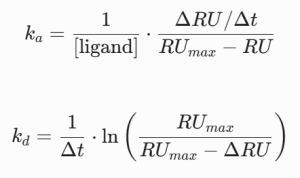
As per Surface plasma resonance methods, analyze the binding kinetics of a biomolecule to calculate the association rate constant (ka) and the dissociation rate constant (kd) using the following hypothetical dataset:
| Time (s) | SPR Response (RU) |
| 0 | 0 |
| 10 | 100 |
| 20 | 200 |
| 60 | 500 (Max Response, RUmax |
The fundamental kinetic equations used in Surface plasma resonance methods are:
The Solution Breakdown
If we take a ligand concentration of 100 μg/mL and plug these numbers into our kinetic model, we can separate the binding phase from the washing phase.
-
The calculation yields an association rate constant (ka) of 5.0 × 10³ M-1s-1. This tells us how fast the pairs hook up.
-
The dissociation rate constant (kd) comes out to 0.01 s-1. This tells us how quickly they fall apart.
Common Misconceptions in Surface Plasma Resonance Methods For CSIR NET
A classic trap that students fall into is thinking that SPR is a high-tech tool for measuring surface roughness. It’s easy to see why: you’re shining light on a surface, so it feels like you’re measuring the physical bumps on the metal.
But that isn’t true. SPR reacts to the refractive index of the environment within a few hundred nanometers of the metal surface.
A Quick Analogy: Imagine sticking a straw into a glass of water. The straw looks bent because water bends light differently than air does. Now imagine dissolving sugar into that water. The straw looks even more distorted because the changing concentration alters the liquid’s refractive index.
SPR does something similar at the nanoscale. It doesn’t care if the gold film has microscopic scratches; it cares about the change in light-bending properties caused by molecules attaching or detaching from the surface. Cleared-up concepts like this can prevent you from losing easy marks on conceptual true/false questions.
Real-World Applications of Surface Plasma Resonance Methods For CSIR NET
To make this stick, let’s look at how this plays out in real life across three major areas:
1. Biosensors and Medical Diagnostics
Imagine a fictional medical lab trying to spot a specific cancer biomarker in a blood sample. The team bonds target antibodies to the SPR gold chip. When they run the patient’s sample over it, the biomarkers lock onto the antibodies. The sudden accumulation of mass alters the refractive index, the resonance angle shifts, and the detector flags the match instantly—no chemical dyes needed.
2. Pharmaceuticals and Drug Discovery
Before a life-saving drug hits the pharmacy shelves, scientists need to know how well it sticks to target proteins in the body. If it binds too weakly, it won’t work; if it binds too tightly, it could be toxic. SPR lets chemists watch this handshake happen in real time, helping them optimize drug formulas early in the pipeline.
3. Food Safety
Imagine a safety inspector testing milk for hidden pesticide residues. By running the liquid over an SPR chip coated with pesticide-specific receptors, they can spot tiny amounts of contaminants in minutes, keeping food supplies safe.
Here is a quick look at the core applications you should remember:
| Application Field | What It Actually Does |
| Biotechnology | Tracking protein-ligand and DNA-RNA hybridization dynamics. |
| Pharmaceuticals | Screening small molecule drugs to find the best binding affinity. |
| Materials Science | Measuring the thickness and optical properties of ultra-thin films. |
Exam Strategy: Mastering Surface Plasma Resonance Methods For CSIR NET
When you are staring down a multi-part physical chemistry question on exam day, don’t let the jargon intimidate you. Succeeding with this topic comes down to a simple three-step approach:
-
Visualize the Physics: Always picture the light striking the prism, the evanescent wave dipping into the solution, and the electron wave sloshing on the gold.
-
Learn the Kinetics Graphs: Get comfortable looking at an SPR sensorgram. You should immediately recognize the steep climb of the association phase, the flat plateau of equilibrium, and the downward slope of the dissociation phase.
-
Watch the Units: Keep a close eye on concentration units ($\text{M}$, $\text{mM}$, $\mu\text{g/mL}$) when calculating $k_a$ and $k_d$ so you don’t drop points on easy arithmetic.
We design our learning resources at VedPrep around this intuitive approach. We focus on clear study guides, practical problem breakdowns, and test series that mirror the actual exam environment, helping you build genuine confidence without the stress.
Advanced Topics in Surface Plasma Resonance Methods For CSIR NET
If you want to clear the cutoff for the Junior Research Fellowship (JRF), you need to be ready for advanced, research-level subtopics such as Surface plasma resonance methods.
Surface Plasmon Polaritons (SPPs)
When a light photon couples with the surface electron plasma, it creates a hybrid excitation called a Surface Plasmon Polariton (SPP). These are electromagnetic waves that travel horizontally right along the metal-dielectric boundary. They don’t radiate outwards; instead, they create an evanescent field that drops off exponentially as you move away from the surface.
Quantum Effects at the Nanoscale
When your metal film or nanoparticle shrinks to just a few nanometers across, classical physics stops working. At this scale, you have to account for quantum tunneling (electrons jumping across gaps they shouldn’t be able to cross) and nonlocal screening effects.
Surface Plasma Resonance Methods For CSIR NET: Lab Setup and Equipment
If you walked into a biophysics lab, a standard Surface plasma resonance methods instrument would contain four basic components working in harmony:
-
The Light Source: Usually a high-quality laser emitting monochromatic light.
-
The Prism: Typically set up in a “Kretschmann configuration” to geometry-match the momentum of the incoming light to the surface plasmons.
-
The Sensor Chip: A glass slide coated with a pristine, 50-nanometer-thin layer of gold.
-
The Detector: A photodiode array that tracks the exact angle where the reflected light intensity dips.
Working with Surface plasma resonance methods requires stable laboratory conditions. Even a tiny temperature swing can alter fluid densities and throw off your refractive index readings. Furthermore, working with chemical modifying agents for gold surfaces requires proper ventilation and safety gear to keep things clean and precise.
Conclusion
Mastering Surface plasma resonance methods is an excellent way to pick up points in the Physical Chemistry and Biophysics portions of your upcoming exam. By connecting electromagnetic theory to practical, real-time kinetics, you get a clear look at how light and matter interact at the nanoscale.
Whether you are working through a kinetic equation in Part C or ruling out options in a conceptual question, focusing on refractive index sensitivity and electron oscillations will give you the edge you need. Keep practicing the problems, stay curious about the physical models, and you will be in great shape for the exam.
To know more in detail from our faculty, watch our YouTube video:
Frequently Asked Questions
How does SPR work?
SPR works by exciting surface plasmons at the interface between a metal film and a dielectric medium, resulting in a resonance peak that shifts in response to changes in the refractive index.
What are the applications of SPR?
SPR has various applications in biology, chemistry, and physics, including studying protein-ligand interactions, detecting biomolecules, and monitoring surface reactions.
What are the advantages of SPR?
SPR offers high sensitivity, real-time analysis, and label-free detection, making it a valuable tool for studying molecular interactions and kinetics.
What is the role of SPR in biophysics?
SPR plays a significant role in biophysics, enabling researchers to study biomolecular interactions, folding, and dynamics in a controlled environment.
What are the limitations of SPR?
SPR has limitations, including sensitivity to surface roughness, limited depth penetration, and potential interference from non-specific binding.
How is SPR relevant to CSIR NET?
SPR is a crucial topic in CSIR NET, as it is a biophysical method used to study molecular interactions, which is essential in various biological and chemical processes.
What are the key concepts to focus on for SPR in CSIR NET?
Key concepts to focus on include the principles of SPR, instrumentation, data analysis, and applications in biology and chemistry.
How can I apply SPR to solve problems in CSIR NET?
To apply SPR, one needs to understand the underlying principles and be able to analyze data, interpret results, and relate them to biological and chemical processes.
What are common mistakes in SPR data analysis?
Common mistakes include incorrect data fitting, neglecting surface roughness, and failing to account for instrumental limitations.
How can I avoid errors in SPR experiments?
To avoid errors, ensure proper instrument calibration, use suitable data analysis software, and consider surface chemistry and sample preparation.
What are the recent advancements in SPR technology?
Recent advancements include the development of SPR imaging, multiplexed SPR, and SPR-MS, which enable high-throughput analysis and multi-dimensional characterization.
How can SPR be integrated with other biophysical methods?
SPR can be integrated with methods like NMR, DLS, and microscopy to provide a comprehensive understanding of biomolecular interactions and behavior.
What are the future prospects of SPR in biological research?
SPR is expected to play a crucial role in understanding complex biological systems, studying disease mechanisms, and developing personalized medicine approaches.
Can SPR be used for studying membrane protein interactions?
Yes, SPR can be used to study membrane protein interactions, providing insights into protein-lipid and protein-protein interactions in a controlled environment.