
Receptors & Ligands
Receptors and ligands are the basic building blocks of cellular communication. Receptors are proteins that detect signals. Ligands are chemicals that bind to receptors and induce biological reactions. In living organisms, receptors and ligands interact to control activities such as hormone action, immunological signaling, neurotransmission, growth, metabolism and gene expression.
Cell signaling relies on receptors and ligands.
Receptors and ligands are the basis of cell signaling in unicellular and multicellular organisms. The ligand works as a signaling molecule, and the receptor detects and binds to the signal with a high degree of selectivity. So receptors bind to ligands, and this translates an outside message to a detectable response inside the cell. This response can include activating an enzyme, moving ions, or regulating genes.
Cells are always taking in information from their environment. Ligands are hormones, neurotransmitters, cytokines and growth factors. The ligands diffuse in the extracellular fluid or in the blood and bind to target receptors on the cell membrane or inside the cell.
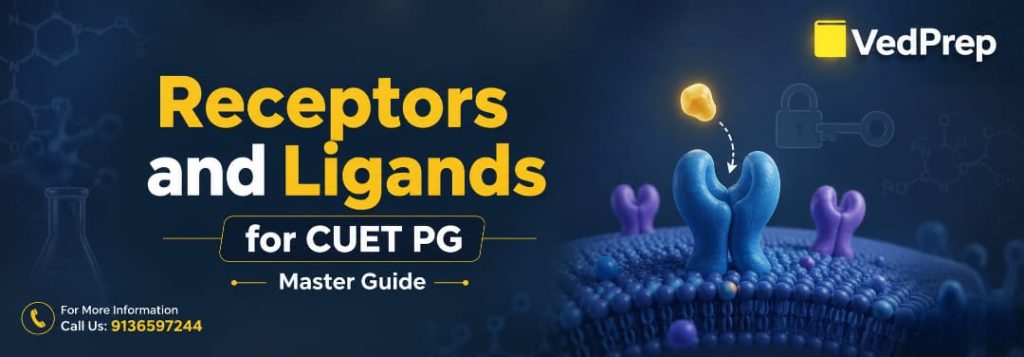
The specificity of receptors and ligands is often referred to as a lock-and-key mechanism. A receptor can only bind efficiently to ligands with the correct molecular structure. This selected connection enables the cell to respond correctly to changes in physiological conditions.
Receptors and ligands play a role in physiology, pharmacology, immunology and molecular biology. Many medications either activate receptors or prevent ligand binding. So, it is necessary to know about receptors and ligands for the students studying for CSIR NET, IIT JAM, CUET PG, GATE & other life science exams.
Receptors: Structural Features
Receptor and Ligands (Ligands are molecules that bind to a specific binding site on a protein called a receptor.) The binding sites are composed of amino acid combinations that generate a complementary shape and chemical environment to the ligand. The shape of receptors determines binding selectivity, signaling intensity and cellular response.
Most of the receptors are located in two major places, i.e., the plasma membrane and the intracellular compartment. Membrane receptors recognize hydrophilic ligands, which cannot cross the lipid bilayer. Lipid-soluble ligands such as steroid hormones bind to intracellular receptors.
The typical receptor has 3 key parts. The ligand-binding domain detects signaling chemicals. The transmembrane domain, if present, fixes the receptor in the membrane. The intracellular domain activates signaling pathways within the cell.
Ligand binding induces changes in receptor conformation. This conformational change triggers downstream signaling proteins or enzymes. Receptor activation often leads to phosphorylation cascades, second messenger synthesis or transcriptional modifications.
Some receptors are monomers while others need to dimerize or oligomerize to get activated. Receptor organisation has a substantial influence on signal amplification and response length.
Types of Ligands in Biological Systems
Ligands are chemicals that bind selectively to receptors and start or alter signaling cascades. Ligands vary in size, chemical composition and biological function. The diversity of ligands enables cells to use several signaling pathways simultaneously.
Hormones are typical ligands in endocrine signaling. Some hormones , including insulin , estrogen , and cortisol , attach to specific receptors and govern growth , development , and metabolism . Ligands in the neurological system include neurotransmitters such as dopamine and acetylcholine.
Another major class of ligands are growth factors. Epidermal growth factor and platelet-derived growth factor control cell proliferation and differentiation. Cytokines: Ligands in Immune Communication and Inflammation.
Ligands are classed as agonists, antagonists, or partial agonists. Agonists bind to the receptor and fully activate it. Antagonists bind to the receptor but do not activate the signaling pathways. Partial agonists have a reduced effect as they attach to the receptor.
Artificial ligands are frequently employed in health and biotechnology. Many of the therapeutic medicines are either mimics of natural ligands or antagonists of ligand-receptor interactions. This idea provides the basis for treating hypertension, diabetes, allergies, neurologic diseases, and cancer.
Signal Transduction and Membrane Receptors
Located on the cell surface, membrane receptors mediate communication between external ligands and intracellular signalling systems. These receptors are important because many ligands are hydrophilic and cannot pass directly through the plasma membrane.
Three major classes of membrane receptors are often researched. G protein-coupled receptors, ion channel receptors and enzyme-linked receptors differ in their structures and signaling processes.
G protein-coupled receptors are one of the most frequent types of receptors in eukaryotic cells. Ligand binding activates G proteins that control second messengers such as cyclic AMP and calcium ions. These receptors modulate sensory perception, metabolism and neurotransmission.
Ion channel receptors control the passage of ions across membranes. The ligands for these receptors are often neurotransmitters. Opening or closing ion channels when a ligand binds. This rapidly changes the membrane potential and cellular activity.
Enzyme-linked receptors usually have inherent kinase activity. Important examples are receptor tyrosine kinases mediating growth and differentiation. Ligand binding induces receptor dimerisation and phosphorylation, leading to activation of signaling cascades such as MAPK and PI3K pathways.
Deregulated signaling of membrane receptors is related to diabetes, autoimmunity and cancer progression.
Intracellular Receptors and Control of Gene Expression
Intracellular receptors are located in the cytoplasm or nucleus and bind lipid-soluble ligands that diffuse across the plasma membrane. These receptors largely influence transcription and long-term cellular responses.
Steroid hormones are classical ligands of intracellular receptors. Cortisol, testosterone, estrogen and thyroid hormones enter cells and attach to certain receptor proteins. • Binding of ligand affects receptor conformation • Receptor-ligand complex interacts with DNA
Most intracellular receptors are transcription factors. They bind to hormone response elements in the promoter regions of target genes. This relationship affects the synthesis of RNA and the creation of proteins.
Signaling by intracellular receptors is slower than that of membrane receptors because of the time required to alter gene expression. However, the effects are typically more long-lasting and impact growth, metabolism and differentiation.
Many people think that membrane signaling is stronger than intracellular signaling. Indeed, signal strength is determined by the number of receptors, the ligand concentration, the cellular environment, and the effectiveness of the downstream pathway. Some membrane receptors elicit fast amplified responses that are larger than the strength of intracellular signaling.
Intracellular receptors and ligands are especially relevant in the fields of endocrinology and cancer biology, as hormone-dependent cancers often have altered receptor activity.
Affinity, Specificity and Receptor-Ligand Interaction
Affinity and specificity are the characteristics that determine how receptors bind ligands. Affinity is the strength of binding of the ligand. Specificity is the selectivity of the receptors in binding specific ligands.
Receptors with high affinity can bind ligands well at low doses. Weak affinity interactions require larger ligand concentrations to elicit a detectable response. Hence, receptor-ligand affinity is a key determinant of cellular sensitivity.
Receptor and ligand binding is stabilized by non-covalent interactions. Molecular recognition is achieved by the combined action of hydrogen bonds, ionic interactions, hydrophobic interactions and van der Waals forces.
Usually, binding is reversible. Receptors are constantly associating and dissociating from ligands. The strength of the signal is dictated by the equilibrium between bound and unbound states.
Most receptor binding sites are occupied when receptor saturation occurs. Increasing the concentration of the ligand above this level elicits minimal further reaction. The idea is commonly used in pharmacological and biochemical experiments.
Mutations in the receptor structure can change ligand recognition and signaling effectiveness. Even slight structural alterations could interfere with the receptor-ligand interaction and contribute to illness states such as hormone insensitivity syndromes or insulin resistance.
Receptors and Ligands: Their Role in Human Health and Disease
Receptors and ligands are directly connected to the normal physiology and disease development. Many clinical disorders result from faulty receptors, aberrant ligand synthesis, or altered signalling pathways.
Take diabetes mellitus, for example. Insulin is a ligand that interacts with insulin receptors to control glucose absorption. Defects in receptor signaling contribute to insulin resistance and metabolic imbalance.
Cancer cells often overexpress or mutate growth factor receptors. Over-activation of the receptor causes uncontrolled cell division and survival. Several anticancer medications are intended to target the blocking of aberrant receptor-ligand signaling.
Receptors and ligands are also involved in neurological illnesses. Dopamine receptor deficiency is associated with Parkinson’s disease and schizophrenia. Many psychiatric medicines target neurotransmitter receptors to restore the balance of signaling.
Infectious disorders can be caused by microorganisms entering cells through receptor systems. Human immunodeficiency virus infects immune cells via CD4 receptors and co-receptors.
Receptor biology is of increasing interest to modern treatments because receptors provide readily accessible and highly specific biological targets. Many drug development strategies tend to identify ligands that can modulate receptor function with minimal adverse effects.
Uses of Receptors and Ligands in Biotechnology and Medicine
Receptors and ligands have numerous applications in diagnostics, medicines and biotechnology. They are highly specific and are useful for the diagnosis of disease and for directing therapy.
Imaging methods use radio-labelled ligands to visualize the distribution of receptors in tissues. Receptor targeting compounds are frequently used in positron emission tomography for cancer detection and neuronal investigations.
Monoclonal antibodies are very selective ligands for biological receptors. They are commonly employed in immunotherapy and targeted medication delivery. The antibody-receptor interaction is important for the selective destruction of sick cells and to limit harm to healthy tissue.
Receptor and ligand binding kinetics are routinely evaluated in drug screening experiments. These assays are used in drug discovery to find molecules with the best affinity and efficacy.
Another use of synthetic biology is creating controllable biological systems through manufactured receptors and ligands. Engineered receptors that are responsive to synthetic ligands have applications in therapy and research.
VedPrep helps students learn these high-level molecular biology topics for exams like CSIR NET, IIT JAM, CUET PG, GATE, and also for assistant professor recruitment exams in Biology, Chemistry, Physics, and multidisciplinary life sciences. VedPrep is able to assist Top rankers and AIR 1 holders with concept-driven learning methodologies.
Why a Receptor Signal Doesn’t Always Have the Same Effect
The receptor signaling results are dependent on cell type, receptor density, ligand concentration and intracellular signaling machinery. Various cells have various signaling pathways; therefore, the same ligand can have different effects in different tissues.
For example, adrenaline works on several receptor subtypes. In cardiac muscle, it leads to an increased rate of heart rate. In some blood arteries, it may trigger vasodilation or vasoconstriction depending on the location of receptors.
Another key constraint is receptor desensitization. Continued exposure to ligands can lead to reduced receptor responsiveness through internalization or structural alteration. This process is responsible for the reduced therapeutic efficacy with continuous use of drugs.
Another difference in routes is signal amplification. Some receptors initiate huge signaling cascades with major downstream effects, while others have local or brief effects.
Understanding these limits helps to avoid oversimplification of receptor biology. To effectively analyse the data, it is important to evaluate ligand concentration, receptor subtype, tissue context and downstream signaling networks collectively, rather than in isolation.
Frequently Asked Questions
2. What is the difference between a receptor and a ligand?
A receptor is the target protein that receives a signal, while a ligand is the signaling molecule that binds to the receptor. Receptors are usually located on the cell membrane or inside cells, whereas ligands can include hormones, neurotransmitters, drugs, ions, or peptides.
3. How do receptors and ligands interact?
Receptors and ligands interact through specific molecular binding. The ligand fits into the receptor’s binding site based on shape, charge, and chemical compatibility. This interaction changes the receptor’s structure, activating intracellular signaling pathways that produce a physiological or cellular response.
4. Why are receptors important in cell signaling?
Receptors are essential because they detect external signals and convert them into cellular responses. Without receptors, cells cannot communicate effectively. They regulate processes such as immune defense, hormone action, neuronal signaling, and tissue growth, making them central to maintaining normal body functions.
5. What are examples of ligands?
Ligands include hormones like insulin, neurotransmitters such as dopamine, ions like calcium, growth factors, and pharmaceutical drugs. Some ligands activate receptors, while others block receptor activity. Their effects depend on receptor type, binding affinity, and cellular context.
6. What are the main types of receptors?
The main receptor types include cell surface receptors and intracellular receptors. Cell surface receptors include G protein-coupled receptors, ion channel receptors, and enzyme-linked receptors. Intracellular receptors are found inside the cell and commonly bind steroid hormones and lipid-soluble molecules.
7. What is receptor specificity?
Receptor specificity refers to the selective binding between a receptor and its ligand. Each receptor recognizes particular molecular structures, ensuring accurate signaling. High specificity prevents unwanted cellular responses and helps maintain precise communication within biological systems.
8. How does ligand binding activate a receptor?
Ligand binding changes the receptor’s three-dimensional structure. This structural change activates intracellular signaling proteins or enzymes, initiating pathways that alter gene expression, metabolism, ion movement, or cellular activity. Different receptors use different activation mechanisms depending on their biological role.
9. What is receptor-ligand affinity?
Affinity describes how strongly a ligand binds to its receptor. High-affinity ligands bind more tightly and usually require lower concentrations to produce effects. Affinity is important in pharmacology because it influences drug potency, receptor occupancy, and therapeutic effectiveness.
10. What is the lock-and-key model in receptor biology?
The lock-and-key model explains receptor-ligand interaction by comparing the receptor to a lock and the ligand to a key. Only ligands with the correct molecular shape fit the receptor properly, allowing signal activation and ensuring biological specificity.
11. What are agonists and antagonists?
Agonists are ligands that activate receptors and produce biological responses. Antagonists bind receptors without activating them, blocking other ligands from binding. These molecules are widely used in medicine to either stimulate or inhibit specific signaling pathways.
12. How do receptors transmit signals inside the cell?
Activated receptors transmit signals using second messengers, phosphorylation cascades, ion movement, or protein interactions. These signaling pathways amplify the original signal and coordinate cellular responses such as gene activation, secretion, contraction, or metabolic regulation.