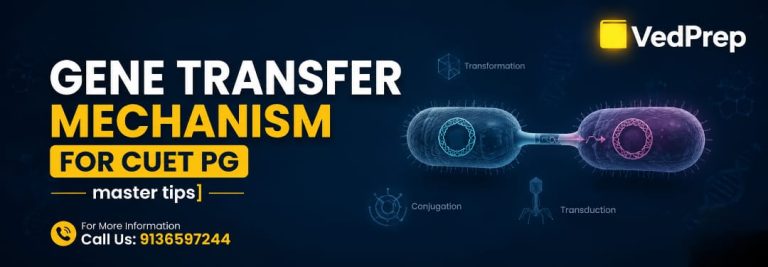

Gene transfer mechanism
Gene transfer mechanism means transfer of the genetic material from one organism or cell to another through transformation, transduction, conjugation, and horizontal gene transfer. Mechanisms of gene transfer are important in microbial evolution, antibiotic resistance, genetic engineering, biotechnology and competitive examinations like CUET PG, CSIR NET, IIT JAM and GATE.
Gene transfer mechanism in biology
Gene transfer mechanism is very important in heredity, adaptation and microbial diversity. The exchange of genetic material allows organisms to gain new traits, survive environmental stress, and evolve rapidly under selective pressure.
Gene transfer mechanisms are relevant to nearly all fields of modern biology. Higher organisms need gene transfer for reproduction and inheritance. Bacteria get antibiotic resistance genes through horizontal gene transfer. The movement of DNA also supports genetic variation, which is necessary for evolution and natural selection.
Gene transfer between cells is particularly important in microbial genetics. Many pathogenic bacteria acquire virulence factors via mobile genetic elements such as plasmids and transposons. Industrial biotechnology uses controlled gene transfer to make insulin, vaccines, enzymes and recombinant proteins.
In CUET PG, the mechanism of gene transfer is an important topic for the examination as frequently questions are asked from conjugation, transformation, bacteriophage-mediated transduction and recombinant DNA technology. Students are also expected to be familiar with the use of gene transfer systems in the laboratory.
Modern genomics has proved that gene transfer is more fluid than we imagined. Genetic exchange happens not only between related organisms, but sometimes also across distant species boundaries under special conditions.
Vertical vs Horizontal Gene Transfer
Gene transfer can occur by vertical transfer from parent to child or by horizontal transfer between unrelated organisms. Both mechanisms contribute to genetic continuity and biological diversity, but horizontal gene transfer is especially important in microbial evolution.
Vertical gene transfer happens during reproduction. In sexually reproducing organisms, genes are transmitted through gametes, while bacteria transfer genetic information in binary fission. Vertical transmission maintains species-specific traits from generation to generation.
Horizontal gene transfer is the uptake of DNA from external sources. Conjugation, transformation, and transduction are frequently how bacteria share their genes. Horizontal transfer is a fast way to adapt, requiring only a few generations for organisms to acquire beneficial traits.
Antibiotic resistance is a major real-world example. Plasmids can facilitate the rapid horizontal transfer of resistance genes between bacterial populations. Infections acquired in hospital are often difficult to treat because bacteria have a good way of sharing genetic material with each other.
A common misconception is that evolution is primarily driven by slow mutation accumulation. In numerous microorganisms, horizontal gene transfer might be a more rapid way to evolve than random mutation. Environmental stress, exposure to antibiotics and microbial density can accelerate genetic exchange.
In CUET PG, gene transfer mechanisms usually have comparison questions to distinguish between vertical inheritance and horizontal transfer pathways.
Transformation as a Gene Transfer Mechanism
Transformation is a gene transfer mechanism that involves competent cells taking up free DNA fragments from the surroundings. The incorporated DNA can recombine with the host genome and lead to stable genetic changes.
The first demonstration of transformation was made by Frederick Griffith in experiments with virulent and non-virulent strains of the bacterium Streptococcus pneumoniae. Avery, MacLeod, and McCarty later studied the phenomenon and confirmed that DNA was the transforming principle.
Bacillus, Streptococcus, Neisseria. Natural transformation in bacteria. Competent cells have specialised membrane proteins that bind to exogenous DNA and introduce genetic material into the cytoplasm.
In molecular biology labs, artificial transformation is a routine practice. Bacterial cells are treated with calcium chloride and electroporated to take up recombinant plasmids carrying the genes of interest. Scientists use transformed bacteria to make therapeutic proteins and cloned pieces of DNA.
Transformation efficiency depends on the environmental conditions, concentration of DNA, and competence of cells. Some systems do not naturally transform. This limits the applicability of the process.
The gene transfer mechanism of transformation is of utmost importance in biotechnology, as recombinant DNA technology is highly dependent upon the artificial transformation methods for cloning and gene expression studies.
Transduction and Gene Transfer by Bacteriophages
Transduction is a process of gene transfer mediated by bacteriophages. These viruses transfer bacterial DNA from one host cell to another during their infection cycle. “Transduction is a significant contributor to the evolution and genetic recombination of bacteria.”
Bacteriophages infect bacterial cells and inject viral nucleic acid. During viral replication, bits of bacterial DNA can get accidentally packed into phage particles. Then, during subsequent infection, the phage transfers bacterial genes to another bacterial cell.
Generalised transduction happens when random pieces of bacterial DNA are transferred. Specialised transduction: Transfer of specific bacterial genes near sites of prophage integration.
Transduction is of great medical importance, since bacteriophage activity may transfer toxin genes and virulence factors between pathogenic bacteria. Certain bacterial pathogens are more virulent upon acquisition of phage-encoded toxins.
Transduction is commonly used in laboratory genetics for gene mapping and strain construction. Bacteriophages are highly efficient vectors for DNA transfer in bacterial systems.
The simplified explanation usually describes bacteriophages as bacterial killers. Furthermore, bacteriophages are important actors in genetic exchange and microbial evolution in natural ecosystems.
CUET PG gene transfer mechanism is typically related to detailed conceptual questions of generalised and specialised transduction pathways.
Conjugation and Plasmid Transfer
Conjugation is a direct cell-to-cell transfer of genetic material. Genetic material is transferred through physical contact between donor and recipient cells. Conjugation usually involves plasmids that carry transferable genes.
The F plasmid of Escherichia coli is a classical model system for bacterial conjugation. Donor cells that carry the fertility factor form conjugation pili that contact recipient cells lacking the plasmid.
In conjugation, a single strand of plasmid DNA is transferred to the recipient cell, and then a complementary strand is synthesised to regenerate double-stranded DNA. Recipient cells may then themselves become donors.
Some conjugative plasmids bear antibiotic resistance genes, heavy metal resistance determinants or metabolic pathways. Bacterial populations adapt to environmental pressures efficiently due to rapid plasmid transfer.
Hfr strains are produced by integrating plasmids into bacterial chromosomes. These strains transfer chromosomal genes during conjugation and greatly aid studies of bacterial gene mapping.
Conjugation shows that bacterial populations are genetically interactive rather than isolated entities. Dense microbial communities in soil and water, and biofilms, often support extensive plasmid exchange.
The mechanism of gene transfer by conjugation remains a focus in microbiology, biotechnology and public health research. This is because plasmid-mediated resistance continues to pose a challenge to antimicrobial therapy globally.
Gene transfer Mechanism in eukaryotes
Mechanisms of gene transfer in eukaryotes include natural inheritance systems and artificial methods of genetic engineering used in biotechnological and medical research. Eukaryotic gene transfer is more complex in general because of larger genomes and membrane-bound nuclei.
Sexual reproduction during meiosis and fertilisation involves natural gene transfer. Meiotic recombination is a process that creates genetic diversity by swapping DNA segments between homologous chromosomes.
Artificial gene transfer methods include microinjection, electroporation, liposome-mediated delivery, viral vectors and CRISPR-associated systems. Scientists insert foreign genes into plant, animal or human cells for research and therapeutic purposes.
Agrobacterium tumefaciens is a widely used tool in plant biotechnology for the insertion of genes into plant genomes. Transgenic crops are developed using gene transfer techniques to confer pest resistance or improved nutritional quality.
A major medical application is gene therapy. Genetic diseases are treated by inserting functional genes into defective cells. But gene therapy also has problems with how well it can be delivered, how the body might react to it, and how safe it is in the long term.
In modern genetics, the gene transfer mechanism for CUET PG can be achieved by using recombinant DNA technology, transgenic organisms and viral vectors.
Mobile genetic elements and gene transfer
Mobile genetic elements are DNA sequences that can move within or between genomes. These elements have a strong influence on gene transfer mechanisms by stimulating recombination, mutation and horizontal DNA exchange.
Plasmids are DNA molecules separate from the chromosome, which replicate independently and often contain resistance or virulence genes. Transposons or jumping genes are mobile elements that move between chromosomal and plasmid locations via transposition mechanisms.
Insertion sequences do have genes for transposase, which is needed for movement. Integrons capture and express exogenous gene cassettes, particularly antibiotic resistance determinants of pathogenic bacteria.
Mobile genetic elements accelerate bacterial adaptation as advantageous genes can be transmitted quickly in microbial populations. Environmental stress can increase the frequency of transposition and genetic rearrangements.
One major limitation often ignored in oversimplified explanations is that gene transfer does not necessarily have positive effects. Some of the transferred genes have a metabolic cost, decrease the fitness of the cell or disrupt normal regulatory pathways.
The knowledge of mobile genetic elements is important for microbial genetics, biotechnology and epidemiology, as these elements dictate the evolution of the genome and the spread of resistance patterns in microbial communities.
Gene Transfer Mechanism in Genetic Engineering
The gene transfer mechanism is the technical basis of genetic engineering, recombinant DNA technology and synthetic biology. Scientists can design organisms for industrial, medical and agricultural applications through controlled DNA transfer.
Recombinant DNA technology is a technology that joins DNA fragments from different sources using restriction enzymes and ligases. Engineered plasmids act as vectors to deliver recombinant genes into host organisms.
Recombinant plasmids are used to transform bacteria to produce molecules of commercial importance such as insulin, growth hormones and vaccines. Industrial fermentation systems then grow genetically engineered microorganisms in large amounts.
Gene editing technologies like the CRISPR-Cas systems enable precise control of genome modification. Scientists can precisely add, remove or change particular stretches of DNA.
Other applications of biotechnology include genetically modified crops, microbes that generate biofuels, biodegradable plastics, and engineered enzymes for industrial processing.
There are still important ethical and ecological issues. Careful control and monitoring of biosafety are needed for genetic engineering projects, to prevent uncontrolled gene flow, ecological imbalance and transfer of antibiotic markers.
VedPrep offers exam-oriented conceptual learning and previous year question analysis to help students prepare for CUET PG, CSIR NET, IIT JAM, GATE and life science exams to make concepts of biotechnology and microbial genetics easy.
Practical Applications of Gene Transfer Mechanism
Gene transfer mechanisms have practical applications in medicine, agriculture, forensic science, environmental biology and pharmaceutical research. Controlled genetic exchange enables the development of modern diagnostic and therapeutic technologies.
Medical labs grow recombinant bacteria to make insulin to treat diabetes. Before this, insulin was extracted from animal tissues with limitations in purity and immune compatibility. Many of these challenges were solved by recombinant DNA technology.
Transferred genes are used in agricultural biotechnology to improve the resistance of crops to insects, pathogens and drought stress. Genetic engineering research also defines nitrogen-fixing capabilities and nutrient enrichment strategies.
Environmental applications include genetically engineered microbes able to degrade pollutants and toxic chemicals during bioremediation programs.
Forensic science uses DNA transfer principles in molecular identification and genetic fingerprinting. The fundamental principles of gene transfer are the basis of PCR amplification and molecular cloning techniques.
One practical limitation is that success in the laboratory does not automatically translate directly into success in the field. Things outside of the lab, the environment, the stability of the gene, and how it interacts with other things in the environment.
CUET PG gene transfer mechanism frequently features questions that are application-based and connect microbial genetics to biotechnology and molecular biology techniques.
Challenges and Limitations of Gene Transfer Mechanism
Gene transfer mechanisms are highly useful in biology and biotechnology. However, there are several biological and technical limitations affecting the efficiency, predictability and safety of this mechanism. Host compatibility and environmental factors often determine the outcome of gene transfer.
Not all organisms readily take up foreign DNA. Membrane barriers, immune responses and restriction enzymes can degrade the genetic material introduced before successful integration.
Horizontal gene transfer mechanism can also be a public health issue. Resistance plasmids spread rapidly among bacterial populations in hospitals or environmental reservoirs, leading to antibiotic-resistant bacteria.
Artificial gene transfer techniques could result in unintentional mutations or unstable gene expression. Viral vectors for gene therapy can sometimes cause immune problems or insertional mutagenesis.
Another limitation is ecological unpredictability. Genetically modified organisms released into natural ecosystems may interact with native species in novel ways. So, long-term ecological research remains important.
The scientific consensus recognises that gene transfer isn’t always good, nor is it necessarily bad. The outcome depends on the regulatory control, environmental monitoring and biological context.
The mechanism of gene transfer is one of the most exciting subjects in microbiology and molecular genetics because new pathways of DNA exchange and genome evolution are still being discovered.
Gene Transfer Mechanism for CUET PG Preparation
The gene transfer mechanism for CUET PG requires conceptual clarity in the areas of transformation, transduction, conjugation, plasmid biology, recombinant DNA technology and microbial genetics. Competitive examinations demand application-based reasoning apart from theoretical understanding.
Students should understand the differences in processes and not just memorise the definitions. Comparative analysis permits the distinction between generalised and specialised transduction and between transformation and conjugation.
Diagram preparation helps with retention, as many exams will have pathway-based or mechanism-based questions. Importantly, conjugation, pili formation, bacteriophage cycles and plasmid transfer steps.
Trends in the examination of the previous year show an increasing emphasis on the applications of biotechnology and horizontal gene transfer in microbial resistance. Genetics with molecular biology and microbiology helps in improving problem-solving ability.
VedPrep is an online coaching platform for aspirants preparing for CUET PG, CSIR NET, IIT JAM, GATE, UPSC Geochemist, and Assistant Professor exams with structured teaching of concepts, PYQ discussion and advanced preparation strategies for life sciences. VedPrep has always been a torchbearer for AIR 1 holders and the best students in competitive science exams.
Frequently Asked Questions
2. What are the main types of gene transfer mechanisms in bacteria?
The three major gene transfer mechanisms in bacteria are transformation, transduction, and conjugation. Transformation involves uptake of naked DNA, transduction occurs through bacteriophages, and conjugation requires direct cell-to-cell contact through a pilus. These mechanisms promote horizontal gene transfer among microorganisms.
3. What is horizontal gene transfer?
Horizontal gene transfer is the transfer of genes between organisms without reproduction. Unlike vertical gene transfer from parent to offspring, horizontal transfer occurs between unrelated cells. It is a major factor in bacterial adaptation, antibiotic resistance spread, and microbial evolution, making it highly relevant for CUET PG exams.
4. What is transformation in gene transfer?
Transformation is the process by which bacteria take up free DNA fragments from their surroundings. Competent bacterial cells can incorporate this external DNA into their genome. Frederick Griffith first demonstrated transformation in Streptococcus pneumoniae, making it one of the foundational concepts in microbial genetics.
5. What is transduction in microbiology?
Transduction is a gene transfer mechanism mediated by bacteriophages, which are viruses that infect bacteria. During infection, phages accidentally transfer bacterial DNA from one cell to another. Transduction is classified into generalized and specialized transduction depending on the DNA transferred by the phage.
6. What is conjugation in bacteria?
Conjugation is the direct transfer of genetic material between bacterial cells through physical contact. It usually involves a donor cell carrying an F plasmid and a recipient cell lacking it. A conjugation tube or sex pilus facilitates DNA transfer during this process.
7. Why are plasmids important in gene transfer?
Plasmids are small circular DNA molecules that replicate independently of the bacterial chromosome. They often carry genes for antibiotic resistance or virulence. Plasmids are important because they can move between bacteria through conjugation, contributing to rapid genetic exchange and microbial adaptability.
8. What is the role of bacteriophages in gene transfer?
Bacteriophages transfer genetic material during transduction. When phages infect bacteria, they may accidentally package bacterial DNA and inject it into another host cell. This process helps spread genetic traits among bacterial populations and plays a key role in microbial evolution and diversity.
9. How does bacterial conjugation occur step by step?
During conjugation, the donor bacterial cell forms a sex pilus that attaches to the recipient cell. The cells establish direct contact, and a copy of plasmid DNA transfers through the conjugation bridge. Both cells eventually contain the plasmid, allowing further genetic exchange in bacterial populations.
10. How is competence developed in transformation?
Competence refers to the ability of bacterial cells to take up external DNA. Some bacteria naturally become competent during specific growth stages, while others can be induced artificially using chemicals or electrical pulses. Competence is essential for successful transformation and genetic recombination.
11. How does generalized transduction occur?
Generalised transduction occurs when a bacteriophage accidentally packages random fragments of bacterial DNA during the lytic cycle. The phage then transfers this DNA into another bacterial cell during infection. Since any bacterial gene can be transferred, the process is called generalised transduction.
12. How does specialized transduction differ from generalized transduction?
Specialized transduction transfers only specific bacterial genes located near the prophage insertion site. It occurs during the lysogenic cycle when the prophage excises incorrectly from the bacterial chromosome. In contrast, generalized transduction can transfer any bacterial gene randomly during the lytic cycle.