
Understanding the Lorentz Force For CUET PG Physics
Direct Answer: The Lorentz force is a crucial concept in CUET PG Physics, describing the combined electric and magnetic forces on a charged particle. It’s essential to understand the formula, its derivation, and its applications for CUET PG preparation.
Lorentz Force For CUET PG Formula and Derivation
The Lorentz force is a fundamental concept in physics that describes the force experienced by a charged particle in the presence of electric and magnetic fields. It is a combination of electric and magnetic forces acting on the particle.
The Lorentz force formula is given by F = q(E + v × B), where F is the force experienced by the particle, q is the charge of the particle, E is the electric field, v is the velocity of the particle, and B is the magnetic field. The cross product v × B represents the magnetic force component.
The Lorentz force formula was derived by Hendrik Lorentz in 1895, and it is a cornerstone of classical electromagnetism. An electric field is a vector field that surrounds charged particles, while a magnetic field is a vector field that surrounds magnets and current-carrying wires.
The Lorentz force equation has numerous applications in physics and engineering, including the study of particle motion in electromagnetic fields, electric motors, and generators. Understanding the Lorentz force is essential for students preparing for exams like CSIR NET, IIT JAM, and GATE.
Syllabus – CUET PG Electromagnetism Unit
The Electromagnetism unit, which is part of the official CSIR NET syllabus, covers several key topics, including electric and magnetic fields, Lorentz force, and electromagnetic induction. This unit is crucial for students preparing for CUET PG, as well as other competitive exams like CSIR NET, IIT JAM, and GATE.
The Lorentz force concept, a fundamental aspect of electromagnetism, describes the force experienced by charged particles in electric and magnetic fields. Students should focus on understanding the mathematical derivations and applications of this concept. Irodov and Resnick, and Halliday are two standard textbooks that cover these topics in detail.
- Electric and magnetic fields: Understanding the behavior of charged particles in various field configurations.
- Lorentz force: Mathematical formulation and applications.
- Electromagnetic induction: Principles and applications.
To master these topics, students should concentrate on developing a strong grasp of the underlying mathematical framework and its practical applications. By doing so, they will be well-prepared to tackle a wide range of problems in electromagnetism.
Lorentz force for CUET PG
A charge of 2 μC is moving with a velocity of 3 m/s in a magnetic field of 0.5 T. The velocity vector of the charge is\vec{v} = 3\hat{i}m/s and the magnetic field vector is\vec{B} = 0.5\hat{j}T. The charge is moving in a region where the electric field is zero.
The Lorentz force on a moving charge is given by the formula.
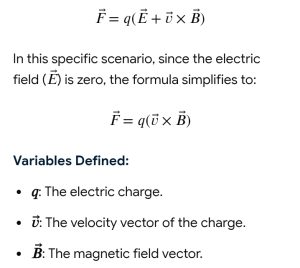
Substituting the given values, the force on the charge is calculated as:
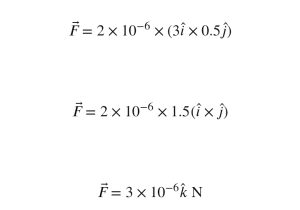
The direction of the force can be determined using theright-hand rule. The right-hand rule states that if the thumb of the right hand points in the direction of the velocity vector and the fingers point in the direction of the magnetic field vector, then the palm faces the direction of the force vector. In this case, the force vector points in the\hat{k}direction.
Misconception: Lorentz Force and Electric Field
Many students assume that the Lorentz force is only due to the magnetic field. This understanding is incorrect because the Lorentz force is, in fact, a combination of electric and magnetic forces acting on a charged particle.
The Lorentz force equation is given by\vec{F} = q(\vec{E} + \vec{v} \times \vec{B}), where q is the charge,\vec{E} is the electric field,\vec{v} is the velocity of the charge, and\vec{B} is the magnetic field. This equation clearly shows that the Lorentz force has two components: one due to the electric field (q\vec{E}) and the other due to the magnetic field (q\vec{v} \times \vec{B}).
Understanding the role of the electric field in the Lorentz force is crucial for CUET PG preparation, as it is a fundamental concept in electromagnetism. The electric field plays a significant role in determining the trajectory of charged particles in various electromagnetic phenomena. For instance, in a cathode-ray tube, the electric field is responsible for deflecting the electron beam.
To reinforce this concept, consider the following:
- The Lorentz force\vec{F}is not solely dependent on the magnetic field.
- The electric field\vec{E}contributes to the Lorentz force.
Students should ensure they grasp the combined effect of electric and magnetic fields on charged particles to excel in their exams, particularly when revising the Lorentz force for CUET PG.
Application: Lorentz Force in Particle Accelerators
Particle accelerators are complex machines that rely on the Lorentz force to steer and accelerate charged particles to incredibly high energies. The Lorentz force, a fundamental concept in physics, is the force experienced by a charged particle in the presence of electric and magnetic fields. In particle accelerators, the Lorentz force is used to guide and focus charged particles, such as electrons and protons, along a desired trajectory.
The Lorentz force enables the creation of high-energy collisions, which are essential for scientific research in particle physics. By accelerating charged particles to nearly the speed of light and then colliding them, researchers can study the properties of subatomic particles and the fundamental forces of nature. This has led to numerous discoveries, including the detection of the Higgs boson at CERN’s Large Hadron Collider.
The application of the Lorentz force in particle accelerators operates under strict constraints, including precise control over the electric and magnetic fields, ultra-high vacuum conditions, and sophisticated particle detection systems. Understanding the Lorentz force and its applications is essential for students preparing for Lorentz force For CUET PG Physics and other advanced physics exams, as it represents a critical concept in the study of electromagnetism and particle physics.
The use of Lorentz force in particle accelerators can be seen in various research facilities around the world, including the Large Hadron Collider (LHC) at CERN, the Relativistic Heavy Ion Collider (RHIC) at Brookhaven National Laboratory, and the Fermilab particle accelerator. These facilities have significantly advanced our understanding of the universe, and the Lorentz force has played a crucial role in their operation.
Exam Strategy: Focus on Mathematical Derivations for the Lorentz force for CUET PG
The CUET PG Physics exam emphasizes mathematical derivations and applications, making it essential for students to focus on problem-solving skills. A key concept in this area is the Lorentz force, which describes the force experienced by a charged particle in the presence of electric and magnetic fields.
To prepare effectively, students should practice solving problems using the Lorentz force formula: F = q(E + v × B), where F is the force, q is the charge, E is the electric field, vis the velocity, and B is the magnetic field. This formula is crucial in understanding the behavior of charged particles in various electromagnetic configurations.
Frequently tested subtopics include the force on a current-carrying wire, the torque on a current loop, and the motion of charged particles in uniform electric and magnetic fields. Students can find expert guidance on these topics through resources like VedPrep, which offers comprehensive study materials and video lectures. Watch this free VedPrep lecture on Lorentz force for CUET PG to get started.
For additional practice, students are recommended to use reference books like Irodov, Resnick and Halliday, which provide a wide range of problems to help reinforce their understanding of the Lorentz force and its applications. By focusing on mathematical derivations and practicing problem-solving, students can build a strong foundation in Physics and excel in the CUET PG exam.
Lorentz Force For CUET PG
The Lorentz force formula, which describes the force experienced by a charged particle in the presence of electric and magnetic fields, can be extended to continuous charge distributions. In such cases, the charge is not confined to a single point or a discrete set of points but is spread over a region of space.
For a continuous charge distribution, the force per unit volume, f, is given by f = ρ(E + v × B), whereρis the charge density, E is the electric field, vis the velocity of the charge, and B is the magnetic field. This equation represents the Lorentz force per unit volume exerted on the charge distribution.
Understanding the concept of continuous charge distribution and the resulting Lorentz force is crucial for CUET PG Physics. The Lorentz force equation helps in analyzing the behavior of charged particles in various electromagnetic field configurations. A clear grasp of this concept enables students to tackle complex problems in electromagnetism and charged particle dynamics.
In the context of continuous charge distributions, technical terms such as charge density(ρ) and force per unit volume(f) are essential. Charge density represents the amount of charge per unit volume, while force per unit volume describes the force experienced by the charge distribution per unit volume.
Lorentz force for CUET PG
The Lorentz force is a fundamental concept in electromagnetism that describes the force experienced by a charged particle in the presence of electric and magnetic fields. It is a crucial concept for students preparing for CUET PG, as well as other exams like CSIR NET, IIT JAM, and GATE.
The Lorentz force equation is given by\vec{F} = q(\vec{E} + \vec{v} \times \vec{B}), where\vec{F}$is the force experienced by the charged particle, q is the charge of the particle,\vec{E}is the electric field,\vec{v} is the velocity of the particle, and\vec{B} is the magnetic field. Understanding the mathematical derivations and applications of this equation is essential for solving problems related to electromagnetism.
Students should practice solving problems using the Lorentz force formula to develop a strong grasp of the concept. This includes problems involving charged particles moving in electric and magnetic fields, as well as applications in devices like cyclotrons and magnetic spectrometers.
- Electric field: a field that surrounds charged particles and exerts a force on other charged particles.
- Magnetic field: a field that surrounds magnets and exerts a force on other magnets or charged particles in motion.
- Cross product: a mathematical operation that combines two vectors to produce a third vector.
By mastering the Lorentz force concept and practicing problem-solving, students can build a strong foundation in electromagnetism and perform well in their exams.
Frequently Asked Questions
Core Understanding
What is the Lorentz force?
The Lorentz force is the force experienced by a charged particle in the presence of electric and magnetic fields. It is a fundamental concept in physics, described by the equation F = q(E + v x B), where F is the force, q is the charge, E is the electric field, v is the velocity of the charge, and B is the magnetic field.
What are the components of the Lorentz force?
The Lorentz force has two components: the electric force (qE) and the magnetic force (qv x B). The electric force is in the direction of the electric field, while the magnetic force is perpendicular to both the velocity of the charge and the magnetic field.
What is the significance of the Lorentz force in physics?
The Lorentz force is significant in physics as it describes the interaction between charged particles and electromagnetic fields. It is a fundamental principle in understanding various phenomena, including the behavior of charged particles in electromagnetic fields, electric currents, and magnetic forces.
How is the Lorentz force used in real-world applications?
The Lorentz force has numerous real-world applications, including electric motors, generators, particle accelerators, and magnetic resonance imaging (MRI) machines. It is also used in the study of plasma physics, astrophysics, and particle physics.
What are the units of the Lorentz force?
The units of the Lorentz force are Newtons (N). The electric field is measured in Volts per meter (V/m), and the magnetic field is measured in tesla (T).
What is Magnetostatics?
Magnetostatics is the study of magnetic fields and their interactions with charged particles at rest. It is a fundamental concept in physics, and it is closely related to the Lorentz force.
How does Magnetostatics relate to Electricity and Magnetism?
Magnetostatics is a part of Electricity and Magnetism, which is a fundamental branch of physics. It deals with the study of magnetic fields and their interactions with charged particles, and it is closely related to the study of electric fields and currents.
What are the applications of Magnetostatics?
Magnetostatics has numerous applications, including the design of magnetic devices, such as motors, generators, and magnetic resonance imaging (MRI) machines. It is also used in the study of magnetic materials and their properties.
What is the relation between the Lorentz force and Magnetostatics?
The Lorentz force and Magnetostatics are closely related, as the Lorentz force describes the force experienced by a charged particle in electromagnetic fields, while Magnetostatics deals with the study of magnetic fields and their interactions with charged particles.
Exam Application
How is the Lorentz force applied in CUET PG exams?
In CUET PG exams, the Lorentz force is often applied to problems involving electric and magnetic fields. Students are expected to understand the concept of the Lorentz force and be able to calculate the force experienced by a charged particle in various field configurations.
What types of questions can be expected on the Lorentz force in CUET PG exams?
In CUET PG exams, questions on the Lorentz force may include calculations of the force experienced by a charged particle, determining the trajectory of a charged particle in electric and magnetic fields, and understanding the applications of the Lorentz force in various devices.
How can students prepare for Lorentz force questions in CUET PG exams?
Students can prepare for Lorentz force questions in CUET PG exams by practicing problems, understanding the concept of the Lorentz force, and reviewing the applications of the Lorentz force in various devices and phenomena.
How is Magnetostatics applied in CUET PG exams?
In CUET PG exams, Magnetostatics is often applied to problems involving magnetic fields and their interactions with charged particles. Students are expected to understand the concept of Magnetostatics and be able to calculate the magnetic field and force experienced by a charged particle.
How to solve problems on Lorentz force and Magnetostatics?
To solve problems on Lorentz force and Magnetostatics, students should understand the concept of the Lorentz force and Magnetostatics, and be able to apply the relevant equations and principles to calculate the force and field experienced by a charged particle.
Common Mistakes
What are common mistakes made when applying the Lorentz force?
Common mistakes made when applying the Lorentz force include incorrect calculation of the force, misunderstanding the direction of the force, and neglecting to account for the velocity of the charged particle.
How can students avoid mistakes when applying the Lorentz force?
Students can avoid mistakes when applying the Lorentz force by carefully reading the problem, understanding the concept of the Lorentz force, and checking their calculations. They should also ensure that they are using the correct units and considering all the components of the Lorentz force.
What are common mistakes made when applying Magnetostatics?
Common mistakes made when applying Magnetostatics include incorrect calculation of the magnetic field, misunderstanding the direction of the force, and neglecting to account for the properties of magnetic materials.
Advanced Concepts
What is the relationship between the Lorentz force and relativity?
The Lorentz force is closely related to relativity, as it describes the force experienced by a charged particle in electromagnetic fields. The Lorentz force is a fundamental concept in special relativity, and it has been used to describe the behavior of charged particles at high speeds.
How is the Lorentz force used in quantum mechanics?
The Lorentz force is used in quantum mechanics to describe the interaction between charged particles and electromagnetic fields. It is a fundamental principle in understanding the behavior of charged particles in various quantum systems.
What are the implications of the Lorentz force on particle physics?
The Lorentz force has significant implications for particle physics, as it describes the interaction between charged particles and electromagnetic fields. It has been used to study the properties of subatomic particles and the behavior of particles in high-energy collisions.
What are the implications of Magnetostatics on advanced physics topics?
Magnetostatics has significant implications for advanced physics topics, such as particle physics, astrophysics, and condensed matter physics. It is used to study the behavior of charged particles in various systems and to understand the properties of magnetic materials.