
Ultrastructure of Plant Cell: Components, Organization, Functions and Exam-Oriented Concepts
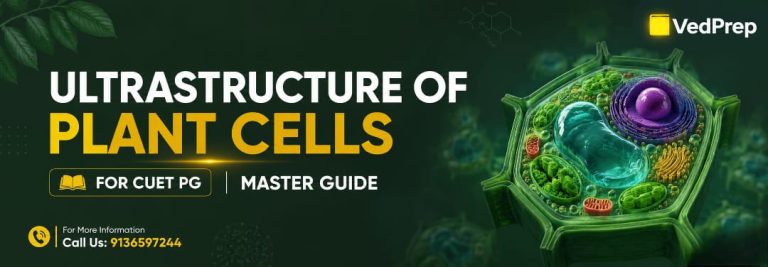
The ultrastructure of plant cells is the study of the fine structure of plant cells as observed under an electron microscope. Plant cells have a stiff cell wall , a big central vacuole , chloroplasts , nucleus , mitochondria , endoplasmic reticulum , Golgi bodies and ribosomes . All these cell organelles work together for growth, metabolism, photosynthesis and cellular regulation.
Ultrastructure of Plant Cells
The ultrastructure of plant cells refers to the microscopic architecture of organelles and cellular compartments beyond the resolution of a light microscope. Electron microscopy has demonstrated that plant cells contain highly ordered membrane-bound structures involved in energy production, protein synthesis, transport, storage and genetic regulation.
The ultrastructure of plant cells is a very important subject in cell biology, plant physiology, genetics, biotechnology and molecular biology. This topic is very common in the entrance test of life science as it correlates cellular organization with physiological function.
By understanding organelle structure, students can explain how plants photosynthesise, maintain turgor pressure, transport molecules and adapt to changes in their environment.
For students appearing for competitive examinations, the ultrastructure of plant cells for CUET PG is an important aspect of cell biology and often comes in conceptual as well as diagram-based questions.
Organization of the Plant Cell
The ultrastructure of plant cells shows a highly segregated system where each organelle carries out specialized duties. The cell architecture allows for efficient biochemical processes and coordination of metabolic pathways.
The usual plant cell consists of three major structural sections. These include the cell wall, plasma membrane and protoplasm. The protoplasm consists of the cytoplasm and the nucleus.
In the cytoplasm are membrane-bound organelles such as chloroplasts, mitochondria, endoplasmic reticulum, Golgi apparatus, vacuoles and microbodies.
Plant cells differ from animal cells in that they have chloroplasts, a cell wall made of cellulose, plasmodesmata, and a huge central vacuole. These specialized structures allow plants to accomplish photosynthesis, provide structural support, and manage water balance.
For CUET PG, the ultrastructure of plant cells is usually about the difference between plant-specific and animal-specific cell components.
Cell Wall: The Protecting Layer
Plant cells have a cell wall that provides mechanical support, protection, and form. It is the initial line of defense to environmental stress, and it surrounds the plasma membrane.
The primary cell wall is thin and flexible, enabling cell expansion during growth. During maturation, a secondary wall can be added to the primary wall to give added rigidity and strength.
The main structural framework consists of cellulose microfibrils embedded in a hemicellulose and pectin matrix. Pits and plasmodesmata perforate the cell wall, providing communication and transfer between surrounding cells. These channels are important for the coordinated growth and development of plant tissues.
In electron microscopy, the ultrastructure of plant cells shows the layered structure of the cell wall and its intimate relationship with the plasma membrane.
Organization of Plasma Membrane and Cytoplasm
The plasma membrane controls the passage of chemicals into and out of the cell. “It’s semi-permeable, and it keeps the cell in homeostasis, but it also allows the cell to absorb nutrients and excrete waste.”
The membrane is based on the fluid-mosaic model and is mostly composed of phospholipids, proteins, carbohydrates, and sterols. Transport proteins carry ions, carbohydrates and signaling chemicals across the membrane.
Organelles are suspended in cytosol within the membrane-bound cytoplasm. This is a site for many metabolic activities, including protein synthesis, glucose metabolism and intracellular transport.
Detailed ultrastructural research of plant cells reveals that the plasma membrane is also involved in cell signalling, membrane trafficking and contact with the external environment.
The Nucleus: The Genetic Control Centre
The nucleus contains the genetic information and regulates cellular functions through gene expression and control. It is among the most prominent organelles in the ultrastructure of plant cells.
The nucleus is enclosed by a double-membraned nuclear envelope. Nuclear pores in the envelope control the exchange of molecules between the nucleus and cytoplasm.
Nucleoplasm comprises chromatin and one or more nucleoli. DNA wrapped around proteins is called chromatin. When the cell divides, it condenses into chromosomes. The nucleolus is where ribosomal RNA synthesis and ribosome assembly take place.
Electron microscopy shows several compartments within the nucleus. This emphasizes the importance of structure in the management of genetic information and function in the cell.
Ribosomes and the Endoplasmic Reticulum
The ER ( endoplasmic reticulum ) is a large membrane network that is involved in the creation of proteins and lipids. Ribosomes anchored to certain locations improve the efficiency with which the cell makes proteins.
Membrane proteins, secretory proteins and enzymes are synthesized by ribosomes present in the rough endoplasmic reticulum. Smooth ER has no ribosomes and is involved in lipid synthesis, detoxification and membrane biosynthesis.
Ribosomes may be free in the cytoplasm or connected to the rough endoplasmic reticulum. These structures transform messenger RNA into proteins needed for development, metabolism and cellular upkeep.
In CUET PG, exams on the ultrastructure of plant cells often include questions about rough and smooth endoplasmic reticulum.
Golgi Apparatus and Vesicular Transport
The Golgi apparatus alters, packages, and distributes cellular products generated in the endoplasmic reticulum. In plant cells, the Golgi bodies are often referred to as dictyosomes.
Proteins and lipids entering from the endoplasmic reticulum are chemically modified in Golgi cisternae. Vesicles transfer the processed material to other regions of the cell.
Dictyosomes are also heavily involved in forming the cell wall by generating pectins and other polysaccharides. This role is particularly critical during cell proliferation and tissue formation.
The ultrastructure of plant cells displays the dynamism of the endoplasmic reticulum, Golgi apparatus and transport vesicles in the maintenance of intracellular organization.
Photosynthetic Organelles: Chloroplasts
Chloroplasts are the specialized organelles for photosynthesis.
What is the ultrastructure of a plant cell?
Each chloroplast is bounded by a double membrane and contains a fluid matrix called the stroma. Within the stroma, there is a network of thylakoid membranes stacked in stacks called grana.
Light energy is captured by chlorophyll pigments in thylakoid membranes. Light-dependent processes happen on thylakoid membranes, and carbon fixation reactions happen in the stroma.
Chloroplasts contain their own DNA and ribosomes, which is evidence in favour of the endosymbiotic theory of organelle evolution.
Mitochondria and Cell Respiration
Mitochondria are the main energy-generating organelles in plant cells, making ATP by aerobic respiration. Even when chloroplasts exist, mitochondria are still needed for the cell’s metabolism.
Mitochondria have a double membrane. The inner membrane is folded into cristae, which increases the space available for respiratory enzymes. The matrix comprises ribosomes, metabolic enzymes and mitochondrial DNA.
The energy released during the oxidation of carbohydrates is trapped in the form of ATP, which drives many cellular processes. Mitochondria and chloroplasts work in concert to coordinate the process of energy transformation within plant cells.
The ultrastructure of plant cells demonstrates that specialization of organelles increases efficiency of metabolism and fosters plant development.
Vacuoles, Microbodies and Storage
The vacuole of plant cells is often big and takes up a considerable part of the cell volume. This compartment has storage, waste management and osmotic regulating activities. The membrane surrounding the vacuole is called the tonoplast.
It is a reservoir of water, ions, pigments, metabolites and defensive chemicals. Vacuolar pressure is a major component of cell stiffness and plant support. Microbodies, including peroxisomes and glyoxysomes, are also significant components of the ultrastructure of plant cells.
Peroxisomes function in photorespiration and detoxification. Glyoxysomes convert stored lipids to sugars during seed germination. These organelles are examples of how specialized compartments increase metabolic coordination and resource use.
Intercellular Communication and Plasmodesmata
Plant cells are not independent entities. Plasmodesmata are cytoplasmic connections between neighbouring cells, mediating direct intercellular communication and transfer across tissues.
These minuscule channels traverse cell walls and are bordered by the plasma membrane. For example, ions, signalling molecules, proteins and tiny RNAs can pass through plasmodesmata.
Plant organs can develop and respond physiologically in a coordinated manner, thanks to plasmodesmata. Electron microscopy has given us important insights into their structural intricacy.
Thus, the ultrastructure of plant cells is not limited to organelles, but also includes processes that coordinate cell activity in the whole plant body.
A Widespread Myth about Plant Cell Ultrastructure
It is often assumed that the total energy requirement of plants may be met only by chloroplasts. This interpretation simplifies plant cell metabolism and may lead to wrong outcomes in tests.
Photosynthesis makes carbohydrates. Respiration still depends on mitochondria to make ATP. Mitochondrial activity is also needed for biosynthesis, transport and maintenance functions in photosynthetic tissues.
Likewise, the big vacuole is frequently seen as simply a storage space. In fact, vacuoles govern turgor pressure, pH balance, ion homeostasis and cellular defence systems.
With this functional interaction knowledge, students can have a better comprehension of the ultrastructure of plant cells, and increase their analysis performance in higher-level biological topics.
Applications of Plant Cell Ultrastructure in Contemporary Biology
Knowledge of plant cell ultrastructure is useful in agriculture, biotechnology, genetics and environmental science. Structural information is often used to enhance agricultural output and stress tolerance.
Vacuolar organization, membrane transport systems and chloroplast efficiency are studied by drought-tolerant agricultural researchers. Organelles are a common target for genetic engineering approaches. Such organelles are usually associated with photosynthesis, metabolism and cellular signalling.
Plant tissue culture, molecular breeding and transgenic crop development also rely on cellular architecture. Electron microscopy continues to uncover new aspects of organelle interaction and cellular regulation.
Students can relate the ideas of structural biology to real-world scientific applications since the test questions are more often based on conceptual knowledge rather than rote memorizing.
Conclusion: Ultrastructure of plant cells for CUET PG
The ultrastructure of the plant cell is a detailed perspective of how the cell components are arranged to allow life processes. Organelles such as the nucleus, chloroplasts, mitochondria, endoplasmic reticulum, Golgi apparatus, vacuoles and microbodies cooperate in growth, metabolism, communication and adaptability.
A good grasp of plant cell ultrastructure and plant cell ultrastructure for CUET PG is important for students to develop a strong basis for higher studies in cell biology, plant physiology, biotechnology, CSIR NET, IIT JAM, CUET PG, GATE and other life science competitive exams.
VedPrep has been guiding students for these exams consistently and has produced AIR 1s and top rankers in many competitive exams.
Frequently Asked Questions
2. Why is the study of plant cell ultrastructure important for CUET PG?
Plant cell ultrastructure is a fundamental topic in cell biology and is frequently included in CUET PG Life Sciences examinations. It helps students understand organelle functions, cellular organization, photosynthesis, protein synthesis, and transport mechanisms, which are essential concepts in advanced biological sciences.
3. What are the major components of a plant cell ultrastructure?
The major components include the cell wall, plasma membrane, cytoplasm, nucleus, chloroplasts, mitochondria, endoplasmic reticulum, Golgi bodies, ribosomes, peroxisomes, and a large central vacuole. Each structure has specialized functions that collectively maintain cellular activities and plant survival.
4. How does a plant cell differ from an animal cell ultrastructurally?
Plant cells possess a rigid cell wall, chloroplasts, plasmodesmata, and a large central vacuole, which are absent in animal cells. Animal cells generally have centrioles and lysosomes that are either absent or less prominent in plant cells. These differences reflect distinct physiological roles.
5. What is the role of the plant cell wall?
The cell wall provides structural support, protection, and shape to plant cells. It is primarily composed of cellulose, hemicellulose, and pectin. The wall prevents excessive water uptake, maintains turgor pressure, and serves as a barrier against pathogens and mechanical damage.
6. What is the significance of the plasma membrane in plant cells?
The plasma membrane is a selectively permeable boundary that regulates the movement of substances into and out of the cell. It consists mainly of phospholipids and proteins and plays essential roles in transport, communication, signaling, and maintaining cellular homeostasis.
7. Why are chloroplasts considered unique organelles in plant cells?
Chloroplasts are unique because they perform photosynthesis, converting light energy into chemical energy. They contain chlorophyll pigments, thylakoid membranes, grana, and stroma. Their semi-autonomous nature, including their own DNA and ribosomes, supports the endosymbiotic theory.
8. What is the function of the large central vacuole?
The central vacuole stores water, ions, metabolites, pigments, and waste products. It maintains cell turgidity and contributes to cell growth by exerting turgor pressure. Vacuoles also help regulate intracellular pH and protect the cell from toxic substances.
9. How do mitochondria function in plant cells?
Mitochondria generate ATP through cellular respiration. They oxidize carbohydrates and other organic molecules to produce energy required for growth, transport, biosynthesis, and cellular maintenance. Like chloroplasts, mitochondria contain their own DNA and replicate independently within cells.
10. What role does the endoplasmic reticulum play in plant cells?
The rough endoplasmic reticulum synthesizes and transports proteins, while the smooth endoplasmic reticulum is involved in lipid synthesis and detoxification. Together, these membrane systems facilitate intracellular transport and support various metabolic and biosynthetic processes.
11. How does the Golgi apparatus contribute to plant cell function?
The Golgi apparatus modifies, sorts, and packages proteins and lipids for transport. In plant cells, it is also involved in synthesizing cell wall polysaccharides and secreting materials required for cell wall formation, growth, and maintenance.
12. What are ribosomes and why are they important?
Ribosomes are non-membranous organelles responsible for protein synthesis. They translate genetic information from messenger RNA into functional proteins. Ribosomes may occur freely in the cytoplasm or be attached to the rough endoplasmic reticulum.
13. What is the function of plasmodesmata in plant cells?
Plasmodesmata are microscopic channels connecting adjacent plant cells through their cell walls. They facilitate the movement of water, nutrients, signaling molecules, and metabolites, enabling communication and coordination between neighboring cells and tissues.