
If you are gearing up for the IIT JAM Bio-Sciences or Biotech exam, you already know that Ecology and Evolution isn’t a section you can just skim through. Right in the middle of this unit sits Adaptive Radiation, a heavyweight concept that also shows up heavily if you eventually transition into CSIR NET prep. At its core, adaptive radiation is all about how a single pioneer species moves into a brand-new territory and splits into a whole family tree of different species, each grabbing a unique ecological niche.
When you start digging into the standard prep material, you will constantly see this topic pop up in classic textbooks like ‘Ecology and Evolution’ by S.N. Singh and your trusty old NCERT Biology books. Here at VedPrep, we always tell students that mastering adaptive radiation isn’t about memorizing dry definitions. It is about understanding how changing environments, natural selection, and genetics team up to reshape life. Let’s break down these mechanisms so you can walk into the exam room feeling completely confident.
Understanding Adaptive Radiation: A Conceptual Framework
Let’s strip away the heavy academic jargon. Imagine a single ancestral species landing in a brand-new environment with tons of open space and zero competition. Because there are so many different roles—or ecological niches—up for grabs, this one species rapidly evolves and splits into multiple new species, each customizing itself to survive in a specific spot.
This rapid-fire splitting does wonders for biodiversity. As these organisms adapt to their new homes, their body shapes, inner wiring, and behaviors start to shift.
Here is a quick mental checklist of the core traits of adaptive radiation:
- Rapid evolution and diversification from a single ancestor
- The birth of entirely new species (speciation)
- A major boost in local biodiversity
- An evolutionary stepping stone that often leads to divergent evolution (where related species look different) and can spark convergent evolution (where unrelated species in similar niches end up looking alike)
To nail those tricky multiple-choice questions on your exam, you need to see exactly how these moving parts fit together.
Adaptive Radiation: A Worked Example
To make this crystal clear, let’s look at a classic scenario. Imagine a single, uniform group of birds flies over to a brand-new, isolated island chain. In the beginning, every bird looks identical and eats the exact same thing. But as the population grows, competition kicks in, and groups start spreading out to different parts of the islands to find food.
Let’s tackle a practice question that looks exactly like something you’d find on an IIT JAM paper:
Question: A population of finches colonizes a new island with three distinct habitats: a dense forest, an open grassland, and rocky coastal areas. The initial pioneer population has a middle-of-the-road beak size range of 10–20 mm. Assuming that beak size is the main tool for gathering food and that the population undergoes adaptive radiation, what is the expected outcome after many generations?
Here is how the environmental pressures break down:
| Habitat | Primary Food Source | Best-Suited Beak Size Adaptation |
| Forest | Heavy seeds and tough nuts | Large, powerful beak (>15 mm) |
| Grassland | Fast, hiding insects | Medium, nimble beak (12–15 mm) |
| Coastal areas | Tiny, hiding invertebrates | Small, precise beak (<12 mm) |
The Expected Outcome: Over generations, natural selection weeds out the birds with poorly suited beaks in each zone. The single original finch population splits into three distinct, specialized species. The forest finches develop massive, nut-cracking beaks; the grassland finches get perfectly average, insect-catching beaks; and the coastal finches end up with tiny, tweezer-like beaks. This is adaptive radiation in action—one ancestor, multiple specialized outcomes.
Common Misconceptions About Adaptive Radiation
A super common trap that trips up a lot of aspirants is using the terms “adaptive radiation” and “speciation” like they mean the exact same thing. They don’t!
Think of it this way: adaptive radiation is the process, and speciation is the final result. Speciation just means the formation of a new species. Adaptive radiation is the specific, fast-paced pathway where one ancestral line branches out into many species at once because a bunch of ecological niches suddenly opened up.
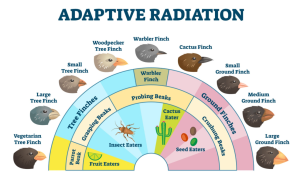
A classic real-world example of this is Darwin’s finches on the Galapagos Islands. A single ancestral finch arrived from the South American mainland and encountered an array of vacant ecological niches. The process of adapting to those various niches is adaptive radiation; the resulting array of unique finch species is the speciation event.
Real-World Applications of Adaptive Radiation
Why should we care about this outside of clearing our exams? Well, understanding adaptive radiation is actually a huge deal for fields like conservation biology and managing ecosystems.
Take wildlife conservation. When scientists look at the evolutionary history of an area, like the Galapagos, understanding how the finches radiated helps them pinpoint which specific habitats are absolutely critical to protect. If you lose just one specific habitat type, you might wipe out an entire evolutionary branch.
This concept even shows up in agriculture and biotechnology. For instance, when human activities introduce heavy pesticides, we often see pests rapidly adapt and diversify to resist those chemicals. It is a modern, fast-forward version of the same evolutionary pressures. Even in ecosystem restoration, knowing how species naturally adapt helps ecologists pick the right mix of plants and animals to bring a degraded piece of land back to life.
Mastering Adaptive Radiation: Study Tips and Strategies
When you are mapping out your study schedule, don’t just memorize the definitions. Focus heavily on the driving forces behind the scenes, like genetic variation and how natural selection filters that variation when a geographical barrier pops up.
Here are a few quick tips from the team at VedPrep to help you ace this topic:
- Sketch out your own evolutionary trees showing a single ancestor branching out into different feeding habits.
- Work through case studies—not just Darwin’s finches, but also Australian marsupials and African cichlid fish.
- Grab standard reference books like Evolution by Futuyma and Kirkpatrick, or Biology by Campbell and Reece to read through the classic experiments.
At VedPrep, we love breaking down these massive, intimidating syllabus topics into bite-sized, conversational ideas because we know how stressful exam prep can get.
Key Subtopics in Adaptive Radiation
As you do your final revision, make sure you can answer questions on these specific areas:
- The exact definition and identifying traits of adaptive radiation.
- How geographic isolation acts as the trigger for evolutionary divergence.
- The clear differences between adaptive radiation and convergent evolution.
- The ecological impact of having multiple specialized species instead of just one generalist.
Conclusion
Adaptive radiation is one of the most elegant concepts in evolutionary biology. It shows us how life doesn’t just sit still—it rushes to fill every empty corner of the planet, driving the incredible biodiversity we see today.
There is still so much we are figuring out about how these evolutionary paths react to modern threats like climate change and human habitat destruction. By wrapping your head around these concepts now, you aren’t just earning marks for the IIT JAM; you are building the foundation to understand how the living world adapts, survives, and thrives.
To know more in detail from our faculty, watch our YouTube video:
Frequently Asked Questions
What is the main trigger that starts adaptive radiation?
It usually starts with opportunity. This could be a geographical breakout (like a species colonizing a new, isolated island chain) or a mass extinction event that wipes out competing species, leaving a ton of ecological niches completely vacant.
Why is "rapid" such an important word in this concept?
In evolutionary terms, "rapid" means it happens much faster than the baseline rate of typical speciation. Because there is little to no competition in the new niches, natural selection accelerates the adaptation process.
Are adaptive radiation and speciation the same thing?
This is a classic exam trap. Adaptive radiation is the process or the pathway, while speciation is the actual result. Adaptive radiation is just a specific, fast-paced type of divergent speciation.
What is the difference between divergent evolution and adaptive radiation?
Adaptive radiation is a specific, intense subtype of divergent evolution. While divergent evolution simply means two related species evolve different traits over time, adaptive radiation involves one ancestor splitting into many different species relatively quickly.
How do Darwin’s finches demonstrate this concept?
A single ancestral finch species from mainland South America arrived on the Galapagos Islands. Because the islands had different food sources (seeds, insects, cactus fruits) and no other birds competing for them, the finches quickly evolved distinct beak shapes specialized for each food type.
What is another textbook example of adaptive radiation besides Darwin's finches?
Australian marsupials are a fantastic example. A single ancestral marsupial radiated into a massive variety of forms—kangaroos, koalas, wombats, and Tasmanian devils—each filling niches that placental mammals occupy on other continents.
What role does geographical isolation play in this process?
Geographical isolation (like an ocean separating islands) stops gene flow between the newly forming groups. Without this isolation, the populations would keep interbreeding, mixing their genes, and preventing distinct new species from forming.
How does adaptive radiation relate to ecological niches?
An ecological niche is essentially an organism's "job" and address in an ecosystem. Adaptive radiation only happens because multiple ecological niches are empty, prompting the ancestral species to diversify to fill those roles.
What is the connection between adaptive radiation and convergent evolution?
When species undergo adaptive radiation on different, isolated landmasses, they often adapt to similar niches. For example, the Australian marsupial sugar glider and the North American placental flying squirrel look almost identical because they radiated into the exact same ecological niche, despite being completely different lineages.
Does natural selection drive adaptive radiation?
Yes, it is the primary engine. Once mutations and genetic drift create variations in a population, natural selection steps in and favors the individuals whose traits give them an advantage in a specific niche, weeding out the rest.
What kind of questions does IIT JAM ask on this topic?
You will typically see multiple-choice questions (MCQs) asking you to identify true/false statements about the mechanisms, match-the-following questions with classic examples (like finches or marsupials), or conceptual questions testing if you confuse it with convergent evolution.
Can human activities cause adaptive radiation?
Indirectly, yes. When humans introduce heavy pesticides or antibiotics, we create intense new environmental pressures. Pests and bacteria can rapidly diversify to survive in these altered environments, which is essentially a fast-forwarded, human-driven version of the process.
How do mass extinctions affect adaptive radiation?
Mass extinctions are huge catalysts. When a major group dies out (like the dinosaurs), they leave behind an eco-system full of empty niches. The surviving groups (like early mammals) then undergo massive adaptive radiation to fill those vacant roles.
What is "ecological release"?
Ecological release happens when a species escapes from its usual competitors or predators—often by moving to a new island. With the pressure off, the species can expand its niche and kickstart the radiation process.