
Chromosome mapping for IIT JAM involves understanding the structure and organization of chromosomes, including gene mapping, linkage analysis, and recombination frequencies, which is crucial for competitive exam success.
Understanding the Syllabus: Chromosome Mapping For IIT JAM
If you are gearing up for the IIT JAM, you already know that biology isn’t just about memorizing facts; it is about figuring out the puzzles of life. One major puzzle you will encounter is Chromosome mapping, which sits comfortably in the genetics portion of your syllabus. While some syllabi like CSIR NET categorize this under molecular genetics, for IIT JAM, you will usually find it anchoring your core genetics unit.
Chromosome mapping, or genetic mapping, is basically like building a GPS for chromosomes. It is a technique we use to pinpoint exactly where specific genes live on a chromosome. To get this right, you have to master two big ideas: gene mapping and linkage analysis. These aren’t just dry theories; they are tools that look at how traits pass down from parents to offspring and how often genes swap places. This swap rate—known as recombination frequency—is your best friend because it helps you calculate the actual distance between genes.
If you want to dive deep, classic textbooks like Principles of Genetics by Snustad and Simmons (or Gardner) and Genetics by Lewin are fantastic resources. Here at VedPrep, we always tell our students that mastering these core pillars is your secret weapon for cracking tough numerical questions in IIT JAM, GATE, and even CSIR NET later on.
Chromosome Mapping: A Comprehensive Overview
Think of a chromosome as a long, winding highway made of DNA and proteins packed tightly inside a cell’s nucleus. Genes are like towns along that highway. Gene mapping is the process of creating a roadmap to find out where these towns are. When you map genes, you figure out their relative distances and can predict how likely they are to get separated when cells divide.
Linkage analysis comes into play when you want to see which towns are next-door neighbors. If two genes sit right next to each other on the same chromosome, they are “linked.” This means they tend to travel together into the next generation instead of splitting up independently.
Chromosome Mapping For IIT JAM: Key Concepts
To ace the genetics questions in IIT JAM, you need to get comfortable with a few non-negotiable concepts:
-
Gene Linkage and Recombination Frequencies: Linkage keeps genes together; recombination (crossing over during meiosis) breaks them apart. The frequency of this breakup tells you the distance.
-
Chromosome Structure and Organization: You need to know your centromeres from your telomeres, and how chromatin packing changes during cell division.
-
Genetic Mapping Techniques: This includes calculating map units (centimorgans) using two-point and three-point test crosses.
Solved Question: Chromosome Mapping for IIT JAM
Let’s look at a classic problem type you will definitely see in your VedPrep practice mock tests.
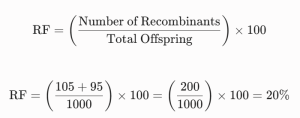
Question: In a test cross between a heterozygous parent for two genes (AaBb) and a homozygous recessive parent (aabb), the following offspring numbers were obtained:
-
Wild type (AaBb): 415
-
Double mutant (aabb): 385
-
Recombinant 1 (Aabb): 105
-
Recombinant 2 (aaBb): 95
Calculate the recombination frequency and the map distance between gene $A$ and gene B.
Solution: 1. Identify the Recombinants: The recombinants are the offspring that don’t look like the parental combinations. Here, they are Aabb (105) and aaBb (95).
2. Find the Total Number of Offspring:
Common Misconceptions in Chromosome Mapping for IIT JAM
When we sit down with students at VedPrep to analyze their test mistakes, we see the same few traps tripping people up. Let’s clear them up right now:
-
Misconception 1: Recombination frequency can go over 50%. The Reality: It can’t. Even if genes are on opposite ends of a massive chromosome, independent assortment caps the maximum recombination frequency at 50\%. If your math gives you 65\%, double-check your calculations!
-
Misconception 2: Genetic maps and physical maps are exactly the same. The Reality: Genetic maps use recombination frequencies (measured in centimorgans), which depend on how often crossing over happens. Physical maps look at the actual number of DNA base pairs (measured in megabases). Because some areas of a chromosome cross over more easily than others, the distances don’t always align perfectly.
-
Misconception 3: Double crossovers don’t matter in three-point crosses. The Reality: They absolutely do. If you forget to count the double crossovers twice when calculating the distance between the two outer genes, your map distance will end up shorter than it actually is.
Real-World Applications of Chromosome Mapping
Chromosome mapping isn’t just a hurdle to clear for your exam; it has incredible real-world value.
In genetic engineering and gene therapy, knowing exactly where a gene lives allows scientists to fix or replace faulty DNA. Think of it like fixing a broken pipe in a house—you can’t fix it if you don’t know which wall it is behind.
The Human Genome Project is a massive, real-life example of mapping. By mapping out every single human gene, scientists opened the door to predicting risks for conditions like sickle cell anemia or cystic fibrosis long before symptoms show up.
It is also the backbone of personalized medicine. Doctors can analyze your specific chromosome map to see how your body will handle a certain drug. This means you get a treatment tailored exactly to your DNA, cutting out the dangerous trial-and-error phase of medicine.
Other massive applications include:
-
Predicting genetic conditions like Down syndrome and Thalassemia.
-
Designing targeted cancer therapies.
-
Improving genetic counseling and prenatal screenings for families.
Exam Strategy: Mastering Chromosome Mapping for IIT JAM
When you are in the exam hall and the pressure is on, you need a rock-solid strategy to tackle genetics problems. Here is how you should approach this topic:
-
Get the Basics Down Cold: Understand how a chromosome’s physical structure, including centromeres and telomeres, impacts crossing over. Recombination rarely happens near the centromere, which skews your map distances.
-
Differentiate Your Maps: Keep a clear line in your head between cytological maps (visual bands under a microscope), genetic maps (linkage distances), and physical maps (base pairs).
-
Practice the Mechanics: Spend time solving three-point test crosses. You should be able to identify the gene order, find the middle gene, and calculate the interference coefficient quickly.
-
Use Visual Frameworks: Draw out the chromosomes when solving a problem. Visually placing the alleles on chromatids makes it much harder to make a careless error.
Additional Study Tips and Resources for Chromosome Mapping
-
Solve Previous Years’ Question (PYQ) Papers: IIT JAM loves to twist chromosome mapping data. Go back through at least ten years of papers to get used to their question phrasing.
-
Form Small Study Groups: Try explaining a three-point cross problem to a friend. If you can explain how to calculate interference to someone else, you genuinely know the material.
-
Leverage Structured Guidance: If you find yourself staring blankly at recombination data, don’t waste days spinning your wheels. Joining structured preparation programs, like our target batches at VedPrep, can give you access to step-by-step video breakdowns and high-yield practice questions that simplify these exact concepts.
Final Thoughts
Mastering chromosome mapping isn’t about memorizing endless formulas—it’s about learning how to read the blueprint of life. When you shift your perspective from just chasing exam marks to appreciating how these microscopic distances shape living organisms, the numerical problems actually start to become fun. Genetics questions are some of the highest-scoring sections in the IIT JAM papers because they have definitive, logical answers.
To learn more in detail from our faculty, watch our YouTube video:
Frequently Asked Questions
Chromosome mapping is crucial for understanding the genetic basis of traits and diseases. It helps identify genetic variations associated with specific conditions and facilitates the development of genetic tests and therapies. There are several types of chromosome maps, including genetic maps, physical maps, and cytogenetic maps. Genetic maps show the relative positions of genes based on recombination frequencies, while physical maps display the actual distances between genes in base pairs. Chromosome mapping involves various techniques, such as pedigree analysis, linkage analysis, and genome sequencing. These methods help researchers identify genetic markers and determine their locations on the chromosome. Recombination is a critical process in chromosome mapping, as it allows researchers to estimate the distances between genes. By analyzing recombination frequencies, geneticists can infer the relative positions of genes on the chromosome. Genetic maps show the relative positions of genes based on recombination frequencies, while physical maps display the actual distances between genes in base pairs. Both types of maps are essential for understanding chromosome structure and gene function. Chromosome mapping has several applications in agriculture, including crop improvement, disease resistance, and genetic engineering. By understanding the genetic basis of desirable traits, plant breeders can develop more resilient and productive crops. Chromosome mapping helps researchers understand the genetic basis of variation by identifying genetic markers and determining their locations on the chromosome. This information can be used to study the evolution of genetic variation and its impact on fitness. In IIT JAM, chromosome mapping is often tested through questions on genetic linkage, pedigree analysis, and chromosome structure. Students are expected to apply their knowledge of chromosome mapping to solve problems and answer multiple-choice questions. Common problems in IIT JAM include determining gene order, calculating map distances, and predicting recombination frequencies. Students should practice solving these types of problems to build their skills and confidence. To prepare for chromosome mapping questions, focus on understanding the fundamental concepts, practicing problem-solving, and reviewing previous years' questions. VedPrep's study materials and practice tests can also help you assess your knowledge and identify areas for improvement. To solve genetic linkage problems, analyze the pedigree data, determine the recombination frequencies, and calculate the map distances. Practice solving these types of problems to build your skills and confidence. Common mistakes include incorrect calculation of map distances, misunderstanding genetic linkage, and failing to account for recombination frequencies. Students should be careful when working with chromosome mapping problems and double-check their calculations. Chromosome mapping plays a crucial role in personalized medicine by enabling the identification of genetic variations associated with specific diseases. This information can be used to develop targeted therapies and tailor treatment strategies to individual patients. Chromosome mapping is used in gene therapy to identify the location of genes that need to be modified or replaced. By understanding the genetic basis of a disease, researchers can develop gene therapies that target specific genes and restore normal function.
Why is chromosome mapping important?
What are the types of chromosome maps?
How is chromosome mapping done?
What is the role of recombination in chromosome mapping?
What is the difference between genetic and physical maps?
What are some applications of chromosome mapping in agriculture?
What is the relationship between chromosome mapping and genetic variation?
How is chromosome mapping tested in IIT JAM?
What are some common chromosome mapping problems in IIT JAM?
How can I prepare for chromosome mapping questions in IIT JAM?
How do I solve genetic linkage problems?
What are some common mistakes in chromosome mapping?
What is the role of chromosome mapping in personalized medicine?
How is chromosome mapping used in gene therapy?