

Conformational analysis of ethane, butane, and cyclohexane is an essential topic in organic chemistry that involves the study of the three-dimensional structures of these molecules, which is necessary for IIT JAM aspirants to understand the stereochemistry of simple organic compounds.
Understanding the Syllabus: Conformational Analysis of Ethane, Butane, and Cyclohexane for IIT JAM
Stereochemistry can feel a bit like mental gymnastics. You are trying to spin three-dimensional molecules in your head while staring at a flat piece of paper or a laptop screen. But if you are gearing up for the IIT JAM, mastering the conformational analysis of ethane, butane, and cyclohexane is non-negotiable. It forms the backbone of how organic molecules actually behave in real life.
Standard textbooks like Organic Chemistry by J. E. McDonald or Robert C. Atkins dive deep into these concepts, tracking energy profiles, molecular stability, and how these structures flip back and forth in Conformational analysis of ethane.
At its core, Conformational analysis of ethane is just the study of the different 3D shapes a molecule can adopt simply by rotating around its single bonds. The molecules that change shapes this way are called conformers. Because these rotations happen constantly, understanding which shapes a molecule prefers helps us predict everything from its physical properties to how it will behave in a crucial exam reaction mechanism.
Conformational Analysis of Ethane, Butane, and Cyclohexane: A Core Concept
Think of conformational isomerism like a person sitting in a cramped middle seat on a flight versus stretching out in an empty row. The person is exactly the same, but their comfort level—or energy state—changes entirely based on their posture.
In organic chemistry, molecules also look for the most comfortable setup in Conformational analysis of ethane. When atoms rotate around a C-C single bond, they create different shapes with distinct energy levels. In ethane, this simple twist gives us eclipsed and staggered shapes. Move up to butane, and things get a bit more crowded, introducing anti and gauche shapes. When you clip those carbons into a ring like cyclohexane, the molecule flexes into chair and boat shapes to keep itself stable.
As per Conformational analysis of ethane, understanding these shapes lets you predict how stable a molecule is and how fast it will react. If you get a handle on dihedral angles (the angle between two specific bonds on adjacent carbons) and steric effects (atoms bumping into each other’s personal space), you will be able to face tricky JAM questions without breaking a sweat. Here at VedPrep, we always remind students that visualizing these forces is the real secret to mastering Conformational analysis of ethane.
Conformational Analysis of Ethane: A Case Study
Let’s start with the absolute basics: the conformational analysis of ethane (C2H6). Ethane gives us the perfect, clean look at how bond rotation changes a molecule’s energy.
Imagine two people holding three balloons each, standing face-to-face. If they hold the balloons so they line up perfectly directly behind one another, that is the eclipsed conformation. The dihedral angle here is 0° (or 120°, 240°). Because the bonds line up perfectly, the electron clouds repel each other, creating a high-energy, unstable situation known as torsional strain.
Now, if one person twists their hands by 60°, the balloons instantly slot into the gaps between the other person’s balloons. This is the staggered conformation (at dihedral angles of 60°, 180°, or 300°).
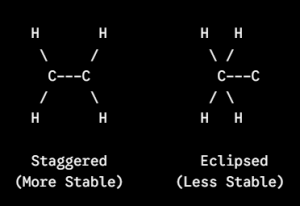
The staggered shape is much more stable because it minimizes all that electronic crowding. The energy jump between these two states is about 12 kJ/mol. It might not sound like much, but it is enough that ethane spends about 99% of its time chilling in the relaxed staggered state at room temperature.
Conformational Analysis of Butane: A More Complex Scenario
Once you add more carbons, the molecular party gets crowded. Butane (C4H10) introduces a more complex landscape because we are no longer just looking at tiny hydrogen atoms—we now have two bulky methyl (-CH3) groups rotating around the central C2-C3 bond.
Imagine you are sitting on a crowded subway bench next to someone carrying a massive backpack. If they sit directly opposite you or right next to you, you are going to feel squished. That is steric hindrance—atoms physically getting in each other’s way.
-
Anti Conformation: This is the ultimate comfort zone. The two bulky methyl groups are at a 180° dihedral angle, sitting as far away from each other as possible. It is the lowest energy, most stable form.
-
Gauche Conformation: Here, the methyl groups are rotated to a 60° angle. They aren’t directly on top of each other, but they are close enough to cause some steric repulsion, making this form about 3.5 kcal/mol less stable than the anti form.
Because of this energy gap, butane molecules mostly prefer the anti setup at room temperature, though they constantly flip back and forth.
Cofromational Analysis of Cyclohexane: A Special Case
Cyclohexane (C6H12) is a completely different ball game because it is a ring. If it stayed flat like a regular hexagon, the bond angles would be 120° (instead of the ideal 109.5° for sp3 carbons), and every single C-H bond would be perfectly eclipsed. The strain would be massive.
To solve this, the ring puckers into a chair conformation. In this shape, every single bond angle sits perfectly at 109.5° (zero angle strain), and all the hydrogens are perfectly staggered (zero torsional strain). It is incredibly stable.
However, the ring can flip into a boat conformation. Think of this like a temporary mid-flip state. The boat form is about 22 kJ/mol less stable than the chair.
Why is the boat so stressed out? Two main reasons:
-
The hydrogens along the “sides” of the boat are completely eclipsed.
-
The two hydrogens at the “bow” and “stern” of the boat point directly at each other, causing what we call flagpole interactions. It is like two people trying to share a tiny umbrella—they keep bumping heads.
Worked Example: Conformational Analysis of Ethane
Question:
Calculate the energy difference between the staggered and eclipsed conformations of ethane, given that a specific substituted eclipsed conformation has an energy value of 12.5 kJ/mol and the corresponding staggered conformation sits at 10.5 kJ/mol.
Solution:
To find the energy difference (ΔE), you just need to subtract the lower energy value of the stable staggered form from the higher energy value of the eclipsed form:
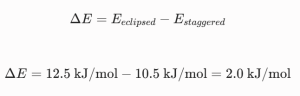
In an exam scenario, remember that the staggered shape will always be your baseline for stability due to minimal steric repulsion and torsional strain.
Misconception Alert: Conformational Analysis of Butane
The Trap: A very common mistake students make during JAM prep is assuming butane only has two basic positions like ethane.
Because butane has those two large methyl groups, it actually has four distinct energy levels on its rotation profile:
-
Fully Eclipsed: The two methyl groups are directly on top of each other (0°). This is the absolute highest energy state.
-
Gauche: The methyl groups are 60° apart. Stable, but still has some steric strain.
-
Eclipsed: The methyl groups eclipse hydrogen atoms (120°). High energy, but not as bad as fully eclipsed.
-
Anti: The methyl groups are completely opposite each other (180°). The absolute lowest energy state.
Application in the Real World
Conformational analysis of ethane isn’t just a theory meant to torture students during exams; it is a core tool in fields like drug design.
For a pharmaceutical molecule to work, it has to bind perfectly to a target protein or enzyme in the body, almost like a key fitting into a lock. If a drug molecule is highly flexible, it might spend most of its time in a shape that doesn’t fit the lock. Scientists use computational modeling to figure out the lowest-energy, most stable shapes of a molecule to ensure it can easily adopt its biologically active form.
Take aspirin, for example. Its ability to relieve pain and reduce inflammation relies entirely on its active conformation lining up perfectly to bind with and block cyclooxygenase (COX) enzymes. If steric or electronic forces pushed it into a different shape, it wouldn’t be able to do its job.
Exam Strategy: Conformational Analysis of Ethane, Butane, and Cyclohexane
As per Conformational analysis of ethane, when you are sitting in the exam hall, time is short, and pressure is high. To tackle conformational analysis smoothly, we recommend a systematic approach:
-
Master Your Projections: Get incredibly comfortable drawing and reading Newman projections and cyclohexane chair forms.
-
Identify the Strain: The moment you look at a conformation, look for torsional strain (eclipsed bonds) and steric strain (bulky groups close together).
-
Watch the Substituents: In cyclohexane, remember that bulky groups always prefer the equatorial positions over axial positions to avoid $1,3$-diaxial interactions.
We map out these exact visual patterns at VedPrep to help students see the answers without getting lost in the math. Regular practice with potential energy diagrams will make these questions some of the fastest points you score on the test paper.
Some of the most frequently tested areas of Conformational analysis of ethane include:
-
Comparing stability differences in butane’s gauche vs. anti forms.
-
Drawing ring flips in cyclohexane and tracking axial/equatorial shifts.
-
Calculating total strain energy based on given values for specific interactions.
Conclusion
Mastering Conformational analysis of ethane isn’t about memorizing static drawings—it’s about learning to see molecules as dynamic, moving structures that always want to find their ultimate comfort zone. Whether it is a simple twist in ethane, a bit of steric crowding in butane, or a full ring flip in cyclohexane, tracking these energy changes is what unlocks the trickiest stereochemistry problems on the test. If you can confidently visualize how these molecules bend and flex to avoid strain, you are well on your way to securing those core marks.
To learn more in detail from our faculty, watch our YouTube video:
Frequently Asked Questions
Why does the staggered conformation of ethane have lower energy than the eclipsed form?
It comes down to two things: minimized steric hindrance and lessened torsional strain. In the staggered form, the C–H bonds are as far apart as possible (60° dihedral angle), which minimizes the electrostatic repulsion between the bonding electron pairs.
What exactly is torsional strain?
Think of torsional strain as the electronic repulsion that happens when bonds on adjacent carbons line up perfectly with each other. In the conformational analysis of ethane, when the molecule hits the eclipsed form, the electron clouds of the C–H bonds crowd each other, bumping up the potential energy.
What is hyperconjugation, and how does it relate to ethane's stability?
Hyperconjugation is a stabilizing orbital interaction. In ethane's staggered conformation, the filled C–H σ bonding molecular orbital aligns perfectly with the empty C–H σ* antibonding orbital of the adjacent carbon. This slight electron-sharing stabilizes the staggered form—an interaction that is completely lost in the eclipsed form.
Why do we study the conformational analysis of ethane as a baseline in organic chemistry?
Ethane is the simplest hydrocarbon that can exhibit conformational isomerism via single-bond rotation. Mastering its simple two-state energy profile (staggered vs. eclipsed) makes it much easier to understand more complex molecules like butane and substituted cyclohexanes later on.
Why is the anti conformation of butane more stable than the gauche conformation?
Both are technically staggered, but the anti conformation places the two bulky, electron-heavy methyl groups (–CH3) completely opposite each other at a 180° dihedral angle. In the gauche form (60°), these bulky groups physically crowd each other's space, causing steric strain.
What is a steric profile, and why is it worse in butane than in ethane?
A steric profile maps out how a molecule's potential energy changes as bulky groups bump into each other. Ethane only has tiny hydrogen atoms rotating past each other. Butane features bulky methyl groups, which occupy significantly more space and cause much steeper energy spikes when they force their way past each other.
What is the total number of energy minima in the rotational profile of butane?
There are three energy minima: one absolute global minimum (the anti conformation at 180°) and two degenerate local minima (the two gauche conformations at 60° and 300°).
Why doesn't cyclohexane adopt a perfectly flat planar structure?
If cyclohexane stayed completely flat like a regular geometric hexagon, its interior bond angles would be forced to 120°, causing massive angle strain since sp3 carbons prefer 109.5°. Plus, all twelve C–H bonds would be perfectly eclipsed, creating unbearable torsional strain.
What makes the chair conformation of cyclohexane so uniquely stable?
In the chair conformation, cyclohexane completely eliminates both angle and torsional strain. Every single carbon manages to hit the ideal tetrahedral angle of 109.5°, and looking down any C–C bond reveals a perfectly relaxed, staggered arrangement of hydrogens.
Why is the boat conformation of cyclohexane less stable than the chair form?
The boat conformation is an energy peak because it suffers from severe torsional strain along its "sides" where the C–H bonds are fully eclipsed. Additionally, it experiences steric strain due to flagpole interactions—the two inside hydrogens on the ends of the boat point right at each other and bump heads.
What are flagpole interactions in a cyclohexane boat conformer?
Imagine the bow and stern of a small boat. The hydrogens attached to the C1 and C4 carbons point upward and inward toward the center of the ring. Because they are forced closer together than their van der Waals radii allow, they repel each other, driving up the molecule's total energy.
What happens to the positions of substituents during a cyclohexane ring flip?
During a ring flip, the chair undergoes a dynamic twist-boat transition to invert itself into a new chair. When this happens, every single substituent that was pointing in an axial position flips to an equatorial position, and vice versa. However, their relative direction (up stays up, down stays down) never changes.
Why do bulky groups on a cyclohexane ring prefer the equatorial position?
When a bulky group (like a methyl or tert-butyl group) sits in an axial position, it points straight up or down, putting it too close to the other two axial hydrogens on the same side of the ring. This causes steric crowding known as 1,3-diaxial interactions. Placing the group equatorially points it outward into empty space, relieving that strain.