
Nucleophilic substitution (SN1, SN2, SNi) reactions are a crucial topic in organic chemistry for IIT JAM. If you are gearing up for the IIT JAM, you already know that organic chemistry isn’t something you can just memorize overnight. It requires understanding how molecules actually behave. At the absolute core of organic synthesis lies a family of reactions you simply cannot skip: nucleophilic substitution.
In plain terms, this is the ultimate game of musical chairs at the molecular level. A nucleophile (an electron-rich species looking for a positive center) walks into the room, spots a carbon attached to a leaving group, kicks that leaving group out, and takes its place. While the big picture is simple, the way this swap happens can change completely depending on your players. That is why we break them down into three main pathways: SN1, SN2, and the quirkier cousin, SNi to understand nucleophilic substitution.
Syllabus — Nucleophilic Substitution Reactions
Nucleophilic substitution is a massive anchor point in the IIT JAM Chemistry Syllabus. You can’t master multi-step synthesis or predict major products without mastering this first.
When you are diving into the standard textbooks, you will find this covered across several classic chapters. For instance, Organic Chemistry by J.D. Lee gives you great insights into how inorganic nucleophiles behave, while the classic Organic Chemistry by Morrison and Boyd walks you through the mechanistic grit.
At VedPrep, we always tell our students to focus on three pillars for these reactions:
-
Kinetics: How fast does the reaction go, and what dictates that speed?
-
Stereochemistry: Does the molecule retain its shape, flip upside down like an umbrella, or turn into a 50/50 mixture?
-
Reactivity: Why does one alkyl halide react instantly while another just sits there?
Nucleophilic Substitution (SN1, SN2, SNi) For IIT JAM — Basic Concept
Let’s break down the vocabulary so we are on the same page.
First, meet the nucleophile. Think of it as an electron donor looking for a partner. It has a lone pair or a negative charge that it is dying to share with an electron-deficient carbon.
Second, meet the leaving group. This is the fragment that gets pushed out, taking the bonding electrons with it. A great leaving group is like a mature adult who can handle being single—it is perfectly stable on its own with that new negative charge (think weak bases like I– or Br–).
The two main ways this breakup and new relationship happen are SN1 and SN2:
-
The SN1 pathway: This is a dramatic, two-step breakup. First, the leaving group pack its bags and walks out entirely on its own, leaving behind a highly vulnerable, flat carbocation intermediate. Only after this slow, painful separation does the nucleophile swoop in to bond. If you look at its energy profile, you will see two distinct peaks with a valley in the middle where that carbocation temporarily chilled.
-
The SN2 pathway: This is a single-step, coordinated ambush. The nucleophile doesn’t wait for the leaving group to leave. It sneaks up from the exact opposite side (backside attack) at the exact same time the leaving group is pushed out. The energy profile here is just one single, smooth mountain peak representing a high-energy transition state where the carbon is momentarily bonded to both groups.
There is also the rarer SNi mechanism, which we will look at shortly. Grasping these differences is what separates a top-ranker from the crowd on exam day.
Worked Example: SN2 Reaction
Let’s look at a classic textbook problem you might encounter: reacting 2-bromopropane with a hydroxide ion (OH–).

Here, OH– acts as our strong nucleophile, and the bromide ion (Br–) is our leaving group. Because 2-bromopropane is a secondary alkyl halide, it sits right on the fence between mechanisms, but using a strong, high-concentration nucleophile like hydroxide tips the scales heavily toward SN2.
Imagine a crowded coffee shop where someone is sitting at a small table. To take that exact spot without waiting for them to get up, you have to approach from the only open angle—the back of the chair. As you sit down, they are pushed out the front.
That is exactly what happens to the secondary carbon in Nucleophilic substitution. The OH– attacks from the backside, directly opposite the bromine atom. As a result, the molecular geometry completely flips inside out—a phenomenon known as Walden inversion. The final product is 2-propanol, and the bromide ion wanders off alone into the solvent.
Common Mistakes in Nucleophilic Substitution Reactions
SN1 reactions love polar protic solvents (like water, methanol, or ethanol). A common mistake is thinking these solvents speed up the reaction by making the nucleophile happy. It’s actually the exact opposite. In an SN1 reaction, the bottleneck—the rate-determining step—is getting that leaving group to break away and form the carbocation. Polar protic solvents are amazing at wrapping around the leaving group and stabilizing that raw, positive carbocation intermediate, lowering the energy barrier to start the reaction.
On the flip side, SN2 reactions run circles around everything when they are in polar aprotic solvents (like DMSO or acetone). These solvents don’t have active hydrogens to cage your nucleophile, leaving it naked, aggressive, and free to attack the substrate immediately.
Another mental hurdle is separating nucleophiles from bases.
The Golden Rule: Nucleophilicity is all about speed (kinetics) and attacking a carbon atom. Basicity is all about stability (thermodynamics) and grabbing a proton (H+).
For instance, the cyanide ion (CN–) is a fantastic nucleophile for pushing out leaving groups, but it is a relatively weak base. As per Nucleophilic substitution, if you mix up these properties, you will accidentally predict an elimination product when the molecule actually wanted to do a substitution. At VedPrep, we spend a lot of time mapping out substrate structure, steric hindrance, and solvent types so you can look at a reaction and instantly know which path it will take.
Applications of Nucleophilic Substitution Reactions
Substitution reactions are the bread and butter of chemical synthesis. If you want to make alkyl halides, alcohols, ethers, or amines, you are using nucleophilic substitution.
The pharmaceutical industry uses these reactions to build life-saving medications. For example, creating the core structures of beta-lactam antibiotics—like penicillins and cephalosporins—depends on careful nucleophilic attacks. The same goes for making common antihistamines and local anesthetics.
Even nature uses this chemistry. When you study biochemistry, you will realize that many enzyme-catalyzed reactions in our bodies are just highly sophisticated, perfectly oriented nucleophilic substitutions. Understanding how a lab flask handles these reactions gives us a window into how complex biological pathways operate under strict temperature and cellular constraints.
Nucleophilic substitution (SN1, SN2, SNi) For IIT JAM
When you are staring down the physical chemistry, organic, and inorganic sections of the JAM, organic mechanism questions can feel like the highest stakes because they require real spatial reasoning.
To master this section, do not just stare at mechanisms on a page. Grab a scratchpad and practice drawing out the pathways for primary, secondary, and tertiary substrates. Predict what happens when you switch the solvent from water to acetone. Look at previous years’ question papers to see how IIT professors love to trick students with stereochemical centers.
Our team at VedPrep builds video lectures, targeted practice sets, and mock tests designed to mimic those exact exam day curveballs. Balancing your theory reading with hands-on problem-solving is the only way to build true confidence.
Simplifying the Energy Profile of SN1 and SN2 Reactions
An energy profile diagram tells the whole story of a reaction’s life cycle. Let’s look at them side by side.
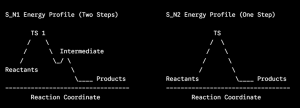
For the SN1 pathway, you are looking at a two-peak roller coaster. The first peak is the highest mountain to climb—this is the activation energy needed to break the carbon-leaving group bond. At the bottom of the valley sits our carbocation intermediate. The second, smaller peak is just the quick attachment of the nucleophile to that unstable intermediate. Because step one is so difficult, the concentration of the nucleophile does not change the reaction speed at all.
For the SN2 pathway, the diagram is a single, clean hill. There are no valleys and no intermediates. The top of the hill represents the transition state where the incoming nucleophile and departing leaving group are perfectly balanced. Because both entities must crash into each other simultaneously, changing the concentration of either one alters the reaction rate instantly.
Nucleophilic substitution (SN1, SN2, SNi) For IIT JAM: Understanding the SNi Mechanism
Finally, let’s talk about the SNi pathway—Substitution Nucleophilic Internal. Nucleophilic substitution is an intramolecular reaction, meaning the attack comes from inside the reacting complex itself.
The classic textbook example of an SNi reaction is mixing an alcohol with thionyl chloride (SOCl2) in Nucleophilic substitution. Instead of an outside nucleophile coming in, the reagent reacts with the alcohol to form an alkyl chlorosulfite intermediate. This intermediate breaks down, keeping the chlorine atom trapped incredibly close to the front side of the carbon atom. Because it is physically held on the same side where the leaving group is exiting, it attaches to the exact same face.
While an SN1 reaction gives you a mix of configurations (racemization) and SN2 flips it completely (inversion), a pure SNi reaction goes forward with retention of configuration in Nucleophilic substitution. However, if you add a nucleophilic solvent like pyridine to the mix, it changes the game, attacking the intermediate and forcing a traditional inversion instead.
Here is a quick snapshot to keep these paths straight in your head:
| Reaction Type | Mechanism Structure | Stereochemical Outcome |
| SN1 | Stepwise via a distinct carbocation | Racemization (mix of inversion and retention) |
| SN2 | Concerted single step via backside attack | Complete Inversion of configuration |
| SNi | Internal attack via a close-knit ion pair | Retention of configuration (without pyridine) |
Final Thoughts
Mastering nucleophilic substitution isn’t about memorizing every single reaction path by heart; it’s about learning to read the clues the molecules are giving you. When you sit down for the IIT JAM, treat every reaction like a puzzle where the substrate structure, the strength of your nucleophile, and the solvent choice are all giving away the answer. If you can train your eyes to spot these details, predicting whether a reaction will flip, mix, or retain its stereochemistry becomes second nature. Organic chemistry can feel overwhelming, but with steady practice and the right guidance, it can easily become your highest-scoring section.
To learn more in detail from our expert faculty, watch our YouTube video:
Frequently Asked Questions
Why does SN2 cause an inversion of configuration?
Because the leaving group blocks the front side of the molecule as it departs, the incoming nucleophile is forced to attack from the exact opposite side (backside attack). This forces the remaining three groups on the carbon to flip to the opposite side, much like an umbrella blowing inside out in a strong wind.
What does SN1 stand for?
It stands for Substitution Nucleophilic Unimolecular. The "1" indicates that the rate-determining step involves only one molecule—the substrate losing its leaving group.
What does SN2 stand for?
It stands for Substitution Nucleophilic Bimolecular. The "2" indicates that the single, rate-determining step requires a collision between two distinct chemical species—the substrate and the nucleophile.
Why do SN1 reactions lead to racemization?
Once the leaving group departs in an SN1 mechanism, it leaves behind a flat, planar carbocation intermediate. Because this intermediate is completely flat, the incoming nucleophile has an equal 50% chance of attacking from the front side or the back side, resulting in a mixture of both configurations.
Which type of substrate is best for an SN1 mechanism?
Tertiary alkyl halides are excellent for SN1 reactions. This is because they form highly stable tertiary carbocations (due to inductive effects and hyperconjugation) and are too crowded (sterically hindered) to allow a direct backside SN2 attack.
Which type of substrate is best for an SN2 mechanism?
Primary alkyl halides and methyl halides are ideal for SN2 reactions. They experience almost no steric hindrance, giving the incoming nucleophile a completely open path to perform a swift backside attack.
What exactly is an SNi reaction?
SNi stands for Substitution Nucleophilic Internal. It is an intramolecular reaction mechanism where a portion of the leaving group breaks away but remains trapped in a tight ion pair, eventually attacking the carbon from the exact same side it left.
What makes a chemical group a "good" leaving group?
A good leaving group is a weak base that can stable itself after taking on a negative charge. Highly stable anions, like iodide (I-), bromide (Br-), and tosylate (OTs-), are excellent leaving groups because they are perfectly happy existing on their own.
What is the difference between a nucleophile and a base?
While both possess lone pairs of electrons, they act differently. A nucleophile uses its electrons to attack an electron-deficient carbon atom (a kinetic property measuring reaction speed). A base uses its electrons to abstract a proton, H+ (a thermodynamic property measuring equilibrium stability).
Can a secondary alkyl halide undergo both SN1 and SN2 reactions?
Yes. Secondary alkyl halides sit right on the fence. You can deliberately push them toward SN2 by using a strong nucleophile and a polar aprotic solvent, or direct them toward SN1 by using a weak nucleophile and a polar protic solvent.
How does temperature affect substitution reactions?
While substitution reactions occur at mild temperatures, raising the temperature significantly usually shifts the reaction away from substitution and toward elimination (E1 or E2). This happens because elimination reactions create multiple molecules, increasing entropy, which is heavily favored at higher temperatures.
How can I quickly tell if a nucleophile is strong or weak?
As a general rule of thumb, species carrying a full negative charge (like OH-, CN-, or CH3O-) act as strong nucleophiles. Neutral molecules with lone pairs (such as H2O, CH3OH, or CH3COOH) act as weak nucleophiles.