
Diels-Alder reaction For IIT JAM involves the 1, 4-addition of an alkene to a conjugated diene to form a six-membered ring adduct, a fundamental concept in organic chemistry that requires in-depth understanding and application.
Understanding the Syllabus
Cracking the IIT JAM chemistry paper requires a smart strategy, not just memorizing textbook pages. The Diels-Alder reaction—a classic [4+2] cycloaddition between a diene and a dienophile—is one of those high-yield topics you simply can’t skip. While you might see this topic listed under specialized pericyclic reactions in advanced syllabi like CSIR NET, for your IIT JAM prep, it is a staple of core organic chemistry.
At VedPrep, we always tell students that the examiners aren’t just going to ask you for a basic definition. They want to test your grip on reaction mechanisms, conditions, and how substituents change the game.
To build a rock-solid foundation, you can flip open standard bibles like:
Organic Chemistry by Clayden (3rd edition)
Principles of Biochemistry by Lehninger (mostly for seeing how these molecular shapes pop up in biological systems)
Don’t just read through them passively. Grab a scratchpad, scribble down the mechanisms, and work through as many practice problems as you can get your hands on.
The Diels-Alder reaction For IIT JAM: A Comprehensive Overview
At its core, the Diels-Alder reaction is like a molecular handshake. You take a conjugated diene (a molecule with two alternating double bonds) and match it with a dienophile (a molecule with a single double bond). They come together, reshuffle their electrons, and close up into a brand-new six-membered ring.
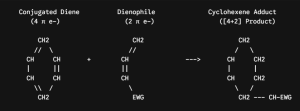
The magic here is in the mechanism. It is a concerted, single-step process. Imagine a group of friends switching seats all at the exact same millisecond—there are no awkward intermediate stages, no carbocations floating around, and no radicals waiting to make a mess. Because everything happens simultaneously, the reaction is completely stereospecific. This means whatever geometric setup your starting materials have, that geometry is locked tight and preserved right into the final product.
When you’re staring down an IIT JAM question paper, stereochemistry and regioselectivity are where the real points are won or lost. Depending on how the substituents are arranged on your starting pieces, you can end up with completely different shapes. Regioselectivity is just a fancy way of saying the groups prefer to sit in specific positions relative to each other on the new ring. Master these two nuances, and you will be well on your way to clearing the cutoff with flying colors.
| Feature | Description |
| Reactants | Diene (needs to be electron-rich) and a dienophile (loves electron-withdrawing groups) |
| Product | A brand new cyclohexene ring (six-membered ring adduct) |
| Mechanism | Concerted, single-step cycloaddition with zero intermediates |
Worked Example: Cycloaddition Reaction
Let’s look at a classic problem that routinely shows up in competitive exams to see how this works in practice.
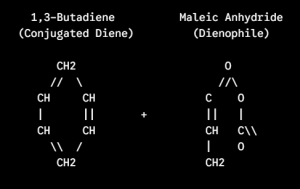
Problem Statement: What is the major product of the reaction between 1,3-butadiene and maleic anhydride?
Here, we have 1,3-butadiene acting as our simple, conjugated diene, and maleic anhydride stepping in as our electron-poor dienophile.
Solution:
The major product forms through an endo-selective transition state. When the two molecules approach each other, they don’t just collide randomly. They stack on top of each other like two sheets of paper. In the endo approach, the bulky carbonyl groups of the maleic anhydride tuck directly underneath the double bonds of the diene. This allows the π electrons of both pieces to interact favorably during the transition state, lowering the activation energy.
Because it is a concerted mechanism, two new sigma bonds click into place simultaneously. The anhydride ring stays perfectly intact, and because of that endo alignment, the substituents are pushed into a specific spatial layout. The final, major product is cis-4-cyclohexene-1,2-dicarboxylic anhydride.
Common Misconceptions about Diels-Alder reaction For IIT JAM
A trap we frequently see students fall into at VedPrep is muddying the waters between a Diels-Alder reaction and the broader family of [4+2] cycloadditions. It’s a classic “all thumbs are fingers, but not all fingers are thumbs” scenario. Every Diels-Alder reaction is a [4+2] cycloaddition, but you can’t just call any [4+2] cycloaddition a Diels-Alder reaction.
For it to be a true Diels-Alder reaction, your starting players must be a conjugated diene and a dienophile.
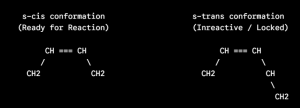
Another massive hurdle is the conformation of the diene. The molecule must be able to twist into an s-cis conformation (where both double bonds face the same side of the single bond linking them). If a diene is locked in an s-trans shape—like it’s trapped in a rigid ring system that can’t rotate—the reaction is dead in the water because the ends of the double bonds are simply too far apart to bridge the gap to the dienophile.
keep an eye out for Lewis acid catalysts like AlCl3 or BF3. Students often assume catalysts just speed things up across the board, but here, the Lewis acid selectively docks onto the electron-withdrawing group of the dienophile. This pulls electron density away, making the dienophile incredibly hungry for electrons and dramatically fixing the regiochemistry of the final product.
Real-World Applications of Diels-Alder reaction For IIT JAM
Why are organic chemists so obsessed with this reaction? Because it lets you build incredibly complex, three-dimensional molecular scaffolding in a single step with almost no waste.
To picture how useful this is, imagine you are a manufacturing engineer trying to forge a highly intricate car chassis. Instead of welding twelve different small metal plates together over several hours—and risking weak joints at every step—you use a heavy-duty press that stamp-forms the entire frame out of a single sheet of metal in seconds. That is essentially what the Diels-Alder reaction does for a synthetic chemist.
In the pharmaceutical industry, this reaction is a heavy hitter for making life-saving medications. For example, it plays a starring role in the complex synthesis of Taxol, a widely used chemotherapy drug for fighting ovarian and breast cancers. The drug molecule features a complex, crowded ring system that is a nightmare to build piece-by-piece, but a clever cycloaddition snaps the core together smoothly.
Beyond the lab, nature figured this out long before we did. The reaction is a key pathway in the biosynthesis of various natural products, including complex steroids and plant alkaloids. Synthetic chemists even design biomimetic reactions—man-made processes that mimic these elegant biological steps—to study how enzymes speed up chemical transformations in our own bodies.
Optimizing Conditions for Diels-Alder reaction For IIT JAM
When you’re trying to maximize your yield in a lab scenario—or answering a multi-step synthesis question on the JAM paper—the environment matters just as much as the reactants.
Temperature and Pressure: Most standard Diels-Alder reactions run beautifully under mild conditions, usually between 20°C and 100°C. Cranking up the heat can speed things up, but it’s a double-edged sword. Excess thermal energy can trigger side reactions or even cause the product to undergo a retro Diels-Alder reaction, breaking the ring right back down. If you want to push a stubborn reaction forward without heat, applying high pressure is a fantastic alternative because the transition state is more compact than the starting materials.
Solvent Effects: The right solvent choice can completely change your reaction rates. Polar solvents like DMF (dimethylformamide) or acetonitrile can compress the hydrophobic reactants together, accelerating the process. Even water is sometimes used to force non-polar dienes and dienophiles into tight contact through hydrophobic effects, drastically speeding up the bond formation.
Catalysts: As we touched on earlier, adding a dash of a Lewis acid catalyst like aluminum chloride or boron trifluoride can make a sluggish reaction click at room temperature. By coordinating with the dienophile’s electron-withdrawing group, it lowers the energy barrier of the transition state.
When you manage these conditions properly, you gain complete control over the structural outcome of your synthesis.
Stereochemistry: You can steer the reaction to favor either the endo or exo product by adjusting the temperature.
Regioselectivity: Using catalysts or tweaking the electronic properties of your substituents ensures you get the exact structural isomer you want, rather than a messy mixture of products.
The Diels-Alder reaction is a [4+2] cycloaddition between a diene and a dienophile, resulting in the formation of a new six-membered ring. This reaction is highly regio- and stereoselective, making it a powerful tool for organic synthesis.
Final Thoughts
Once you have mastered the basics, the competitive exams will expect you to tackle asymmetric variants and hetero-Diels-Alder reactions (where an atom like oxygen or nitrogen replaces a carbon in the ring). The best way to get comfortable with these advanced variations is to see them in action. We recommend jumping into some interactive practice tools to test how different electron-donating and electron-withdrawing substituents alter the molecular orbitals and change your reaction yields. It is a fantastic way to turn abstract chemical theory into something you can actually visualize.
To learn more in detail from our faculty, watch our YouTube video:
Frequently Asked Questions
Why is the Diels-Alder reaction called a concerted mechanism?
"Concerted" means that all bond-breaking and bond-forming events happen at the exact same time. There are no intermediate stages, no carbocations, and no carbanions. The diene and dienophile pass through a single, cyclic transition state to give the product directly.
Why is the s-cis conformation mandatory for the diene?
For the reaction to occur, the two ends of the conjugated diene (carbons 1 and 4) must simultaneously reach out and touch the double bond of the dienophile. In an s-trans conformation, these terminal carbons are physically too far apart in space to bridge that gap. If a diene is rigidly locked in an s-trans geometry, it cannot undergo a Diels-Alder reaction.
Can acyclic dienes like 1,3-butadiene participate in the reaction if they prefer the s-trans form?
Yes, because the single bond between the two double bonds in 1,3-butadiene can freely rotate. At room temperature, it naturally prefers the more stable s-trans form, but it easily rotates into the s-cis form to react whenever it collides with a dienophile.
Why are cyclic dienes like cyclopentadiene exceptionally reactive in Diels-Alder reactions?
Cyclopentadiene is permanently locked in the s-cis conformation by its five-membered ring structure. It doesn't have to waste any thermal energy rotating into the correct shape, meaning every single collision with a dienophile has the potential to lead to a reaction. It is so reactive that it even reacts with itself at room temperature to form a dimer!
What makes a dienophile highly reactive?
Dienophiles love Electron-Withdrawing Groups (EWGs). Groups like carbonyls (-CHO, -COCH3), nitriles (-CN), nitro groups (-NO2), or esters (-COOR) pull electron density away from the dienophile's double bond. This lowers its Lowest Unoccupied Molecular Orbital (LUMO), making it a much better target for the diene's electrons.
What makes a diene highly reactive?
Dienes love Electron-Donating Groups (EDGs). Alkyl groups (-CH3), alkoxy groups (-OCH3), or amino groups (-NR2) push electron density into the diene system. This raises its Highest Occupied Molecular Orbital (HOMO), allowing it to attack the dienophile much more efficiently.
What does it mean when we say the Diels-Alder reaction is stereospecific?
It means that the spatial arrangement (stereochemistry) of the starting materials is perfectly locked and preserved in the final product. If you start with a cis-substituted dienophile, the substituents will end up cis to each other on the new six-membered ring. If you start with a trans-dienophile, they will end up trans in the product.
What is the difference between endo and exo products in a Diels-Alder reaction?
This distinction arises when using cyclic dienes to form bicyclic compounds:
Endo: The substituent on the dienophile points towards the newly formed double bond (or the larger bridge of the ring system).
Exo: The substituent points away from the double bond (towards the shorter bridge).
Why is the endo product usually the major product, even though it is less thermodynamically stable?
This is due to secondary orbital interactions. When the molecules stack on top of each other in the endo orientation, the π orbitals of the dienophile's electron-withdrawing group overlap favorably with the internal π orbitals of the diene. This stabilizes the transition state and lowers the activation energy, making the endo product form much faster (kinetic control).
Is the endo product always the major product?
Not always. Because the endo product is more sterically crowded, it is less stable than the exo product. If you run the reaction at very high temperatures or allow it to sit for a long time, the reaction can become reversible. Under these thermodynamic conditions, the system equilibrium will shift to favor the more stable, less crowded exo product.
How do Lewis acid catalysts change the Diels-Alder reaction?
Lewis acids (like AlCl3, BF3, or ZnCl2) coordinate with the lone pairs on the electron-withdrawing group of the dienophile. This makes the group even more strongly electron-withdrawing, drastically lowering the dienophile's LUMO. It speeds up the reaction rate, allows it to run at much lower temperatures, and significantly improves regioselectivity.
What is a Retro-Diels-Alder reaction?
Since the Diels-Alder reaction is an equilibrium process, it can be reversed. A Retro-Diels-Alder reaction uses high temperatures to crack a six-membered cyclohexene ring adduct back down into its original diene and dienophile components. This is frequently used in synthesis to "protect" reactive dienes.
Can alkynes act as dienophiles in the Diels-Alder reaction?
Yes! Alkynes containing electron-withdrawing groups (like dimethyl acetylenedicarboxylate, DMAD) work perfectly. Because an alkyne contains a triple bond, the resulting Diels-Alder adduct will contain two double bonds in the six-membered ring (a 1,4-cyclohexadiene structure) instead of just one.