

If you are gearing up for the IIT JAM, you already know that Physical Chemistry isn’t just about memorizing formulas—it’s about visualizing what’s actually happening at the atomic level. One concept that often trips students up is metallic bonding, also known as Band Theory.
Think of it as the ultimate explanation for why metals behave the way they do. Why does a copper wire hand over electrons so easily to power your phone? Why does a metal spoon get burning hot if you leave it in a soup pot? Band theory gives you the backstage pass to these answers, and it is a hot favorite for question setters in the IIT JAM Physical Chemistry section.
Syllabus: Metallic bonding (Band theory) For IIT JAM
To really grasp this topic for the IIT JAM exam, standard textbooks are your best friends. Most of us at VedPrep swear by Physical Chemistry by Atkins & De Paula. It gives you that deep, granular understanding you need to tackle those tricky Multiple Select Questions (MSQs).
The core of this topic boils down to two things: how energy bands form in solids, and how the delocalization of electrons creates that classic “metallic bond.” Get a grip on these, and you are well on your way to saving serious time during the exam.
Overview: Metallic bonding (Band theory) For IIT JAM
What actually is metallic bonding? School textbooks love the phrase “sea of electrons,” but let’s look at what that means.
Imagine you are at a massive music festival. Instead of everyone sitting tightly in designated, cordoned-off seats, the crowd is free to roam, dance, and flow anywhere across the entire festival grounds. In a metal lattice, the fixed metal ions are like the stages, and the valence electrons are that energetic, free-flowing crowd. They aren’t tied down to any single atom; they are shared by the whole structure.
Because these valence orbitals overlap so heavily with their neighbors, the electrons form a giant, shared cloud. This free movement is exactly why metals conduct electricity so well and why you can hammer them into sheets without them shattering.
Electronic Band Structure of Metals
When we talk about thousands of atomic orbitals overlapping, they don’t just stay as individual energy levels. They merge into continuous bands of energy.
-
Valence Bands: This is the lower energy band where the valence electrons usually hang out. It’s packed with closely spaced energy levels.
-
Conduction Bands: This is the next level up—a band of empty energy states where electrons can move around with total freedom.
-
Band Gap Energy (Eg): This is the “no man’s land” between the valence and conduction bands.
In metals, there is a twist: the valence band and the conduction band actually overlap. The band gap (Eg) is essentially zero.
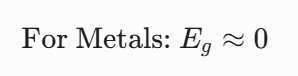
Because there is no hurdle to cross, electrons hop into the conduction band effortlessly. Here is a quick breakdown to keep handy for your revision notes:
| Feature | Description |
| Valence bands | Heavily populated, closely spaced energy levels filled with valence electrons. |
| Conduction bands | Empty or partially filled higher-energy levels where electrons move freely. |
| Band gap energy (Eg) | The energy jump between the two bands. In metals, this is zero. |
Worked Example: Metallic Bonding (Band Theory) For IIT JAM
Let’s look at a quick conceptual problem. Imagine a theoretical solid where the valence band is completely full, but it directly overlaps with an empty conduction band. Would this material act as a metal or an insulator?
Solution: Since the bands overlap, the band gap is zero. Even though the valence band is full, electrons need virtually zero external energy to jump into the empty overlapping states of the conduction band. They can move freely under an applied electric field, meaning this material will conduct electricity like a classic metal.
Misconceptions in Metallic Bonding (Band theory) For IIT JAM
A classic trap that many IIT JAM aspirants fall into is thinking that metallic bonding only happens if a metal has a completely filled valence band. That is a myth.
The whole point of band theory is that atomic orbitals combine to make molecular orbitals spread across the entire solid. The key isn’t whether a band is 100% full or half-full; it’s all about the overlap. If the orbitals overlap enough to let electrons break free from their home atoms and drift through the lattice, you have got metallic bonding.
Application of Metallic Bonding (Band Theory) For IIT JAM: Real-World Examples
To make this concrete, let’s look at a fictional scenario. Imagine an engineer named Kabir who is trying to build a ultra-efficient solar panel in his lab. He needs a material that doesn’t just block electricity like rubber, but also doesn’t just let it dump through wildly like copper. He needs control.
Kabir turns to semiconductors. By using band theory, he knows that semiconductors have a tiny, manageable band gap. By tweaking the material, he can use light or heat to kick just the right amount of electrons across that gap.
This same logic applies across the board:
-
Copper wires: Total band overlap means instant electricity for our homes.
-
Semiconductors: Small gaps let us build transistors, diodes, and microchips.
-
Materials Science: Researchers use band structures to design brand-new superconductors and nanomaterials.
Exam Strategy: Metallic Bonding (Band Theory) For IIT JAM
When you are prepping for the solid-state and bonding questions, you want to focus heavily on the band diagrams. Don’t just read the theory—draw the overlaps.
To score well, make sure you spend time on these specific areas:
-
How band gaps change between metals, semiconductors, and insulators.
-
The basic math and assumptions behind the Kronig-Penney model.
-
How the Fermi-Dirac distribution changes when you turn up the heat.
At VedPrep, we always tell students that practicing previous years’ questions (PYQs) is the best way to see how these concepts are tested. Try solving them without looking at the solutions first to see where your gaps are.
Solved Problems – Metallic bonding (Band theory) For IIT JAM
Question: A specific material has a band gap energy of 1.5 eV. What is the minimum energy required for an electron to move from the valence band to the conduction band?
Answer: The band gap energy (Eg) is the exact height of the energy wall separating the valence band from the conduction band.
If the gap is 1.5 eV, an electron needs to absorb at least that exact amount of energy to make the leap. If you hit it with anything less, it stays put in the valence band.
Therefore, the minimum energy required is 1.5 eV.
Key Takeaways – Metallic Bonding (Band Theory) For IIT JAM
-
The Sea of Electrons: Metals are held together by shared, delocalized electrons that move freely through the lattice.
-
Zero Band Gap: Metals conduct electricity perfectly because their valence and conduction bands overlap (Eg = 0).
-
Focus on the Overlap: Metallic properties come from overlapping atomic orbitals, not from how full the individual valence bands are.
Final Thoughts
Mastering metallic bonding and band theory isn’t just about ticking off another box on your IIT JAM syllabus—it’s about building the intuitive, physical mindset that separates top rankers from the rest of the pack. When you can look at a problem and visually see the orbital overlaps, the zero band gap, and how electrons shift under different conditions, those tricky MSQs and NATs become much less intimidating.
To know more in detail from our faculty, watch our YouTube video:
Frequently Asked Questions
Why is Band Theory used to explain metallic bonding?
While the "sea of electrons" model is great for basic visualization, it doesn't explain things like why some materials are semiconductors and others are insulators. Band theory takes a deeper look at quantum mechanics, explaining how overlapping atomic orbitals merge into continuous energy bands.
What is the difference between a valence band and a conduction band?
The valence band is the lower-energy band that is packed with electrons at absolute zero. The conduction band sits right above it and is mostly empty. When electrons get enough energy to hop into the conduction band, they can roam freely and conduct electricity.
Why do metals conduct electricity so well according to Band Theory?
In metals, the valence band and the conduction band actually overlap. This means the band gap energy (Eg) is zero. Because there is no barrier, electrons can move into the conduction band and flow as an electric current with virtually zero effort.
Can metallic bonding occur if the valence band is partially filled?
In fact, this is a major misconception among IIT JAM aspirants. Metallic character depends on the overlap of atomic orbitals to form delocalized bands, not whether the starting valence band is 100% full.
How does Band Theory differentiate between metals, semiconductors, and insulators?
It all comes down to the size of the band gap. Metals have zero band gap (overlapping bands). Semiconductors have a small, bridgeable band gap. Insulators have a massive band gap that electrons can't cross under normal conditions.
Why does the electrical conductivity of metals decrease as temperature rises?
As a metal heats up, its positive metal ions start vibrating violently in their fixed positions. This extra movement gets in the way of the traveling conduction electrons, causing collisions and increasing electrical resistance.
Why does the conductivity of semiconductors increase with temperature?
Unlike metals, semiconductors have a small band gap. When you turn up the heat, you give the valence electrons enough thermal energy to jump across the gap into the conduction band, increasing the total number of charge carriers.
What textbook is best for studying this topic for IIT JAM at VedPrep?
Our team at VedPrep highly recommends Physical Chemistry by Atkins & De Paula. It covers solid-state concepts and molecular orbital theory with the exact level of mathematical and conceptual depth required for the exam.
What is the Kronig-Penney model?
The Kronig-Penney model is a quantum mechanical model that uses a simplified periodic potential (like a series of square wells) to show how energy bands and forbidden gaps naturally form when electrons move through a crystal lattice.
Why is the Kronig-Penney model important for IIT JAM?
It helps you understand the theoretical origin of band gaps. The exam often tests your conceptual grasp of how electron wave functions behave in a periodic lattice and what happens when the potential barriers change.
What is the Fermi energy level?
The Fermi level is the highest energy state that an electron can occupy at absolute zero (0 K). Think of it as the "water level" of the electron sea.
Does VedPrep provide specific practice tests for Metallic Bonding?
Yes! At VedPrep, we offer dedicated topic-wise worksheets, video solutions, and mock tests that specifically target the solid-state and chemical bonding sections of the IIT JAM syllabus to help you lock in your concepts.
How can I avoid silly mistakes in MSQs on Band Theory?
Always read the options carefully regarding band filling and orbital overlaps. Remember that conductivity depends on the availability of empty states close to occupied states, not just the total number of electrons.
Are transition metal oxides covered under this topic?
Yes, they are a frequent application area. Transition metal oxides can exhibit fascinating properties, switching from insulators to metals based on temperature or doping, which makes them a favorite for advanced solid-state chemistry questions.