
Redox titrations for IIT JAM involve the quantitative determination of the amount of a substance in a solution by measuring the amount of another substance that reacts with it, typically using a redox indicator, to achieve a color change.
Redox titrations For IIT JAM: Overview
Chemistry can sometimes feel like a massive puzzle. But when it comes to redox titrations, you are essentially playing a game of electron musical chairs. At its core, a redox titration (or oxidation-reduction titration) is just a way to find out how much of a specific substance is floating around in your beaker by making it react with something else.
The magic happens through the transfer of electrons between two species. One buddy loses electrons (gets oxidized), and the other snaps them up (gets reduced). To nail this in the IIT JAM chemistry paper, you need a strong oxidizing agent, a solid reducing agent, and a clear understanding of how their oxidation states flip during the reaction.
In the lab, you take your unknown sample (the analyte) and slowly drop in a solution with a known concentration (the titrant) from a burette. How do you know when to stop? That is where an indicator steps in Redox titrations. It changes color right at the equivalence point, which is your cue that the reaction is done.
The math behind it comes down to basic stoichiometry. When you reach that equivalence point, the total moles of electrons lost by your reducing agent perfectly match the moles of electrons gained by the oxidizing agent. Master this balance, and you can crack any numerical question the exam throws at you.
Redox Titrations For IIT JAM: Syllabus and Key Textbooks
If you are mapping out your study schedule, you will find Redox titrations nestled right inside Unit 3 of the IIT JAM Physical Chemistry syllabus under Electrochemistry. It is a major crossover topic too, so if you are also eyeing CSIR NET down the road, you will see it pop up in Unit 4 there as well.
When you want to dive deep into the theory without getting bogged down in confusing jargon, these two textbooks are absolute lifesavers:
Physical Chemistry by Peter Atkins
Inorganic Chemistry by Catherine E. Housecroft
These books lay out the core concepts beautifully. At VedPrep, we always remind our students that while standard textbooks give you the raw theory, the trick for competitive exams is learning how to apply those concepts quickly under exam-room pressure.
Understanding the Principle of Redox Titration
Let’s break down how this works in practice. Imagine you have a mystery solution, and you need to figure out its exact concentration. You run a quantitative analysis by reacting it with a titrant of known strength. As they mix, electrons pass from one to the other, changing their oxidation states.
As per Redox titrations, an indicator helps you spot the exact moment the reaction wraps up by changing color at the endpoint. Since the whole process relies on fixed chemical ratios (stoichiometry), you can use the volume of the titrant you added to calculate the exact amount of your mystery analyte.
In most IIT JAM problems, your titrant will be a powerhouse chemical like potassium permanganate (KMnO₄) or potassium dichromate (K₂Cr₂O₇). If you can write out a balanced chemical equation and track where the electrons are moving, you are already halfway to the right answer.
Worked Example: Redox Titration of a Mixture
Let’s look at a classic numerical problem you might see on test day.
Imagine you have a 25 mL mixture containing Fe²⁺ and Cr³⁺ ions, and you titrate it using K₂Cr₂O₇ in an acidic environment. You use diphenylamine as your indicator, which switches color the moment the reaction hits its equivalence point.
Here are the half-reactions you need to worry about:
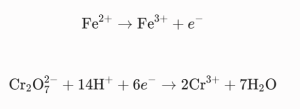
In this setup, your Fe²⁺ ions lose an electron to become Fe³⁺, while the Cr₂O₇²⁻ ion pulls in electrons to become Cr³⁺. Let’s say you are using a 0.1 M solution of K₂Cr₂O₇, and it takes exactly 20 mL of it to react with all the Fe²⁺ ions. How do we find the weight of the Fe²⁺ ions?
| Reaction | Eq. Mass |
| Fe²⁺ → Fe³⁺ + e⁻ | 55.85 |
| Cr₂O₇²⁻ + 14H⁺ + 6e⁻ → 2 Cr³⁺ + 7H₂O | 49.03 |
Step-by-Step Solution:
Find the millimoles of titrant used:
Millimoles of K₂Cr₂O₇ = 20 mL × 0.1 M = 2 millimolesUse the reaction ratio: Looking at the half-reactions, 1 mole of Cr₂O₇²⁻ needs 6 moles of electrons, which means it oxidizes 6 moles of Fe²⁺.
Millimoles of Fe2+ = 2 × 6 = 12 millimolesCalculate the final mass:
Mass of Fe2+ = 12 millimoles × 55.85 (Atomic Mass) = 670.2 mg
Common Misconceptions in Redox Titration
A big trap many students fall into is thinking that a redox titration is just a simple, instantaneous spark where electrons jump directly from one chemical to another the split second they touch.
But it doesn’t quite work that way. In reality, these reactions can be sluggish or complex in Redox titrations. The indicator isn’t just there to look pretty; it often works alongside the specific pH environment to make sure we can actually track the exact equivalence point.
As per Redox titrations, take the classic titration of Fe²⁺ with KMnO₄. The intense purple KMnO₄ solution is your titrant. As you drop it into the colorless Fe²⁺ solution, it reacts immediately and loses its color. The reaction keeps going until every single Fe²⁺ ion transforms into Fe³⁺. The moment you add one extra drop of KMnO₄ and there’s no Fe²⁺ left to react with it, the solution turns a permanent pale pink. That is your endpoint!
Application of Redox Titration in Real-World Scenarios
To make this tangible, let’s look at how this chemistry works outside the classroom. Think of it like a quality control checkmark used across different industries.
Pharmaceutical Quality Control: Imagine a fictional medicine factory making Vitamin C tablets. To make sure every tablet has the exact dosage listed on the box, chemists use redox titrations with iodine to check the purity of the ingredients before the pills hit pharmacy shelves.
Food Safety Testing: Think of a hypothetical juice company. They might use redox chemistry to measure preservative levels or monitor oxygen exposure so your morning orange juice stays fresh and doesn’t spoil early.
Environmental Monitoring: Environmental teams use these exact methods to test river water downstream from industrial plants, checking for dissolved oxygen levels or spotting heavy metal pollution.
Clinical Diagnostics: In a medical lab setup, doctors can use specialized redox reactions to analyze blood or urine samples, helping them track specific biomarkers like uric acid to diagnose metabolic conditions.
Exam Strategy for Redox Titration
Cracking the IIT JAM, CSIR NET, or GATE requires more than just memorizing definitions. You need to know how to spot patterns in numerical questions and manage your time well for topics like Redox titrations.
Key Subtopics to Focus On:
Types of redox titrations: Get comfortable with permanganometry, dichrometry, and iodometry.
Electrodes: Know your indicator electrodes versus your reference electrodes.
Titration Curves: Understand how pH and cell potential (Ecell) shift throughout the process.
A great way to get fast at these problems is to practice balancing equations using the ion-electron method until it becomes second nature. Here at VedPrep, we build our study modules to help you spot the shortcut paths in these calculations, saving you precious minutes during the actual exam.
Redox Titration in IIT JAM Chemistry: Tips and Tricks
When you are diving into your preparation for Redox titrations, pair up your reading of Atkins with a reliable analytical text like Harris. The questions in IIT JAM love to test how well you understand the relationship between concentration changes and electrical potential.
Master the Nernst Equation: This is your best friend for predicting cell potential at different stages of your titration:
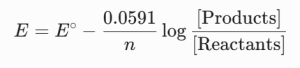
Track your ‘$n$‘ value: Always double-check the total number of electrons transferred in your balanced net ionic equation. Getting this number wrong will throw off your entire calculation.
Watch the pH: Many redox reactions behave completely differently depending on whether they are in an acidic, basic, or neutral medium.
If you want to see these steps broken down visually, we have put together plenty of conceptual walk-throughs over at VedPrep to help you build your confidence.
Final Thoughts
At VedPrep, we know that preparing for national-level exams can feel overwhelming. That is why we focus on breaking down complex topics like Redox titrations, equivalent weights, and endpoint detection into bite-sized, logical steps.
If you are looking for a little extra clarity on this topic, you can check out this free VedPrep lecture on Redox titrations For IIT JAM. Staying consistent with your practice problems and keeping a clear formula cheat sheet handy will make a massive difference when exam day rolls around.
To know more in detail from our faculty, watch our YouTube video:
Frequently Asked Questions
How does a redox titration differ from an acid-base titration?
While acid-base titrations depend on the transfer of protons (H+) to neutralize a solution, redox titrations rely entirely on the transfer of electrons (e-) between an oxidizing agent and a reducing agent.
What is the difference between the equivalence point and the endpoint?
The equivalence point is the theoretical moment in the reaction where the moles of electrons lost by the reducing agent exactly equal the moles of electrons gained by the oxidizing agent. The endpoint is the physical moment you actually see—usually marked by a distinct color change in the indicator or a sharp jump on a meter.
Why are redox titrations usually carried out in an acidic medium?
Many common oxidizing agents, like potassium permanganate (KMnO₄), need an abundance of hydrogen ions (H⁺) to be reduced completely and predictably. For example, in an acidic medium, MnO₄⁻ cleanly reduces from an oxidation state of +7 to a stable +2. In neutral or basic media, it forms a messy brown precipitate of MnO2, which ruins the titration.
Can a chemical act as its own indicator in a redox titration?
Yes! This is known as a self-indicator. The most famous example used in IIT JAM problems is potassium permanganate (KMnO₄). Because the MnO₄⁻ ion has an intense purple color while the reduced Mn²⁺ ion is virtually colorless, the very first drop of excess permanganate turns the solution a permanent pale pink, signaling the end of the reaction without needing an extra indicator.
Which unit of the IIT JAM Chemistry syllabus covers redox titrations?
It is featured under Physical Chemistry, specifically within the Electrochemistry unit. However, because it involves transitioning oxidation states and specific reagents, it heavily overlaps with analytical and inorganic chemistry topics.
How should I manage my time when solving redox calculation questions during the exam?
The biggest timesaver is mastering the n-factor concept. Instead of writing out and balancing massive, complex molecular equations under exam pressure, find the n-factor for your species and use the law of chemical equivalence (N1V1 = N2V2). This bypasses a lot of tedious algebra.
Are there specific textbooks recommended by VedPrep for mastering this topic?
Yes, we highly recommend anchoring your core concepts in Physical Chemistry by Peter Atkins and Inorganic Chemistry by Catherine E. Housecroft. For the practical and analytical calculation side of things, Analytical Chemistry by Gary D. Christian or Daniel C. Harris is incredibly helpful.
What is the 'n-factor' in a redox reaction, and how do I calculate it?
The n-factor (or valence factor) is the total number of electrons lost or gained by one mole of a reactant. To find it, calculate the change in the oxidation state of the atom being oxidized or reduced, and multiply that change by the number of those atoms present in one molecule of the reactant.
What is the law of chemical equivalence, and how does it apply to titrations?
The law states that chemicals always react with each other in the ratio of their equivalents. At the equivalence point:
Or in terms of normality (N) and volume (V):
How does starch work as an indicator in iodometric titrations?
Starch forms a unique, intense dark-blue complex with triiodide ions (I₃⁻), which are present in iodine solutions. In an iodometric titration, as you titrate residual iodine with sodium thiosulfate, the blue color fades away. The moment the solution turns completely colorless, you know all the iodine has reacted.
Why did my solution turn brown during a KMnO4 titration?
This usually happens because there wasn't enough acid in your beaker. When the solution isn't acidic enough, the permanganate ions drop into an incomplete reduction path, creating a brown precipitate of manganese dioxide (MnO₂) instead of staying as clear, reduced Mn²⁺ ions.
Does a redox indicator participate directly in the main chemical reaction?
No. Much like acid-base indicators, a redox indicator is an organic molecule that undergoes its own reversible oxidation-reduction process. It changes color because its oxidized form has a completely different chemical structure (and color) than its reduced form. It shifts only when there is an excess of titrant in the flask.