





Cauchy’s Integral Formula asserts that the values of a function that is holomorphic within a disk are fixed by the function’s values along the perimeter of that disk. It represents a function value at a singular point via a path integral, demonstrating that analytic functions possess infinite differentiability.
The Mathematical Foundation of Cauchy’s Integral Formula
Cauchy’s Integral Formula stands as a fundamental tenet of Complex Analysis. It establishes a direct connection between the function’s value at a point inside a region and its values along a closed perimeter. If a function is analytic within and on a simple closed contour, the integral around that contour defines the function at any point inside. This relationship distinguishes complex differentiable functions from real differentiable functions. In real analysis, knowing the values on a boundary does not determine the interior values. Complex Analysis requires a more rigid structure where the local behavior dictates the global properties.
The standard mathematical expression for Cauchy’s Integral Formula is:
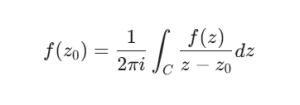
This statement holds true when f(z) is holomorphic within a simply connected region encompassing a smooth, closed curve C. The point z0 needs to be situated inside C. Integration proceeds along the positive (counterclockwise) sense. This equation illustrates that the term in the lower part introduces a non-analytic point at z0. The integral extracts the value of the numerator at that specific point. Many students preparing for RPSC Assistant Professor Maths (PYQs) encounter this as a primary tool for evaluating complex line integrals. Covering Paper I and Paper II under RPSC Assistant Professor Maths Syllabus is necessary before solving past papers.
Higher Order Derivatives and Generalizations
Cauchy’s Integral Formula extends to the derivatives of analytic functions. This generalization is known as the Cauchy Integral Formula for Derivatives. This demonstrates that for any function analytic at a specific location, it will have derivatives of every order there. Such a characteristic is distinctive to the field of Complex Analysis. Determining the function’s n-th derivative can be achieved by computing an integral featuring an elevated power in the denominator. This extension is vital for solving RPSC Assistant Professor Maths (PYQs) involving power series and Taylor expansions.
The generalized formula for the n-th derivative is:
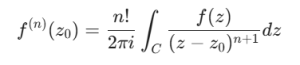
This form lets you gauge integrals when the lower part has a singularity of rank higher than one. It eases the steps for calculating residues when facing specific kinds of irregular points. Within the study plan for RPSC Assistant Professor Maths (PYQs), this equation links Cauchy’s Fundamental Principle to the calculus of residues. It guarantees that any function that possesses single complex differentiation capabilities is inherently smooth to any order. This degree of consistency is a key characteristic of functions that are analytic.
Application in RPSC Assistant Professor Maths (PYQs)
Individuals preparing for the RPSC Assistant Professor Maths (Previous Year Questions) often utilize Cauchy’s Integral Formula when tackling contour integration exercises. Numerous test items present a closed path and inquire about the result of an integral featuring a singular point. The initial step is ascertaining whether this point is located within or external to the path. Should the point reside outside, Cauchy’s Theorem frequently establishes the integral’s value as null. If the point is internal, applying Cauchy’s Integral Formula allows for rapid determination of the outcome. This speed is essential given the nature of competitive tests.
Typical issues in Complex Analysis often feature round or square boundaries. The equation applies irrespective of the contour’s exact geometry, provided it is both simple and sealed. It is essential to confirm the function in the dividend is holomorphic across the entire domain. Regarding RPSC Assistant Professor Maths (PYQs), practice frequently centers on pinpointing the right f(z) and z0. Mistaking the holomorphic component of the expression under the integral yields erroneous outcomes. Proficiency with this relationship offers a substantial edge in the specialized components of the mathematics curriculum.
Calculations and Practical Examples
To use Cauchy’s Integral Formula, one needs a clear method for spotting the parts of the function being integrated. The table below demonstrates the formula’s operation in various situations frequently encountered in Complex Analysis texts and in RPSC Assistant Professor Maths (PYQs).
| Function f(z) | Singularity z0 | Integral Form | Resulting Value |
|---|---|---|---|
| ez | 0 |  |
2πi |
| sin(z) | π/2 | 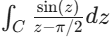 |
2π |
| z2+ 1 | i |  |
0 |
| 1 | a | 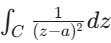 |
0 |
For the third illustration, the outcome is null since the numerator z2+ 1 becomes zero precisely at the singular point z0 = i. In the fourth case, because the derivative of a constant function yields zero, the second-order integral disappears. These instances show how the formula translates Complex Analysis into straightforward function appraisal. Complex Analysis students frequently encounter these regularities in material for competitive tests. Maintaining accuracy in pinpointing the analytic segment of the function being integrated guarantees correct answers during time-sensitive assessments such as the RPSC Assistant Professor Maths (PYQs).
Limitations and Critical Perspectives
Cauchy’s Integral Formula demands that the function be analytic throughout the region enclosed by the contour. Should the function possess additional singular points inside the boundary, this particular formula proves inadequate. Consequently, you would need the Residue Theorem to address numerous poles. A frequent mistake is utilizing the formula when the singularity resides precisely upon the boundary. Under these circumstances, the integral frequently diverges or necessitates principal value evaluation. Conventional Cauchy theory excludes points situated exactly on the contour line.
A further constraint relates to the domain’s connectedness. Within domains having multiple connections, one needs to alter the path to establish a region of single connectivity. Overlooking voids within the area results in the formula being applied wrongly. Although this formula serves as a potent instrument in Complex Analysis, it is not a panacea for every integral. It is precisely aimed at functions possessing separate pole-like singularities. When dealing with essential singularities or branch points, alternative approaches such as Laurent’s Expansions or particular path modifications become essential. Grasping these constraints avoids improper use of the formula when reviewing past questions for the RPSC Assistant Professor Maths exam.
The Role of Cauchy’s Integral Formula in Geometry
Cauchy’s Integral Formula carries significant geometric meaning in Complex Analysis. It suggests that an analytic function’s magnitude at a circle’s core equals the average of its magnitudes around the edge. This concept is termed the Mean Value Property. This characteristic guarantees that the greatest and smallest magnitudes an analytic function can attain cannot be found within an open region; they must be located on the perimeter, which is the Maximum Modulus Principle.
Conclusion
Grasping Cauchy’s Integral Formula is crucial for mathematicians aiming for higher academic work or rigorous teaching assessments. This concept converts challenging path integration into straightforward function appraisal, demonstrating the profound coherence of analytic functions in Complex Analysis. By knowing how perimeter values determine internal characteristics, you acquire an indispensable asset for tackling RPSC Assistant Professor Maths (Past Questions) and similar technical problems. VedPrep offers expert lecturers to help you achieve high scores by addressing core subjects like Cauchy’s Integral Formula.
To learn more in detail from our expert professionals. watch our YouTube video:
Frequently Asked Questions (FAQs)
Why is Cauchy’s Integral Formula significant for students?
This formula allows you to calculate complex integrals by evaluating the function at a specific point. It bridges the gap between local analyticity and global behavior. Candidates preparing for RPSC Assistant Professor Maths (PYQs) use it to simplify path integrals that would otherwise require difficult parameterization.
What are the prerequisites for applying Cauchy’s Integral Formula?
You must ensure the function is analytic within and on a simple closed contour. The path of integration must be rectifiable and closed. The point of interest must lie strictly inside the contour. The integration process must follow a positive or counterclockwise direction to yield standard results.
How does Cauchy’s Integral Formula differ from Cauchy’s Theorem?
Cauchy’s Theorem states the integral of an analytic function over a closed loop is zero. Cauchy’s Integral Formula deals with integrands containing a denominator term like z - z0. The formula extracts a specific value rather than resulting in zero. Both are pillars of Complex Analysis studies.
What is the Mean Value Property in this context?
The Mean Value Property stems from Cauchy’s Integral Formula. It states the value at the center of a circular disk equals the arithmetic mean of the values on the circle. This property ensures that analytic functions do not have local maxima or minima within their domain of analyticity.
How do you solve RPSC Assistant Professor Maths (PYQs) using this formula?
Identify the singularity in the integrand first. Check if the singularity lies inside the given contour. If it does, rewrite the integral to match the standard Cauchy form. Substitute the interior point into the analytic part of the function and multiply by 2πi to find the answer.
What are the steps to evaluate higher order derivatives?
Use the generalized Cauchy Integral Formula for derivatives when the denominator has a power n+1. Identify the n-th derivative of the numerator function. Evaluate this derivative at the singular point. Multiply the result by 2πi and divide by n factorial to reach the final value.
How do you choose the correct contour for integration?
Select a contour that encloses the singularities of interest while remaining in the region where the numerator is analytic. Circular paths are common in RPSC Assistant Professor Maths (PYQs) due to their simple parameterization. Ensure the contour does not pass directly through any poles or branch cuts.
What happens if the singularity lies outside the contour?
If the singular point z0 is outside the closed path, the entire integrand is analytic within the region. According to Cauchy’s Theorem, the integral over the closed loop is zero. You do not need to apply the integral formula in this specific scenario.
How do you handle a singularity located on the contour?
Cauchy’s Integral Formula does not apply if the point lies exactly on the path. Such integrals are often divergent or require the calculation of the Cauchy Principal Value. In most academic and competitive exams, you will find singularities strictly inside or outside the boundary.
What if the function in the numerator is not analytic?
The formula fails if the numerator possesses its own singularities within the contour. You must decompose the function using partial fractions or other algebraic methods. Ensure the numerator f(z) satisfies the Cauchy Riemann equations throughout the interior region before proceeding with calculations.
How does this formula relate to Taylor Series expansions?
Cauchy’s Integral Formula provides the coefficients for the Taylor Series of an analytic function. The n-th coefficient is directly linked to the n-th derivative calculated via the integral. This connection proves that every analytic function is equivalent to a power series.
What is the role of the winding number in the general formula?
The general version of the formula includes the winding number or index of the curve. This integer represents how many times the path circles the singularity. In most RPSC Assistant Professor Maths (PYQs), the winding number is one, representing a single counterclockwise loop.
How does Liouville’s Theorem derive from this formula?
Liouville’s Theorem states that every bounded entire function is constant. This is proven by using Cauchy’s Integral Formula for the first derivative. By taking a circle with an infinite radius, the derivative is shown to be zero, implying the function does not change.
What is the impact on physical potential fields?
In physics, this formula implies that the potential at a point in a source free region is determined by the potential on the boundary. This applies to electrostatics and fluid dynamics where complex potentials represent physical fields. It ensures smoothness and stability in these models.