
A stable nucleus is achieved when the number of neutrons (n) equals the number of protons (p) or when the n/p ratio is close to 1, making it an essential concept for RPSC Assistant Professor exam.
Syllabus: RPSC Assistant Professor Syllabus Unit
If you are gearing up for the RPSC Assistant Professor exam, you already know the syllabus is vast. But when it comes to the Nuclear Physics unit, there is one concept you simply cannot skip: nuclear stability and the neutron-to-proton (n/p) ratio. This topic is a core pillar of the physics paper, and it is equally crucial if you are pulling double duty preparing for the CSIR NET Physical Sciences exam or IIT JAM.
To get a solid grip on this, standard textbooks are your best friends. Diving into Nuclear Physics by I.E. Irodov gives you excellent mathematical clarity on nuclear properties. Another great pick is Principles of Nuclear Physics by S.S. Schweber, which does a fantastic job of breaking down the core theory. Master the n/p ratio, nuclear structures, and nuclear reactions, and you will be well on your way to locking in those crucial exam points.
Nuclear Stability (n/p Ratio): Definition and Importance for RPSC Assistant Professor
Let’s break down what nuclear stability actually means without getting bogged down in dense academic jargon. Think of the nucleus like a crowded house party. You have protons, which are all positively charged, crammed into a tiny space. Since like charges repel, those protons are constantly trying to push each other away due to electrostatic repulsion.
So, what keeps the nucleus from flying apart? Enter the strong nuclear force. This is a super-strong, short-range attraction that acts between nucleons (protons and neutrons alike). Neutrons act like the ultimate peacemakers at our hypothetical party. They don’t bring any electrical charge to the fight, but they do bring plenty of attractive strong nuclear force to help hold everything together.
The n/p ratio is simply the number of neutrons divided by the number of protons. For lighter elements, a perfect balance works best, meaning an n/p ratio right around 1 keeps things perfectly calm. But as elements get heavier and more protons pack into the nucleus, the electrostatic push gets way more intense. To counter this, heavier atoms need extra peacemakers—meaning more neutrons—which pushes the ideal n/p ratio up.
Nuclear Stability (n/p Ratio): Factors Affecting Stability in Nuclear stability (n/p ratio)
When the proton-neutron balance gets out of whack, the nucleus becomes unstable. It’s like a shaky table that wants to reset itself. To find a comfortable, stable state, the nucleus undergoes radioactive decay. A massive factor here is binding energy—specifically, binding energy per nucleon. Think of binding energy as the structural glue of the atom. The higher the binding energy, the tighter the nucleus is locked together, and the more stable it is.
When a nucleus has a mismatch in its n/p ratio, it fixes the problem based on which particle it has too much of:
- High n/p ratio: The nucleus has too many neutrons. To fix this, it undergoes beta minus (β–) decay. A neutron transforms into a proton, spitting out an electron (beta particle) and an antineutrino. This drops the neutron count and bumps up the proton count, bringing the ratio down toward stability.
- Low n/p ratio: The nucleus is proton-heavy. It remedies this through beta plus (β+) decay or electron capture. Here, a proton turns into a neutron, which raises the n/p ratio back up to a safer zone.
We at VedPrep always remind our students that while light nuclei love a strict 1:1 ratio, the exact stable ratio drifts as you move down the periodic table.
Worked Example: Solved Question on Nuclear Stability (n/p ratio) For RPSC Assistant Professor
Let’s look at a quick, practical example to see how this plays out in exam-style questions.
Take a Carbon-12 nucleus (¹²C). It has 6 protons and 6 neutrons.
To find its n/p ratio, use the straightforward formula:
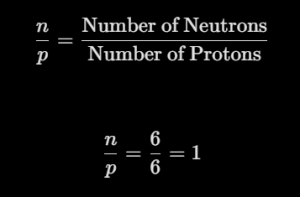
Because 12C is a light element and its ratio hits exactly 1, the strong nuclear force perfectly balances out the electrostatic repulsion. This makes Carbon-12 incredibly stable, which is why it is so abundant around us.
Misconception: Common Student Mistake in Understanding Nuclear Stability (n/p ratio)
A frequent trap that students fall into is assuming that a high n/p ratio automatically means a nucleus is stable because “more neutrons mean more strong force.”
That is a major misconception. Extra neutrons are helpful only up to a point. If you pack too many neutrons into a nucleus, the system becomes top-heavy and unstable. An overly high n/p ratio forces the nucleus into β– decay to get rid of that excess baggage. True stability isn’t about having the most neutrons; it’s about hitting that sweet spot where the forces perfectly balance.
Application: Real-World Applications of Nuclear Stability (n/p ratio) For RPSC Assistant Professor
This isn’t just theory meant to sit on a chalkboard; understanding nuclear stability runs the modern world.
Take nuclear power plants. When engineers design reactors or choose fuels like Uranium-235 or Plutonium-239, they closely look at nuclear stability and fission paths. If you don’t map out how the n/p ratio shifts during fission, you can’t manage the reactor safely or efficiently.
The same rules apply to nuclear medicine. Doctors use unstable isotopes with specific, predictable n/p ratios to track diseases inside the body or target cancer cells. Even in materials science, engineers use these principles to create radiation-resistant materials that can survive inside reactor cores without breaking down.
Nuclear Stability (n/p Ratio): Exam Strategy for RPSC Assistant Professor
When you are prepping for a competitive paper like the RPSC Assistant Professor exam, you need a strategy that goes beyond just memorizing definitions.
Start by building a clear mental map of the stability curve (the Segrè plot). Know exactly how the stable n/p ratio changes from light elements to heavy elements. Next, practice identifying which decay path a nucleus will take based on where it sits relative to that stability line.
Working through past exam questions is a total game-changer here. If you want a bit of extra help structuring your study routine, we have put together video lectures, targeted practice questions, and detailed study notes over at VedPrep. You can check out our free VedPrep lecture on nuclear stability to see a step-by-step breakdown of how these questions show up on the actual exam.
Practice Questions: Nuclear Stability (n/p Ratio) for RPSC Assistant Professor
Let’s try a practical problem together to test your understanding.
Problem: A certain radioactive isotope has an atomic number of 82 and a mass number of 214. This isotope undergoes alpha decay to form a more stable nucleus. Determine the neutron-to-proton (n/p) ratio of the resulting nucleus and analyze its stability.
Step-by-Step Solution:
- Find the initial counts: The parent nucleus has 82 protons (Z = 82) and 132 neutrons (A – Z = 214 – 82 = 132).
- Account for alpha decay: An alpha particle (α) consists of 2 protons and 2 neutrons (⁴₂He).
- Calculate the new counts: * New proton count (p) = 82 – 2 = 80
- New neutron count (n) = 132 – 2 = 130
- Calculate the new n/p ratio:
n/p = 130/80 = 1.625
Stability Analysis: For heavy elements in this region of the periodic table, the stable n/p ratio usually hovers around 1.5 to 1.6. Because our resulting nucleus has a ratio of 1.625, it is significantly more stable than the parent atom, but it still has a slight excess of neutrons. To find perfect comfort, it will likely undergo a follow-up beta decay.
Final Thoughts
The story of nuclear stability doesn’t end with textbook formulas. It is a booming area of modern research. Today, scientists are exploring the “island of stability”—a theoretical region in the superheavy element zone where specific “magic numbers” of protons and neutrons might yield highly stable, long-lived elements that don’t exist in nature.
Researchers are also working on next-generation nuclear fuel cycles to make clean energy safer and minimize long-lived radioactive waste. By diving deep into the fundamentals of the n/p ratio, the scientific community continues to open doors to better medical treatments, tougher materials, and more sustainable power sources.
To know more in detail from our faculty, watch our YouTube video:
Frequently Asked Questions
What is the n/p ratio?
The n/p ratio, or neutron-to-proton ratio, is a measure of nuclear stability. It is calculated by dividing the number of neutrons (n) by the number of protons (p) in an atomic nucleus. A stable nucleus typically has an n/p ratio close to 1.
How does the n/p ratio affect nuclear stability?
The n/p ratio affects nuclear stability by influencing the balance between the strong nuclear force and electrostatic repulsion. A high n/p ratio can lead to instability due to excessive neutron-proton repulsion, while a low n/p ratio can lead to instability due to excessive proton-proton repulsion.
What is the role of neutron excess in nuclear stability?
Neutron excess, or the difference between the number of neutrons and protons, plays a crucial role in nuclear stability. A high neutron excess can lead to instability, as it increases the energy of the nucleus and makes it more prone to radioactive decay.
How does nuclear stability relate to radioactive decay?
Nuclear stability is directly related to radioactive decay. Unstable nuclei with an unfavorable n/p ratio undergo radioactive decay to achieve stability. The type and rate of decay depend on the specific nucleus and its n/p ratio.
What is the relationship between nuclear stability and the strong nuclear force?
The strong nuclear force plays a crucial role in maintaining nuclear stability by holding nucleons together. The strength of the strong nuclear force depends on the distance between nucleons and the n/p ratio.
How does nuclear stability affect atomic mass?
Nuclear stability affects atomic mass by influencing the binding energy of the nucleus. Stable nuclei have a lower atomic mass than unstable nuclei due to the energy released during radioactive decay.
How does the n/p ratio affect nuclear reactivity?
The n/p ratio affects nuclear reactivity by influencing the probability of nuclear reactions. A high n/p ratio can lead to increased reactivity due to the excess neutrons available for reaction.
How is the concept of nuclear stability applied in the RPSC Assistant Professor exam?
In the RPSC Assistant Professor exam, nuclear stability is often tested in the context of nuclear chemistry and inorganic chemistry. Questions may focus on the relationship between n/p ratio, nuclear stability, and radioactive decay, as well as applications in analytical chemistry.
What types of questions can I expect on nuclear stability in the RPSC Assistant Professor exam?
You can expect questions on nuclear stability to cover topics such as the n/p ratio, neutron excess, radioactive decay, and nuclear reactions. Questions may also involve analytical applications, such as neutron activation analysis or radiometric dating.
Can you provide an example of a nuclear stability question in the RPSC Assistant Professor exam?
An example question might ask you to calculate the n/p ratio of a given nucleus and predict its stability. Another question might ask you to explain the relationship between nuclear stability and radioactive decay.
How can I apply nuclear stability concepts to analytical chemistry?
Nuclear stability concepts can be applied to analytical chemistry by understanding the role of radioactive decay in analytical techniques such as neutron activation analysis and radiometric dating.
How can I avoid mistakes when applying nuclear stability concepts?
To avoid mistakes, carefully consider the n/p ratio, neutron excess, and electrostatic repulsion when evaluating nuclear stability. Also, be sure to recognize the relationships between nuclear stability, radioactive decay, and analytical applications.
What are some advanced topics related to nuclear stability?
Advanced topics include the study of nuclear isomers, excited nuclear states, and the effects of nuclear stability on chemical reactivity. These topics require a deep understanding of nuclear chemistry and inorganic chemistry.
How does nuclear stability relate to nuclear reactions?
Nuclear stability plays a crucial role in nuclear reactions, as it influences the probability and type of reaction. Understanding nuclear stability is essential for predicting reaction outcomes and designing new nuclear reactions.