
The Partition function is a mathematical tool used to calculate the number of microstates in a system, crucial for understanding thermodynamics and statistical mechanics in RPSC Assistant Professor exams.
Understanding RPSC Assistant Professor Syllabus for Partition function
If you are eyeing that RPSC Assistant Professor seat, you already know that the syllabus doesn’t pull any punches. The Partition function is a heavyweight topic that you will find sitting right in the middle of Thermodynamics and Statistical Mechanics. It is the exact same concept that tracks across the CSIR NET and IIT JAM syllabi, meaning a solid grasp here actually helps you clear multiple hurdles at once.
When you are diving into this at home, standard textbooks like Thermodynamics by C. J. Adkins and Statistical Mechanics by R. K. Pathria are your best bets for deep conceptual breakdowns. Here at VedPrep, we often tell students to think of the partition function as the ultimate bridge. It takes all the chaotic, invisible quantum states of individual particles and packages them into clean, macroscopic numbers you can actually measure in a lab. If you want to calculate the pressure, entropy, or free energy of a system in thermal equilibrium, this function is always your starting line.
Defining the partition function For RPSC Assistant Professor
Let’s strip away the heavy math for a second. Imagine you are managing a massive, multi-story hotel during the peak Rajasthan tourism season. Each guest room represents a specific “microstate”—an exact configuration of where particles are and how much energy they have. As the manager, you don’t really care about the exact room number of every single guest at every second; you want to know the overall occupancy rate, the total energy usage, and how the guests are distributed across the floors.
In this fictional setup, the Partition function (which we write as Q or Z) is your master guest ledger. It sums up all the possible ways your particles can arrange themselves.
Microstate vs. Macrostate: A microstate is the exact, hyper-specific arrangement of every single particle’s position and momentum. The macrostate is just the big-picture view—like the overall temperature and volume of the gas.
By calculating Z, you can figure out the exact probability of finding your system in a specific microstate. More importantly, it lets you calculate entropy (how chaotic the hotel is) and free energy (how much useful work you can squeeze out of the system).
Here are the core pillars to keep straight for the exam:
- It is a literal sum over every single allowed microstate.
- It tells you the probability of a system landing in a specific energy state.
- It acts as the gatekeeper for finding entropy, internal energy, and free energy.
- It turns microscopic chaos into predictable, macroscopic physics.
Worked Example: Calculating Partition function For RPSC Assistant Professor
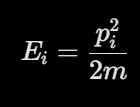
Let’s look at how this actually plays out when you are facing an exam question. Suppose we have a monatomic ideal gas. The energy levels for a single particle depend entirely on its momentum, written out as:
To find the total partition function Z for N indistinguishable particles, we use the standard Boltzmann factor sum, tweaked with a 1/N! term to fix the fact that we can’t tell identical gas particles apart:
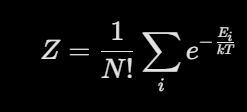
Where k is the Boltzmann constant and T is the absolute temperature. For a gas trapped inside a box of volume V, the quantum mechanics version of these energy levels looks like this:
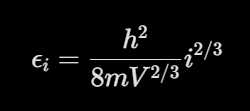
When you plug that energy back into our sum, it looks pretty intimidating:
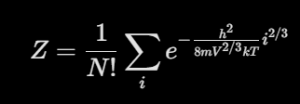
Solution: Thankfully, we can approximate this massive sum as a continuous integral over all space and momentum. When you solve it, it simplifies beautifully into a classic formula you should absolutely memorize for the RPSC exam:
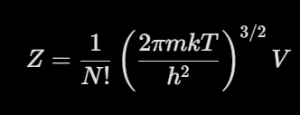
This final expression is pure gold. Once you have this Z, you can take its derivative with respect to temperature to find the internal energy (U = 3/2NkT), proving exactly where that classic ideal gas law comes from.
Common Misconceptions About Partition function For RPSC Assistant Professor
A huge trap that many RPSC aspirants fall into is treating the partition function like an empty mathematical trick—just a random formula you memorize to pass the test. It is easy to see why, considering how heavy the calculus gets. But if you only see it as an abstract tool, the conceptual questions on the exam will trip you up.
The partition function isn’t just a step in an equation; it is a literal measure of how a system shares its energy. In fact, the German word for it is Zustandssumme, which translates perfectly to “sum over states.”
Another regular mix-up is thinking this concept only applies to classic thermal physics. That is completely wrong. The exact same math underpins quantum field theory, solid-state physics, and the behavior of magnetic materials.
- In thermodynamics: It gives you the concrete equation of state.
- In statistical mechanics: It lets you seamlessly switch between microcanonical, canonical, and grand canonical ensembles depending on whether your system can exchange heat or particles with its surroundings.
Getting past these mental blocks is exactly what separates top rankers from the rest of the pack in competitive exams like CSIR NET, GATE, and the RPSC Assistant Professor test.
Real-World Applications of Partition function For RPSC Assistant Professor
While you need this to clear your exam, the partition function drives massive discoveries in materials science and chemical engineering every day.
For instance, think about the race to build better green technology, like thermoelectric materials that turn waste heat from car exhaust pipes straight into usable electricity. To optimize these devices, scientists must predict the Seebeck coefficient (how much voltage you get per degree of heat) and overall electrical conductivity. They do this by calculating the partition function at different temperature ranges to see how electrons distribute themselves.
Over in chemical engineering, the partition function is the backbone of major industrial process simulations. If you are designing a massive refinery flare or a chemical reactor, you have to know exactly how a volatile gas mixture will react under immense pressure and soaring temperatures.
- Designing scalable chemical plants
- Predicting whether a new alloy will melt or hold under pressure
- Developing next-gen thermoelectric energy harvesters
Even though the math operates under strict textbook constraints—like constant temperature, pressure, or energy conservation—the real-world payoffs are massive.
Exam Strategy: Tips for Solving Partition function For RPSC Assistant Professor Questions
When you are sitting in that exam hall, rote memorization will only get you so far. The RPSC examiners love to tweak the boundary conditions of a problem to see if you actually understand the core physics.
First, take a breath and read the question slowly. Identify the ensemble you are dealing with. Is the system completely isolated, or can it swap energy with a heat bath? Knowing the difference tells you instantly whether you need a basic canonical partition function or the grand canonical version.
If you ever feel stuck or overwhelmed by the sheer volume of topics, our team at VedPrep has put together a library of clear, conceptual tools to help you out.
Keep your daily practice focused on these high-yield areas:
- Mastering the exact mathematical setups for basic discrete systems vs. continuous gases.
- Knowing the quick derivative shortcuts to link Z directly to internal energy, pressure, and entropy.
- Practicing classic systems like the 1D harmonic oscillator and the two-level spin system.
Key Subtopics to Focus on for Partition function For RPSC Assistant Professor
As you organize your study calendar, make sure you are prioritizing the right areas. Statistical mechanics is vast, but the RPSC exam tends to cluster its questions around a few predictable themes.
Spend time getting comfortable with how microstates pack into macrostates. You should be able to look at a macrostate (like a flask of gas at room temperature) and conceptually understand how the partition function counts up the astronomical number of microstates hidden inside.
Don’t ignore the Boltzmann constant (k) either. It looks like a simple placeholder, but it is the literal conversion factor between our human scale of temperature (Kelvin) and the microscopic scale of energy (Joules).
If you want a structured way to review these connections, feel free to check out the free VedPrep lecture on the Partition function to sharpen your approach.
Make sure your notes cleanly cover:
- The exact steps to derive Z for both ideal gases and crystalline solids.
- The physical meaning of the weight factor e-βE.
- How the Boltzmann constant balances the scales between heat and energy.
Conclusion
Mastering the partition function might feel like a steep mountain to climb right now, but it is completely doable if you focus on the physical picture rather than just the symbols on the page. Once you see it as a master key that unlocks the bridge between microscopic chaos and real-world thermodynamics, the formulas start making a lot more sense. RPSC exams love to test your conceptual clarity here, so take your time with the derivations and don’t rush the process.
To know more in detail from our faculty, watch our YouTube video:
Frequently Asked Questions
How is the partition function defined?
The partition function is defined as the sum over all possible energy states of the system of the Boltzmann factor, exp(-E/kT), where E is the energy of the state, k is the Boltzmann constant, and T is the temperature.
What is the significance of the partition function?
The partition function is a central quantity in statistical physics, as it allows the calculation of thermodynamic properties such as internal energy, entropy, and specific heat capacity.
How does the partition function relate to thermodynamics?
The partition function is used to calculate thermodynamic properties, such as internal energy, entropy, and specific heat capacity, which describe the behavior of a system in thermal equilibrium.
What are the types of partition functions?
There are two main types of partition functions: the canonical partition function, which describes a system in thermal equilibrium with a heat reservoir, and the grand canonical partition function, which describes a system with variable particle number.
Can the partition function be negative?
No, the partition function is always positive, as it is a sum of positive terms.
What are some common exam questions related to the partition function?
Common exam questions include calculating the partition function for a given system, deriving thermodynamic properties from the partition function, and applying the partition function to solve problems in statistical physics.
How can I practice partition function problems for RPSC Assistant Professor exams?
Practice problems can be found in standard textbooks on statistical physics and thermodynamics, and online resources such as VedPrep EdTech provide practice questions and solutions to help prepare for RPSC Assistant Professor exams.
How do I derive the partition function for a given system?
The partition function can be derived by summing over all possible energy states of the system, using the Boltzmann factor.
What are common mistakes when working with partition functions?
Common mistakes include incorrect calculation of the partition function, incorrect application of the partition function to thermodynamic properties, and confusion between different types of partition functions.
How can I avoid mistakes when working with partition functions?
To avoid mistakes, carefully derive the partition function, double-check calculations, and ensure correct application of thermodynamic formulas.
What is the difference between canonical and grand canonical partition functions?
The canonical partition function describes a system with fixed particle number, while the grand canonical partition function describes a system with variable particle number.
What are some advanced applications of the partition function?
Advanced applications include the study of phase transitions, critical phenomena, and the behavior of complex systems, such as spin glasses and liquid crystals.
How does the partition function relate to quantum field theory?
The partition function is used in quantum field theory to describe the behavior of particles in thermal equilibrium, and is a key concept in the study of quantum statistical mechanics.
What is the connection between the partition function and information theory?
The partition function has been connected to information theory through the concept of information entropy, which is used to describe the information content of a system.