
Radioactive decay is one of those heavy-hitter topics you just can’t skip when you’re preparing for the RPSC Assistant Professor exam. It’s a core slice of nuclear physics that also heavy-lifts for exams like CSIR NET, IIT JAM, GATE, and CUET PG. Let’s break it down naturally, clear up the tricky bits, and see how to ace this section without drowning in textbook jargon.
Radioactive decay For RPSC Assistant Professor: Syllabus
If you glance at the competitive exam landscapes, the topic of Radioactive decay sits right inside the Atomic and Nuclear Physics unit of the physical sciences syllabus.
When you dig into standard reference books like Introductory Nuclear Physics by K. S. Krane or Concepts of Modern Physics by A. Beiser, you’ll see a lot of pages dedicated to this. For an RPSC Assistant Professor aspirant, mastering this isn’t optional. In papers like CSIR NET, you routinely see around 5 to 7 questions tied to nuclear physics, and radioactive decay processes form the bedrock of those questions.
Expect the exam to test your grip on alpha, beta, and gamma decays, along with the math behind half-lives and decay constants. At VedPrep, we always tell our students that practicing a wide variety of numerical problems here is what actually bridges the gap between knowing the theory and scoring the marks.
Core Principles of Radioactive decay For RPSC Assistant Professor
At its heart, Radioactive decay is just nature trying to fix an unstable situation. Think of an atomic nucleus like a poorly packed suitcase. If you stuff too many clothes (protons) or bulky items (neutrons) inside, the latch is under constant stress. Eventually, it’s going to pop open spontaneously to relieve that pressure.
In physics terms, an unstable nucleus has an imbalance of protons and neutrons. To find peace and reach a lower energy state, it sheds radiation. This entire game of nuclear musical chairs is run by the weak nuclear force (for beta decay) and the strong force/Coulomb interactions for alpha decay.
The main ways a nucleus lets off steam include:
- Alpha (α) decay: Tossing out a whole helium nucleus.
- Beta (β) decay: Converting a neutron to a proton (or vice versa) and spitting out an electron or positron.
- Gamma (γ) decay: Relieving excess energy by dropping a high-energy photon.
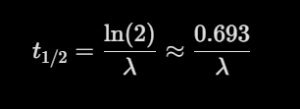
As per Radioactive decay, two critical terms you’ll run into constantly are the decay constant (λ), which is just the probability that a specific nucleus will pop per second, and the half-life (t₁/₂). The relationship between them is incredibly neat:
Key Concepts Explained
Let’s unpack how these pieces fit together. When an unstable atom (a radionuclide) decays, it doesn’t always become stable right away. Sometimes it transforms into another unstable atom.
This triggers a domino effect known as a decay series. Imagine a fictional scenario where you drop a marble down a pegboard; it hits one peg, bounces to another, and keeps moving until it finally lands firmly at the bottom. A classic real-world example of this is Uranium-238. It doesn’t just transform into a stable element overnight. It undergoes a long chain of alpha and beta decays, taking about 4.5 billion years just to reach its final, stable resting state as Lead-206.
Here is a quick reference for what is actually happening during these events:
| Decay Type | What Leaves the Nucleus? | Change in Mass Number (A) | Change in Atomic Number (Z) |
| Alpha (α) | Helium nucleus (⁴₂He) | Decreases by 4 | Decreases by 2 |
| Beta Minus (β-) | Electron (e-) + Antineutrino | No change | Increases by 1 |
| Beta Plus (β+) | Positron (e+) + Neutrino | No change | Decreases by 1 |
| Gamma (γ) | High-energy photon (γ) | No change | No change |
Theoretical Framework of Radioactive decay For RPSC Assistant Professor
The fascinating thing about Radioactive decay is that it is fundamentally random. If you isolate a single radioactive atom, there is absolutely no way to predict exactly when it will snap. However, if you gather billions of them together, the collective behavior becomes beautifully predictable.
This collective behavior follows the exponential decay model. Let’s look at how the math flows. The rate at which your sample is shrinking is directly proportional to how many atoms you have left:
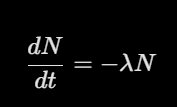
If you separate the variables and integrate both sides from time zero (where you start with N₀ atoms) to time t, you get the famous exponential formula:
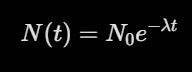
Where:
- N(t) is the remaining number of radioactive atoms at time t.
- N0 is your starting amount.
- λ is the decay constant unique to that isotope.
The actual activity (A) of the sample—the number of disintegrations happening per second—is simply given by A = λN. Because it tracks the number of atoms perfectly, activity decays exponentially too (A = A₀ e-λt.
Solved Problem: Radioactive decay For RPSC Assistant Professor
Let’s try a standard problem that mirrors what you might find on an RPSC paper.
Problem: A certain radioactive substance has a half-life of 20 years. If 10 grams of the substance is present initially, how much of it will remain after 60 years?
- Step 1: Look at your clock. The total time (t) is 60 years, and the half-life (t₁/₂) is 20 years.
- Step 2: Find out how many rounds of halving have occurred. Divide the total time by the half-life:
Number of half-lives (n) = 60/20} = 3 half-lives - Step 3: Apply the halving step-by-step.
- Start: 10 g
- After 1 half-life (20 years): 10 / 2 = 5 g
- After 2 half-lives (40 years): 5 / 2 = 2.5 g
- After 3 half-lives (60 years): 2.5 / 2 = 1.25 g
Your final answer is 1.25 grams. You can also use the formula N = N₀ (1/2)ⁿ, which gives 10 × (1/2)³ = 10 / 8 = 1.25 g.
Real-World Applications
We aren’t just studying Radioactive decay to pass exams; it runs some of the most critical technologies around us.
- Radiocarbon Dating: By measuring how much Carbon-14 is left in an ancient wooden artifact or fossil, scientists can calculate backwards to figure out when the plant or animal died.
- Medical Tracers: Doctors inject tiny, safe amounts of short-lived radioactive isotopes into a patient. As these isotopes decay, imaging machines track the radiation to map out blood flow or spot tumors inside the body without surgery.
- Industrial Testing: In massive oil pipelines, engineers use radiotracers to watch how liquids move through miles of underground pipe, making it easy to pinpoint blocks or leaks instantly.
Preparing Radioactive decay For RPSC Assistant Professor for Your Exam
When you sit down to map out your study sessions for the RPSC Assistant Professor exam, you want to focus your energy on high-yield subtopics. Don’t get bogged down trying to memorize obscure historical facts. Instead, focus heavily on:
- The exact conservation laws in alpha, beta, and gamma decays (charge, mass number, parity).
- The math of radioactive equilibrium (secular and transient).
- Solving mixed numerical problems involving half-life, activity, and sample mass.
Getting a clear handle on these derivations and numerical shortcuts takes consistent practice. If you ever feel like you need a structured hand to guide your revision, we at VedPrep offer a deep library of study guides, mock tests, and free video resources specifically designed to break down tough physical science topics into digestible pieces.
Final Thoughts
Mastering Radioactive decay isn’t about memorizing formulas—it’s about understanding the predictable rhythm behind a completely random natural process. Once you get comfortable with the exponential math and the core decay modes, these questions stop looking like roadblocks and start looking like guaranteed scoring opportunities on your RPSC Assistant Professor paper.
To know more in detail from our faculty, watch our YouTube video:
Frequently Asked Questions
What are the types of radioactive decay?
There are three main types of radioactive decay: alpha decay, beta decay, and gamma decay. Alpha decay involves the emission of an alpha particle, beta decay involves the emission of a beta particle, and gamma decay involves the emission of gamma radiation.
What is the half-life of a radioactive substance?
The half-life of a radioactive substance is the time it takes for half of the radioactive atoms in a sample to undergo radioactive decay. This is a characteristic property of each radioactive substance.
What is nuclear chemistry?
Nuclear chemistry is the study of the properties and reactions of atomic nuclei. It involves the study of radioactive decay, nuclear reactions, and the properties of radioactive substances.
What is the difference between radioactive decay and nuclear fission?
Radioactive decay is a spontaneous process in which unstable atomic nuclei lose energy through radiation, while nuclear fission is a process in which an atomic nucleus splits into two or more smaller nuclei, often accompanied by the release of energy.
What are the units of radioactivity?
The units of radioactivity are the becquerel (Bq), which is the number of decays per second, and the curie (Ci), which is a unit of radioactivity defined as 3.7 x 10^10 decays per second.
How is radioactive decay applied in medical treatments?
Radioactive decay is applied in medical treatments such as cancer therapy, where radioactive substances are used to kill cancer cells. It is also used in diagnostic procedures such as positron emission tomography (PET) scans.
How is radioactive decay used in dating materials?
Radioactive decay is used in dating materials such as rocks and fossils through a process called radiometric dating. This involves measuring the amount of radioactive substances present in the material and using this information to determine its age.
What are the safety precautions for handling radioactive substances?
The safety precautions for handling radioactive substances include wearing protective clothing, using shielding to block radiation, and following proper procedures for handling and disposing of radioactive materials.
How is radioactive decay used in food irradiation?
Radioactive decay is used in food irradiation to sterilize food and extend its shelf life. This involves exposing food to gamma radiation, which kills bacteria and other microorganisms.
What is a common mistake in understanding radioactive decay?
A common mistake in understanding radioactive decay is thinking that it is a chemical reaction, when in fact it is a nuclear process. Another mistake is underestimating the dangers of radiation exposure.
What is the relationship between radioactive decay and nuclear stability?
Radioactive decay is a process by which unstable atomic nuclei gain stability by losing energy through radiation. The stability of a nucleus is determined by the strong nuclear force and the electromagnetic force.
What is the role of radioactive decay in the formation of elements?
Radioactive decay plays a crucial role in the formation of elements through a process called nucleosynthesis. This involves the creation of heavy elements through the fusion of lighter elements.
What are the applications of radioactive decay in inorganic and analytical chemistry?
Radioactive decay has applications in inorganic and analytical chemistry, such as in the analysis of chemical reactions and the determination of chemical structures. It is also used in the study of chemical kinetics and mechanisms.
What is the relationship between radioactive decay and quantum mechanics?
Radioactive decay is a quantum mechanical process that involves the spontaneous emission of radiation from unstable atomic nuclei. The process is governed by the principles of quantum mechanics, including wave-particle duality and uncertainty.