
Rotational spectroscopy For RPSC Assistant Professor is a technique used to study the rotational energy levels of molecules, which is essential for understanding their structure and properties. It is a critical topic for competitive exams like RPSC Assistant Professor.
Rotational Spectroscopy Syllabus For RPSC Assistant Professor
If you look closely at the RPSC Assistant Professor syllabus, physical chemistry borrows heavily from the core concepts of the CSIR NET, IIT JAM, and CUET PG frameworks. This means you need a rock-solid foundation.
Most standard recommendations point you toward Atkins’ Physical Chemistry or McQuarrie’s Physical Chemistry. They are excellent references, but they can be incredibly dense when you are on a tight timeline. The exam expects you to master the rigid rotor model, understand how molecular rotation influences spectral lines, and comfortably calculate the moment of inertia and rotational constants.
For the RPSC exam, you don’t just need to memorize definitions to cover Rotational spectroscopy. You need to know how to interpret a spectrum to extract real structural info like bond lengths.
Core Concept: Rotational Spectroscopy For RPSC Assistant Professor
Let’s strip away the heavy math for a second. Think of rotational spectroscopy as checking the unique signature of a spinning molecule. When a molecule absorbs microwave radiation, it starts tumbling faster, jumping from one discrete, quantized energy level to another.
Molecules don’t just spin wildly; they rotate around specific axes passing directly through their center of mass. To make the math manageable, we use the rigid rotor model, which assumes the molecule is like a dumbbell with a fixed bond length that doesn’t stretch while spinning.
The allowed energy levels are given by a neat formula:
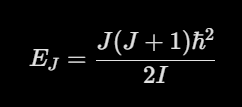
Here, J is the rotational quantum number (J = 0, 1, 2…), h¯ is the reduced Planck constant, and I is the moment of inertia.
To help make this clear, imagine a fictional scenario where you are playing on a playground roundabout. If quantum mechanics ruled the playground, you couldn’t just push the roundabout to any speed you liked. You could only make it spin at exactly 5 RPM, 12 RPM, or 20 RPM, with absolutely no option to spin at 10 RPM. That is exactly how a molecule behaves. It only accepts specific packets of energy to jump to the next allowed spinning speed.
To score well on the RPSC exam, you must focus on:
- Selection rules for transitions (which jumps are actually allowed)
- How to read and interpret the resulting spectra
- Connecting the molecular geometry to those energy gaps
Worked Example: Rotational Spectroscopy Problem
Let’s look at a typical problem you might encounter in the exam hall.
Problem: A diatomic molecule has a rotational constant B = 10.5 cm⁻¹. Calculate the energy difference between the rotational levels J = 2 and J = 3.
Solution:
When working in wave numbers (cm⁻¹), we simplify the energy formula to:
εJ = BJ(J + 1)
Let’s find the energy of both levels:
- For J = 2:
ε₂ = 10.5 × 2(2 + 1) = 10.5 × 6 = 63 cm⁻¹ - For J = 3:
ε3 = 10.5 × 3(3 + 1) = 10.5 × 12 = 126 cm⁻¹
Now, find the difference (ΔE):
ΔE = ε₃ – ε₂ = 126 cm⁻¹ – 63 cm⁻¹ = 63 cm⁻¹
Shortcut for the Exam: The energy gap between any two adjacent levels is always ΔE = 2B(J + 1), where J is the lower level. Here, 2 × 10.5 × (2 + 1) = 21 × 3 = 63 cm⁻¹.. Remembering this shortcut saves precious seconds during the exam.
Misconception: Common Mistakes in Rotational Spectroscopy
A classic trap that catches many aspirants is thinking that rotational spectroscopy only works for simple, two-atom diatomic molecules. That is completely wrong.
While textbooks use diatomics because the math is clean, this technique works for complex polyatomic molecules too. The entire spectrum depends on the molecule’s moment of inertia, which is just a measure of how mass is distributed around the center of gravity.
Think of a figure skater. When they draw their arms in, they spin faster because they changed their mass distribution—their moment of inertia went down. Whether it is a simple linear molecule or a complex asymmetrical top, the rigid rotor model can be adapted to explain its behavior.
Also, keep in mind that the selection rule ΔJ = ±1 represents the allowed transitions for these linear systems, meaning the molecule can only jump up or down by one single energy level at a time when absorbing or emitting a photon.
Application: Rotational Spectroscopy in Real-World Scenarios
Why do we care so much about these tiny molecular tumbles? In the real world, this technique is a powerful tool for mapping out molecular structures. By calculating the exact gaps between spectral lines, scientists can work backward to figure out precise bond lengths and dipole moments.
It plays a massive role in gas-phase chemistry and materials science to track how molecules behave under different temperatures and pressures. It even extends out into deep space. Astrochemists use radio telescopes to pick up microwave signals from interstellar dust clouds. By matching those signals to rotational spectra recorded in labs on Earth, they can identify complex water or alcohol molecules floating light-years away.
Exam Strategy: Tips for Solving Rotational Spectroscopy Problems
When you are sitting for the RPSC Assistant Professor exam, speed and accuracy are everything. Here is how to approach your prep:
- Own the Formulas: Do not just memorize EJ = BJ(J+1). Know how B changes when it is expressed in Joules versus wave numbers (cm⁻¹), and how it links back to the reduced mass (μ) and bond length (r) through the moment of inertia (I = μr²).
- Watch for the Gross Selection Rule: Remember that a molecule must have a permanent dipole moment to show a rotational spectrum. Heteronuclear molecules like HCl or CO are active, while homonuclear ones like N₂ or O₂ are completely silent.
- Practice Active Problem-Solving: RPSC loves conceptual twists on standard numerical problems.
If you want a deeper look at these derivations without getting bogged down in textbook jargon, feel free to check out the free lectures over at VedPrep. We break down these tricky topics step-by-step to help you build the intuition you need for exam day.
Key Concepts: Rotational Spectroscopy For RPSC Assistant Professor
Let’s do a quick mental recap of the core pillars we covered:
| Parameter | Formula / Rule | Key Takeaway |
| Moment of Inertia (I) | I = ∑mi ri² | Measures resistance to rotation; depends entirely on mass and geometry. |
| Rotational Constant (B) | B = h/8πi² I c (in cm⁻¹) | Inversely proportional to the moment of inertia. Heavy molecules have closely spaced lines. |
| Selection Rules | ΔJ = ±1 | Molecules can only transition to adjacent rotational states. |
| Spectral Line Spacing | Δν = 2B | The separation between consecutive lines in a rigid rotor spectrum is constant and equals 2B. |
Real-World Example: Rotational Spectroscopy in Chemistry
To wrap things up, think of rotational spectroscopy as a highly specialized molecular ruler. Because the spacing between lines is exactly 2B, discovering that spacing lets you calculate B. Once you have B, you get the moment of inertia, which instantly gives you the exact distance between the atoms.
This makes it incredibly valuable for studying short-lived chemical reaction intermediates in gas phases or optimizing industrial catalysts. It gives us a direct window into the changing shapes of molecules during a reaction, driving major advancements across chemistry and materials science. Keep these core principles straight, practice the shortcuts, and you will do great on this section of the RPSC exam.
Final Thoughts
Preparing for the RPSC Assistant Professor exam can feel like an uphill battle, but mastering a high-yield topic like rotational spectroscopy gives you a massive advantage. Don’t let the quantum mechanics formulas intimidate you—at its heart, it is just about tracking how a molecule spins. Focus on understanding how the lines are spaced, keep your shortcuts handy for quick calculations during the test, and always check for that permanent dipole moment before solving a problem.
To learn more in detail from our faculty, watch our YouTube video:
Frequently Asked Questions
What are the types of rotational spectroscopy?
There are two main types of rotational spectroscopy: pure rotational spectroscopy and rotational-vibrational spectroscopy. Pure rotational spectroscopy involves the study of rotational energy levels without any vibrational excitation, while rotational-vibrational spectroscopy involves the study of both rotational and vibrational energy levels.
What is the selection rule for rotational spectroscopy?
The selection rule for rotational spectroscopy is ΔJ = ±1, where J is the rotational quantum number. This means that a molecule can only undergo a rotational transition from one energy level to the next or previous energy level.
What is the relationship between rotational energy and molecular structure?
The rotational energy of a molecule is related to its moment of inertia, which depends on the molecular structure. The moment of inertia is a measure of the distribution of mass within the molecule. By analyzing the rotational spectrum, information about the molecular structure, such as bond lengths and angles, can be obtained.
What is the significance of rotational spectroscopy in Physical & Organic chemistry?
Rotational spectroscopy is significant in Physical & Organic chemistry as it provides valuable information about the molecular structure, symmetry, and dipole moment. This information is crucial in understanding the physical and chemical properties of molecules, such as reactivity and intermolecular interactions.
What is the role of spectroscopy in Physical & Organic chemistry?
Spectroscopy plays a crucial role in Physical & Organic chemistry as it provides valuable information about the molecular structure, symmetry, and physical properties. Spectroscopic techniques, including rotational spectroscopy, are used to study the properties of molecules and their interactions.
What is the difference between rotational spectroscopy and vibrational spectroscopy?
Rotational spectroscopy involves the study of rotational energy levels, while vibrational spectroscopy involves the study of vibrational energy levels. While rotational spectroscopy provides information about molecular rotation and structure, vibrational spectroscopy provides information about molecular vibration and bonding.
What is the relationship between rotational spectroscopy and molecular symmetry?
Rotational spectroscopy is closely related to molecular symmetry, as the rotational energy levels and selection rules depend on the molecular symmetry. By analyzing the rotational spectrum, information about the molecular symmetry and structure can be obtained.
How is rotational spectroscopy applied in RPSC Assistant Professor exams?
In RPSC Assistant Professor exams, rotational spectroscopy is often applied to test the understanding of molecular structure, symmetry, and physical properties. Questions may involve the analysis of rotational spectra, calculation of rotational constants, and interpretation of molecular structure.
What are some common topics related to rotational spectroscopy in RPSC Assistant Professor exams?
Common topics related to rotational spectroscopy in RPSC Assistant Professor exams include molecular structure, symmetry, rotational energy levels, selection rules, and spectroscopic techniques. Questions may also involve the application of rotational spectroscopy to Physical & Organic chemistry problems.
How can one prepare for rotational spectroscopy questions in RPSC Assistant Professor exams?
To prepare for rotational spectroscopy questions in RPSC Assistant Professor exams, one should focus on understanding the fundamental concepts, such as molecular structure, symmetry, and rotational energy levels. Additionally, one should also practice solving problems related to rotational spectroscopy and review the applications of rotational spectroscopy in Physical & Organic chemistry.
What are some common exam questions related to rotational spectroscopy?
Common exam questions related to rotational spectroscopy include questions about the selection rules, rotational energy levels, and molecular structure. Additionally, questions may also involve the application of rotational spectroscopy to Physical & Organic chemistry problems.
What are some common mistakes in interpreting rotational spectra?
Common mistakes in interpreting rotational spectra include incorrect assignment of rotational lines, neglecting the effects of centrifugal distortion, and ignoring the presence of multiple isotopic species. Additionally, mistakes can also arise from incorrect calculation of rotational constants and misinterpretation of molecular symmetry.
What are some advanced topics in rotational spectroscopy?
Advanced topics in rotational spectroscopy include the study of rotational-vibrational interactions, Coriolis coupling, and centrifugal distortion. Additionally, advanced techniques such as Fourier transform rotational spectroscopy and microwave spectroscopy can also be used to study complex molecular systems.
How can rotational spectroscopy be used to study molecular dynamics?
Rotational spectroscopy can be used to study molecular dynamics by analyzing the rotational energy levels and line shapes. This can provide information about the molecular motion, such as rotational relaxation rates and molecular collisions. Additionally, rotational spectroscopy can also be used to study the effects of external perturbations, such as electric and magnetic fields, on molecular dynamics.