

Sphenodon, also known as hatteria, is a reptile species that has remained largely unchanged for over 200 million years, making it a living fossil. It is the last survivor of the Rhynchocephalia order and is found in New Zealand.
Syllabus: Evolution and Taxonomy
If you’re aiming for the RPSC Assistant Professor post, you already know that Unit 1 isn’t something you can just skim through. Evolution and taxonomy form the bedrock of core zoology. To crack these high-level exams, you need to understand how evolutionary lineages separate and how we classify diversity.
While general biology books give you a surface-level view, we at VedPrep always recommend diving into specialized evolutionary biology and chordate literature to really grasp things like phylogeny, cladistics, and systematics. Let’s break down one of the most famous evolutionary marvels you’re bound to see in exam questions: the incredible Sphenodon.
What is Sphenodon (Living fossil) For RPSC Assistant Professor?
When we call something a “living fossil,” we mean it’s a surviving species that looks almost identical to its ancient ancestors found in deep fossil layers. Sphenodon—commonly known as the tuatara—is the ultimate poster child for this concept. While dinosaurs came and went, this reptile has been quietly hanging out on Earth since the Triassic period, over 200 million years ago.
For an RPSC Assistant Professor aspirant, mastering Sphenodon isn’t just about memorizing a trivia fact. Examiners love using it to test your deep understanding of primitive versus derived traits.
Imagine a fictional scenario where an RPSC interview board hands you a skull sample and asks you to differentiate a true lizard from a tuatara. If you mix them up, it shows a gap in fundamental taxonomy. That’s why understanding its evolutionary placement is a must-have for your prep toolkit.
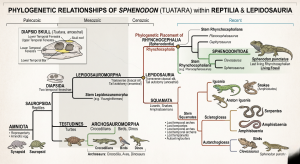
Here are the standout features you need to keep straight:
- True Diapsid Skull: Unlike modern lizards that have lost one or both temporal arches over time, Sphenodon retains the complete, primitive diapsid skull structure with two distinct openings behind the eye.
- Spiny Crest: It sports a prominent, row of spines running down its back and neck (the name “tuatara” actually means “peaks on the back” in Māori).
- The “Third Eye”: It has a well-developed parietal eye on top of its head, complete with a lens and retina, though it gets covered by scales as they grow into adults.
- Endemic to New Zealand: You won’t find them in the wild anywhere else on Earth except for a few offshore islands of New Zealand.
Key Characteristics of Sphenodon (Living fossil) For RPSC Assistant Professor
Let’s look closely at where the tuatara lives and how its body works. Geographically, it’s highly restricted. They live in the cool, misty coastal forests and grasslands of New Zealand’s offshore islands. They don’t like blazing heat; they prefer moderate, humid climates and are active at surprisingly low temperatures where other reptiles would go completely torpid.
From an anatomical standpoint, Sphenodon is a goldmine for exam questions. Let’s clear up a massive detail that often trips students up in multiple-choice questions. A lot of old question banks or hasty online notes mention that it has pleurodont teeth.
But as a peer checking your facts before the big day, let’s correct that: Sphenodon actually features an acrodont dentition. Their teeth are fused directly to the crest of the jawbone. Even cooler, they have a unique double row of teeth on the upper jaw, and the single row of the lower jaw fits perfectly between them like a pair of scissors.
Because they face severe threats from introduced predators like rats and changing climates, conservation biology is another massive angle here. Understanding both in-situ (protecting them in their natural island habitats) and ex-situ (captive breeding programs) conservation strategies is highly relevant for competitive exams like CSIR NET, IIT JAM, and RPSC.
Sphenodon (Living fossil) For RPSC Assistant Professor
When you see a question on Sphenodon in a high-level exam paper, it’s usually designed to test your precision. Let’s look at a typical problem style you might face.
Question: What is a major skeletal characteristic that distinguishes Sphenodon from modern lizards (Squamata), reinforcing its status as a primitive living fossil?
Solution: The presence of a complete, unreduced diapsid skull with two complete temporal arches (the upper and lower bars). Modern lizards have lost the lower temporal bar to make their jaws more mobile, whereas Sphenodon retains the ancestral, rigid reptilian design.
| Feature | Evolutionary Description |
| Skull Architecture | Primitive diapsid with both temporal arches intact. |
| Dental Arrangement | Acrodont dentition with a unique shearing double-row on top. |
| Parietal Eye | Highly developed primitive “third eye” used to track solar cycles. |
| Vertebrae Type | Amphicoelous (biconcave), a highly primitive trait shared with fish and ancient amphibians. |
Common Misconceptions about Sphenodon (Living fossil) For RPSC Assistant Professor
One of the funniest mistakes students make during late-night study sessions is treating Sphenodon like it’s a tiny dinosaur. Because it looks like a prehistoric creature and carries the “living fossil” tag, it’s easy to see why people fall into that trap. But taxonomically, it’s completely wrong.
Dinosaurs belong to the clade Archosauria (alongside birds and crocodilians). Sphenodon, on the other hand, belongs to Lepidosauria, specifically holding down the fort as the last surviving member of the order Rhynchocephalia (or Sphenodontia). It’s a sister group to lizards and snakes, not an offshoot of dinosaurs.
Keeping this phylogenetic tree clear in your mind is exactly what will get you those crucial marks on an RPSC Assistant Professor exam. It’s a distinct reptile lineage that simply decided to retain its primitive traits while the rest of its order went extinct millions of years ago.
Real-World Application of Sphenodon (Living fossil) For RPSC Assistant Professor
In the field, studying Sphenodon isn’t just about old bones—it has incredible real-world ecological applications. Because these reptiles live in delicate island ecosystems in New Zealand, they act as a vital indicator species for environmental health.
They share their burrows with nesting seabirds like petrels, creating a fascinating symbiotic relationship where the bird droppings enrich the soil, bringing in insects for the tuatara to eat.
At VedPrep, we often remind our students to look at the big picture: conserving the tuatara means conserving an entire ancient ecological web. If climate change alters the incubation temperature of their eggs (which determines their sex), the entire population balance can collapse. This makes them an incredible real-world study in climate-driven population dynamics.
Exam Strategy: Sphenodon (Living fossil) For RPSC Assistant Professor
When you’re designing your study schedule for the RPSC exam, treat Sphenodon as your anchor point for evolutionary biology. Don’t just read about it in isolation. Connect it to your larger comparative anatomy notes.
Your Quick Focus Checklist:
- Map out the reptile phylogenetic tree: know where Lepidosauria splits from Archosauria.
- Memorize the specific primitive skeletal traits (amphicoelous vertebrae, immovably fixed quadrate bone).
- Understand how its slow metabolism and long lifespan (often over 100 years!) influence its life history.
To make things easier, we’ve put together comprehensive lectures and test series over at VedPrep that tie these tricky morphological features into actual past-year questions, saving you from sorting through conflicting online sources. Focus on active recall, test yourself regularly, and keep your anatomical terms crisp.
Additional Facts about Sphenodon (Living fossil) For RPSC Assistant Professor
Let’s wrap up with a few fascinating physiological quirks that make great fodder for statement-based questions. The tuatara has an incredibly slow metabolism. They take about 10 to 20 years to reach sexual maturity, and females only lay eggs once every two to five years!
Then there’s that famous parietal eye. While it can’t see images, it can detect minuscule changes in light and wavelengths. Think of it like a natural solar sensor that helps the reptile manage its circadian rhythms and hormonal cycles, which is pretty useful when you’re trying to survive in low-temperature environments.
Also, despite what some outdated texts say about them eating algae, let’s set the record straight: they are strictly carnivorous/insectivorous. They eat giant crickets (wētā), beetles, spiders, snails, and occasionally small lizards or bird eggs. Their slow-motion lifestyle is perfectly tuned to a low-energy, island ecosystem.
Conclusion
Mastering Sphenodon gives you a direct window into how evolutionary forces select for stability rather than constant change. As an aspiring Assistant Professor, being able to explain why a species stands still while the rest of the world evolves is a core teaching skill.
Take some time this week to review its taxonomic path and unique anatomy. If you want to dive deeper into evolutionary concepts or need a structured way to conquer the rest of Unit 1, come check out our community at VedPrep. We’re always here to help you turn these complex zoological topics into clear, exam-winning knowledge.
To learn more in detail from our faculty, watch our YouTube video:
Frequently Asked Questions
What makes Sphenodon a living fossil?
Sphenodon is considered a living fossil because it has retained many primitive characteristics, such as a distinctive crest on its head, a spiky back, and a unique dental structure. These features have remained largely unchanged since the time of the dinosaurs, providing a link to the past.
Is Sphenodon a chordata or Non-Chordata?
Sphenodon is a Chordata, as it belongs to the phylum Chordata. Chordata includes animals with a notochord, a dorsal hollow nerve cord, pharyngeal slits, and a post-anal tail. Sphenodon, being a reptile, exhibits these characteristics during its development.
What is the taxonomic classification of Sphenodon?
Sphenodon belongs to the kingdom Animalia, phylum Chordata, class Reptilia, order Rhynchocephalia, and family Sphenodontidae. Its taxonomic classification is crucial for understanding its evolutionary relationships and unique characteristics.
What is the habitat and distribution of Sphenodon?
Sphenodon is native to New Zealand and is found in a variety of habitats, including forests, grasslands, and rocky outcrops. Its distribution is limited to certain islands and areas with suitable climate and vegetation.
What is the significance of Sphenodon in the study of biology?
Sphenodon is significant in the study of biology due to its unique characteristics, evolutionary history, and conservation status. It provides insights into the evolution of life on Earth and the importance of preserving biodiversity.
How can Sphenodon be used as an example in RPSC Assistant Professor exams?
Sphenodon can be used as an example in RPSC Assistant Professor exams to illustrate the concept of living fossils, evolutionary biology, and taxonomy. Its unique characteristics and classification make it an ideal example for questions on zoology and biology.
What are the implications of Sphenodon's conservation status?
Sphenodon is listed as a vulnerable species, and its conservation status has implications for its habitat and ecosystem. Understanding the conservation status of Sphenodon can help in developing strategies for its protection and preservation.
How does Sphenodon relate to the topic of Chordata?
Sphenodon, as a Chordata, exhibits the characteristic features of the phylum, such as a notochord and dorsal hollow nerve cord. Understanding Sphenodon's relationship to Chordata can help in understanding the evolution and diversity of animals.
What are common misconceptions about Sphenodon?
Common misconceptions about Sphenodon include its classification as a dinosaur or a lizard. However, Sphenodon is a distinct species that belongs to the order Rhynchocephalia and is not a dinosaur or a lizard.
What is often confused with Sphenodon's taxonomic classification?
Sphenodon's taxonomic classification is often confused with that of lizards or dinosaurs. However, its unique characteristics and evolutionary history set it apart from these groups.
What are the phylogenetic relationships of Sphenodon?
Sphenodon's phylogenetic relationships are complex and have been the subject of much debate. Its relationships to other reptiles, such as lizards and snakes, are still being studied and refined.
What can Sphenodon reveal about evolutionary biology?
Sphenodon can reveal insights into evolutionary biology, particularly in the areas of adaptation, speciation, and conservation. Its unique characteristics and evolutionary history make it an important example for understanding the evolution of life on Earth.
What are the conservation implications of Sphenodon's ecology?
Sphenodon's ecology has important conservation implications, particularly in terms of habitat preservation and management. Understanding its ecological role can help in developing effective conservation strategies.
What are the implications of Sphenodon's genomics?
Sphenodon's genomics have implications for understanding its evolution, conservation, and biology. Its genome has been sequenced and studied to gain insights into its evolutionary history and biology.