
Mitosis and Meiosis For IIT JAM are fundamental concepts in cell biology that understanding the life cycle of cells and the transmission of genetic information. In this article, we will delve into the intricacies of these processes and explore their significance in the context of IIT JAM.
IIT JAM Syllabus Unit: Cell Biology and Genetics
If you are gearing up for the IIT JAM, you already know that cell biology and genetics isn’t just another section—it’s a heavy-hitting unit that can seriously boost your rank. The whole drama of cell division, including mitosis and meiosis, sits right under the official syllabus tracking the Structure and Function of the Cell and the Molecular Basis of Inheritance.
When you dig into standard textbooks like Cell Biology by Becker or Genetics by Griffiths, you are essentially reading the biography of the cell. Becker breaks down the mechanical blueprint of how cells split, while Griffiths shows you the genetic consequences of those splits. Here at VedPrep, we like to look at these two units as a tag team:
-
Cell Biology Unit: Structure and Function of Cell (The machinery)
-
Genetics Unit: Molecular Basis of Inheritance (The code being passed on)
Mastering Mitosis and Meiosis isn’t just about memorizing facts for the sake of it; it’s about understanding how life duplicates its assets and mixes up the genetic deck. If you are aiming to crack IIT JAM, CSIR NET, or GATE, getting these fundamentals down is your first major win.
Understanding the Basics ofMitosis and Meiosis For IIT JAM
Let’s strip away the heavy academic jargon and look at what cell division actually is. At its core, it’s just cellular reproduction. You have two main routes here: mitosis and meiosis.
Think of mitosis as a perfect biological Xerox machine. It takes a single parent cell and splits it into two daughter cells that are completely identical to the original. If a skin cell needs replacing, you don’t want a random surprise; you want an exact copy. This is what keeps you growing and heals your cuts.
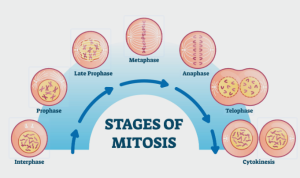
Meiosis, on the other hand, is more like a genetic lottery mixer. Instead of keeping the chromosome count the same, it cuts it right in half, turning one diploid cell into four haploid daughter cells. This reduction is what makes sexual reproduction work, giving us gametes like sperm and egg cells.
The big fork in the road between the two comes down to the final product. Mitosis gives you two identical clones. Meiosis gives you four genetically unique cells. Both processes start with DNA replication, and both have to carefully handle chromosome segregation so no cell ends up with a missing piece. While mitosis wraps up after one clean division, meiosis goes through two intense rounds—meiosis I and meiosis II—to shake things up and drop the chromosome count.
Worked Example: Mitosis and Meiosis For IIT JAM Style Question
Let’s look at a classic problem you might run into on exam day from Mitosis and Meiosis:
Question: A cell undergoes mitosis to produce two daughter cells. If the parent cell has a diploid number of chromosomes (46 chromosomes in humans), what is the number of chromosomes in each daughter cell, and what are the stages involved in this process?
How to solve it: You don’t need to scribble down complex equations for this one. It’s all about knowing how the machinery works.
The cellular choreography of mitosis moves through four main stages: prophase, metaphase, anaphase, and telophase.
-
Prophase: The cell packs its DNA tightly into neat chromosome bundles, and the nuclear wrapper dissolves.
-
Metaphase: The chromosomes line up single-file right down the middle of the cell.
-
Anaphase: The cell pulls the sister chromatids apart, dragging them to opposite sides.
-
Telophase: The cell builds new nuclear wrappers around each set, and the chromosomes unpack.
Because mitosis is an equational division, it keeps the chromosome count perfectly stable. The end result? Two daughter cells, each containing exactly 46 chromosomes, completely identical to the parent cell. When you see these questions on the IIT JAM, just remember: mitosis maintains the status quo; it doesn’t slash numbers.
Common Misconceptions About Mitosis and Meiosis For IIT JAM
It is incredibly easy to mix these two up when you are racing against the clock in an exam hall. One of the biggest traps students fall into is flipping the numbers—thinking mitosis creates four cells and meiosis creates two. Let’s set the record straight: mitosis is equational (one cell becomes two identical ones), while meiosis is reductional (one cell becomes four different ones).
Another slip-up is treating meiosis like it’s just a subset of mitosis. They are completely different paths. A somatic cell (like a liver or muscle cell) will never choose meiosis. At VedPrep, we often see students forget the basic math of the divisions: mitosis is a one-and-done split, while meiosis requires two back-to-back divisions to get the job done. Keep that boundary clear in your mind, and you won’t get tripped up by tricky multiple-choice options.
Real-World Application of Mitosis and Meiosis For IIT JAM
To make these concepts stick, let’s look at how they play out in the real world. Imagine a fictional scenario where a researcher is trying to grow a patch of skin in a lab to help a burn victim. To do this, they harvest a few healthy skin stem cells and place them in a petri dish with a nutrient broth.
What happens next is pure mitosis. The cells replicate their DNA, line up their chromosomes, and split over and over again, creating millions of identical copies to form a seamless layer of tissue. If the cells did not use mitosis, or if they accidentally scrambled the genetic code during the split, the new skin wouldn’t function properly. This exact mechanism is what drives modern regenerative medicine and tissue engineering.
Now, imagine a different fictional scenario: a couple is having trouble conceiving and visits a fertility clinic. The doctors decide to check the health of the partner’s sperm cells. As per Mitosis and Meiosis, this is where meiosis takes center stage. If the process of meiosis goes off the tracks even a little bit—say, chromosomes fail to separate correctly during anaphase I—the resulting gametes might end up with too many or too few chromosomes. Understanding these cellular missteps helps genetic counselors spot risks and allows specialists to improve assisted reproductive technologies like IVF. Whether it’s healing a wound or creating new life, these processes are happening around us every second.
Study Tips and Important Subtopics for Mitosis and Meiosis For IIT JAM
Cracking Mitosis and Meiosis for IIT JAM takes more than just passive reading. You need an active strategy. Start by sketching out the cell cycle stages by hand. Visualize exactly where the checkpoints are and where things can go sideways.
Here is a quick checklist of high-yield areas we focus on at VedPrep to help you streamline your study hours:
-
Phases of Mitosis and Meiosis: Pay extra attention to Prophase I in meiosis (leptotene, zygotene, pachytene, diplotene, diakinesis)—examiners love testing crossing over.
-
DNA Replication vs. Chromosome Segregation: Know the difference between counting chromatids and counting centromeres at each stage.
-
Cytokinesis: Understand how plants (cell plate) and animals (cleavage furrow) split their cytoplasm differently.
Importance: Mitosis and Meiosis For IIT JAM
When you look at the master plan of the IIT JAM syllabus, Mitosis and Meiosis anchors Unit 2: Cell Biology, Genetics and Molecular Biology.
If you want to build an unbreakable foundation, don’t ignore your old schoolbooks. Starting with NCERT Textbooks for Class 11 and 12 is a fantastic way to brush up on the basics before you dive into the deep end. Once you’ve got the groundwork laid, jump into standard reference books like Becker’s Cell Biology and Griffiths’ Genetics to handle the advanced details.
For a more direct, exam-targeted approach, combining these textbooks with structured IIT JAM Study Materials—like chapter-wise sorted notes, mock tests, and previous years’ solved papers—will save you a ton of time and keep your prep on the right track.
Final Thoughts
You don’t have to study in a vacuum, either. Joining a focused study group or an online student community can make a massive difference. When you try to explain a complex topic like homologous recombination to a friend, you quickly realize how well you actually know it.
We regularly put out free resources, so feel free to watch a VedPrep lecture on cell division processes online if you need a visual breakdown of how these chromosomes move.
To learn more in detail from our faculty, watch our YouTub video:
Frequently Asked Questions
Why is Prophase I of meiosis considered the most critical stage for genetic diversity?
Prophase I is exceptionally long and complex compared to mitotic prophase. It is divided into five substages: leptotene, zygotene, pachytene, diplotene, and diakinesis. During pachytene, homologous chromosomes pair up (synapsis) and exchange genetic material through crossing over, creating entirely new combinations of alleles.
How do you count chromosomes versus chromatids during different stages of mitosis?
The absolute rule for the exam hall is to count the number of centromeres. One centromere equals one chromosome.
-
In Metaphase: A human cell has 46 chromosomes, but each chromosome consists of 2 sister chromatids joined together, totaling 92 chromatids.
-
In Anaphase: The centromeres split. The sister chromatids separate and are now considered individual chromosomes. Therefore, during anaphase, the chromosome count temporarily doubles to 92.
What is the difference between a bivalent and a tetrad in meiosis?
These terms describe the same structure during Prophase I but look at it from different angles:
-
Bivalent: Refers to the pair of homologous chromosomes associated together (counting the distinct chromosome bodies).
-
Tetrad: Refers to the four distinct sister and non-sister chromatids visible within that paired structure.
What happens if chromosome segregation fails during meiosis?
If chromosomes or sister chromatids fail to separate properly—a phenomenon called nondisjunction—it leads to gametes with an abnormal number of chromosomes (aneuploidy). When fertilized, this can result in conditions like Down syndrome (Trisomy 21) or Turner syndrome (Monosomy X).
Why doesn't crossing over occur during mitosis?
Mitosis aims to preserve genetic continuity and produce exact clones. Because homologous chromosomes do not pair up (synapse) during mitotic prophase, there is no physical opportunity or evolutionary mechanism for crossing over to happen.
What is the synaptonemal complex, and when does it form and dissolve?
The synaptonemal complex is a protein structure that acts like a zipper, holding homologous chromosomes together so crossing over can happen. At VedPrep, we remind students to remember this specific timeline: it begins assembling during the zygotene stage of Prophase I, remains stable during pachytene, and dissolves during diplotene.
What are chiasmata, and when do they become visible?
Chiasmata are the X-shaped physical sites where crossing over occurred between non-sister chromatids. They become clearly visible during the diplotene stage of Prophase I, right after the synaptonemal complex dissolves and the homologous chromosomes start pulling apart.
How does cytokinesis differ between plant cells and animal cells?
-
Animal cells divide their cytoplasm from the outside in using an actin-myosin contractile ring that pinches the plasma membrane, creating a cleavage furrow.
-
Plant cells have rigid walls and cannot pinch. Instead, they divide from the inside out. Vesicles from the Golgi apparatus fuse at the equatorial plane to form a cell plate, which eventually grows outward to become the new cell wall.
What is the function of the colchicine drug in cell biology experiments?
Colchicine is an alkaloid drug that inhibits microtubule polymerization, effectively shattering the spindle apparatus. If you treat a dividing cell with colchicine, it cannot pull chromosomes apart during anaphase, arresting the cell at metaphase. This trick is heavily utilized in laboratories to create karyotypes or induce polyploidy.
What is the role of Cyclins and Cyclin-Dependent Kinases (CDKs)?
Cyclins and CDKs are the core biochemical engines of the cell cycle. CDKs are enzymes that remain at constant levels but are inactive on their own. Cyclins are regulatory proteins whose concentrations fluctuate throughout the cycle. When a specific cyclin binds to its partner CDK, it activates the complex to phosphorylate target proteins, pushing the cell into the next phase.
What are homologous chromosomes?
Homologous chromosomes are pairs of chromosomes (one inherited from the mother, one from the father) that are identical in size, shape, and gene arrangement. They carry alleles for the same traits at the exact same positions (loci), though the individual alleles themselves can differ (e.g., an allele for brown eyes vs. blue eyes).
Why is Meiosis II often called an "equational" division if the overall process is reductional?
While Meiosis I is the true reductional phase that separates homologous pairs to make the cell haploid (2n → n), Meiosis II behaves exactly like a mitotic division. In Meiosis II, the sister chromatids are pulled apart, keeping the chromosome number stable (n → n).