
Cell signaling pathways for IIT JAM refer to the complex mechanisms by which cells communicate with each other through various signal transduction pathways, enabling them to respond to their environment, grow, and adapt.
Syllabus: IIT JAM Biology
For any IIT JAM aspirant, mastering Cell signaling pathways under Unit 2 (Cell Biology) is am effective strategy to score high in the exam. It is also a massive chunk of the syllabus for CSIR NET Life Sciences and CUET PG Biological Sciences.
If you want to dive deep into the textbook side of things, standard books like Lehninger Principles of Biochemistry by Nelson and Cox, or Biology by Campbell and Reece are your best bets. They break down the nitty-gritty of these molecular conversations perfectly.
Cell Signaling Pathways: An Overview
Think of your body as a massive, bustling metropolis. For everything to run smoothly, the citizens (your cells) need a bulletproof communication system. They can’t just shout across the block, so they use chemical messages instead. At its core, cell signaling pathways are just the cellular version of sending a text, dropping an email, or putting up a billboard to let other cells know what’s going on.
When a signal arrives—maybe it’s a hormone or a growth factor—it binds to a specific receptor on a cell, acting like a key sliding into a lock. This single event kicks off a whole domino effect inside the cell, often called a signal transduction pathway.
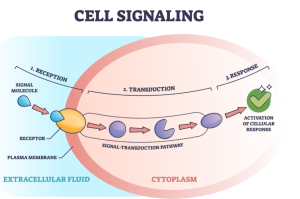
During this molecular chain reaction, you will see a lot of protein phosphorylation (essentially flipping molecular on/off switches) and the production of second messengers. These inside-the-cell messengers carry the memo straight to the headquarters, altering gene expression or shifting how the cell behaves.
When everything goes right, these pathways manage everyday survival tasks like growth, division, and adapting to stress. But when the lines get crossed or a pathway gets stuck in the “on” position, things go downhill fast. That is exactly how we get conditions like cancer or neurodegenerative disorders. For anyone prepping for exams like CSIR NET, IIT JAM, or GATE, mastering cell signaling pathways is a massive milestone because examiners absolutely love testing how these molecular telephone games work.
Worked Example: CSIR NET Style Question on Cell signaling pathways For IIT JAM
Question: A cell signaling pathway involves activating a receptor on the cell surface, which leads to the production of a second messenger. This second messenger then turns on a downstream signaling molecule. If a ligand binds to a G protein-coupled receptor (GPCR) on the cell surface, what type of signaling pathway is this, and what role does that second messenger play?
Answer: This is a classic example of an indirect signaling pathway. Because the GPCR doesn’t directly alter gene expression on its own, it relies on a second messenger to pass the torch.
To visualize this, imagine a fictional scenario where you are trying to turn on a massive stadium light display from a remote control booth. Pressing the button on your console (the ligand binding to the GPCR) doesn’t directly light up the field. Instead, it sends an electrical current through a local relay station (the second messenger, like cAMP or IP3). That relay station then amplifies the current and flips on the massive stadium floodlights (the downstream target proteins).
In the human body, a real-life example of this happens when you get a sudden fright. Your adrenal glands pump out adrenaline. This hormone acts as a ligand and binds to GPCRs on your muscle cells. This triggers a spike in cAMP, which rapidly tells the cell to break down stored glycogen into glucose. Suddenly, your muscles have the fuel they need to run or fight. At VedPrep, we always recommend breaking down these complex Cell signaling pathways into these kinds of step-by-step stories so you don’t get lost in the jargon during the exam.
Common Misconceptions in Cell Signaling Pathways
Misconception 1: Ligands always enter the cell to deliver their message.
The Reality: Most ligands are polar or too large to cross the hydrophobic plasma membrane. They stay completely outside the cell and just knock on the door (bind to a surface receptor), letting internal molecules carry the message inward. Only hydrophobic ligands, like steroid hormones, actually cross the membrane to find intracellular receptors.
Misconception 2: One specific ligand only triggers one specific cellular response.
The Reality: The response depends entirely on the receptor type and the internal machinery of the cell reading the message. For example, acetylcholine makes cardiac muscle cells relax, but it makes skeletal muscles contract. Same key, different doors!
Misconception 3: Second messengers are proteins.
The Reality: Second messengers are small, non-protein molecules or ions (like Ca2+, cAMP, or DAG). Their small size is exactly what allows them to diffuse incredibly fast through the cytoplasm to spread the word.
Application of Cell Signaling Pathways in Real-World Situations
Understanding how these pathways function isn’t just an academic exercise to pass the IIT JAM; it is the cornerstone of modern medicine. When cell signaling pathways break down, serious health issues follow. If a cell ignores the “stop dividing” signal, it can lead to cancer. As per Cell signaling pathways, if insulin pathways get sluggish, it results in type 2 diabetes.
Because of this, drug discovery groups spend billions studying these networks to design targeted therapies. Instead of using a sledgehammer approach, scientists have developed specific protein kinase inhibitors. These drugs act like targeted wrenches thrown into the gears of broken, hyperactive signaling lines in cancer cells, shutting down tumor growth while leaving healthy cells alone.
In research labs, keeping track of major pathways like MAPK/ERK or PI3K/AKT helps us map how cells adapt to environmental stress or nutrient changes.
Smart Drug Design: Identifying exact molecular targets to build better medicines with fewer side effects.
Environmental Adaptation: Mapping out how cells survive extreme shifts in their surroundings.
Personalized Medicine: Examining a patient’s specific pathway mutations to pick the exact drug that will work for them.
Exam Strategy: Tips and Tricks for Cell Signaling Pathways For IIT JAM
Let’s be real: trying to memorize every single step of every pathway will make your head spin. The secret to cracking the IIT JAM and CSIR NET is focusing on the underlying architecture. Every pathway follows a simple pattern: Signal → Receptor → Transduction (Amplification) → Response.
When you are studying, sketch out comparison maps. Group the systems by their receptor types—know your G protein-coupled receptors (GPCRs) inside and out, understand how Receptor Tyrosine Kinases (RTKs) autophosphorylate, and get comfortable with how second messengers amplify a tiny external signal into a massive internal response.
Don’t just read the textbook passively. Grab a blank sheet of paper and try to draw the pathways from memory, or practice parsing out experimental setup questions from previous years’ question papers. We see a lot of students at VedPrep make the mistake of over-complicating the material. If you can explain a pathway simply to a friend over coffee without staring at your notes, you genuinely know it well enough to face whatever twisted question the examiners throw at you.
Key Textbooks and Resources for Cell Signaling Pathways
If you want to build a truly rock-solid foundation for cell signaling pathways, you need to lean on the right resources. Standard, high-quality reference books are your best bet for clear diagrams and accurate experimental contexts.
Essential Reading
Lehninger Principles of Biochemistry (by David L. Nelson and Michael M. Cox): This is the absolute gold standard for understanding the structural chemistry of receptors and the thermodynamic realities of second messenger amplification cascades.
Biology (by Campbell and Reece): Excellent for a high-level, conceptual overview that ties cellular communication into broader physiological and evolutionary themes.
Critical Pathways to Memorize for the Exam
To make things easier as you flip through your textbooks, here is a quick-reference table of the heavy-hitter pathways you are guaranteed to encounter in Cell signaling pathways:
| Signaling Pathway | Primary Function / Role | Key Molecular Players |
| MAPK/ERK Pathway | Dictates cell division, growth, and differentiation. | Ras (G-protein), Raf, MEK, ERK |
| PI3K/AKT Pathway | Promotes cell survival, blocks apoptosis, manages metabolism. | PIP3, Akt kinase, mTOR |
| JAK/STAT Pathway | Crucial for immune system responses and cytokine signaling. | Janus Kinases (JAKs), STAT transcription factors |
| Wnt/$\beta$-catenin | Controls cell fate determination and embryo development. | Frizzled receptor, Axin/APC destruction complex, $\beta$-catenin |
| Notch Pathway | Manages juxtacrine (neighbor-to-neighbor) cell differentiation. | Notch receptor, Delta/Serrate ligands, protease cleavage |
| Hedgehog Pathway | Regulates tissue patterning and body design during development. | Patched, Smoothened, Gli transcription factors |
Final Thoughts
Wrapping your head around cell signaling pathways can feel like trying to untangle a massive ball of yarn at first, but once you see the underlying logic of how these molecular relays work, everything clicks. For exams like IIT JAM and CSIR NET, examiners love testing your problem-solving skills on how these systems flip on and off. Don’t let the complex charts intimidate you—focus on the core steps of reception, transduction, and response, and you will be in great shape.
To know more in detail from our faculty, watch our YouTube video:
Frequently Asked Questions
Why do most signaling molecules need a surface receptor instead of just walking into the cell?
Most signaling molecules (like peptide hormones or neurotransmitters) are either too large, highly polar, or hydrophilic. Because the cell membrane has a greasy, hydrophobic core, these molecules are physically blocked from crossing. They have to stay outside and knock on a surface receptor to get their message across.
Which ligands can actually pass right through the cell membrane?
Small, hydrophobic (lipophilic) molecules can slip right through the lipid bilayer without an escort. The classic examples are steroid hormones (like estrogen, testosterone, and cortisol), thyroid hormones, and gases like nitric oxide (NO). Once inside, they bind to intracellular receptors floating in the cytoplasm or sitting directly in the nucleus.
What exactly does "protein phosphorylation" mean in a pathway?
It is essentially the cellular version of flipping a light switch. Enzymes called kinases take a phosphate group from ATP and stick it onto specific amino acids (usually serine, threonine, or tyrosine) of a target protein. This extra negative charge changes the protein's shape, instantly turning it "on" or "off."
What is a G protein-coupled receptor (GPCR) and how does it work?
A GPCR is a single protein chain that weaves back and forth through the cell membrane seven times (which is why it is often called a serpentine receptor). When a ligand binds to it on the outside, the receptor shifts its shape on the inside, prompting a nearby helper molecule called a G protein to swap out a sleepy GDP molecule for an active, high-energy GTP molecule.
How do G proteins turn themselves off?
G proteins have a built-in timer. They possess an intrinsic enzymatic activity called GTPase activity. This means they automatically chop off one of their own phosphate groups, converting their active GTP back into inactive GDP. It is a brilliant safety feature that prevents a signal from running wild forever.
How does the cAMP pathway actually amplify a signal?
Imagine a single hormone molecule binding to one GPCR. That single active receptor can turn on dozens of G proteins. Each G protein activates an enzyme called adenylyl cyclase, and each adenylyl cyclase churns out thousands of cAMP molecules. Those cAMP molecules wake up an army of Protein Kinase A (PKA) enzymes. A single external molecule results in millions of active internal enzymes—that is molecular amplification.
Where does IP3 go once it is freed into the cytosol?
IP3 heads straight for the endoplasmic reticulum (ER). It binds to ligand-gated calcium channels on the ER membrane, causing the gates to swing open. Because the ER is packed with calcium, a massive wave of Ca²⁺ rushes out into the cytoplasm, where it acts as another major second messenger.
How do Receptor Tyrosine Kinases (RTKs) differ from GPCRs?
While GPCRs rely on an independent G protein to pass the message along, RTKs are a bit more self-reliant. They are single-pass membrane proteins. When a ligand binds, two separate RTK chains slide together to form a pair (dimerization). Then, they cross-phosphorylate each other's tyrosine tails using ATP. This active tail acts as a molecular docking station for downstream signaling proteins.
What is the Ras protein, and which pathway does it belong to?
Ras is a small, monomeric (single-subunit) G protein that acts as a vital bridge in the RTK-mediated MAPK/ERK pathway. When it binds to GTP, it kicks off a cascade of kinases (Raf to MEK to ERK) that ultimately tells the nucleus to get ready for cell division. Mutations that lock Ras in a permanent "on" state are found in roughly 30% of all human cancers.
What does "juxtacrine signaling" mean, and can you give an example?
Juxtacrine signaling is contact-dependent communication. It requires two cells to physically touch because both the signaling molecule and the receptor are anchored to their respective cell membranes. The Notch pathway is the ultimate textbook example of this during tissue development.
How can the same neurotransmitter, like acetylcholine, cause opposite reactions in different tissues?
It all comes down to the door, not the key. Different tissues express different receptor types and different internal machinery. In cardiac muscle, acetylcholine binds to a GPCR that leads to an inhibitory response, slowing down your heart rate. In skeletal muscle, it binds to an ion-channel receptor, causing a rapid excitatory response that makes the muscle contract.
What happens when a cell signaling pathway is dysregulated?
If a pathway that promotes survival and division (like the PI3K/AKT pathway) gets stuck in the "always on" position, cells divide uncontrollably, leading to tumor formation. Conversely, if pathways that keep cells alive are prematurely blunted, it can trigger widespread cell death, which is what we see in neurodegenerative disorders like Alzheimer's or Parkinson's.