
Cell-Cell communication For IIT JAM refers to the complex process by which cells exchange information, coordinate activities, and respond to their environment through various signaling pathways and second messengers.
Syllabus: Cell Communication
preparing for the IIT JAM is no walk in the park. You are juggling a massive syllabus, and right in the middle of Unit 2 (Cell Biology), you hit a massive, high-yield topic: Cell-Cell communication. Whether you are eyeing IIT JAM, CSIR NET, CUET PG, or GATE, this concept is an absolute must-know.
When you look at standard textbooks like Lehninger Principles of Biochemistry or Biology by Campbell and Reece, the sheer volume of signaling pathways and second messengers can feel overwhelming. But don’t worry, here at VedPrep, we’ve broken down these complex molecular mechanisms into simple, digestible pieces to help you ace those exam questions.
To nail this topic, you need to get comfortable with the core lingo: signaling cascades, second messenger systems, and cell adhesion molecules.
Cell-Cell communication For IIT JAM: An Overview
Think of your body as a massive, bustling city. If the cells don’t talk to each other, everything grinds to a halt. Cell-Cell communication is just the way cells chat, coordinate their daily chores, and keep your body running smoothly.
This communication depends on chemical messages like hormones, neurotransmitters, and growth factors. These molecules act like text messages sent to specific receptors on a target cell’s surface, triggering a whole chain reaction inside the Cell-Cell communication.
The ultimate goal? Telling the cell exactly how to behave or which genes to turn on and off. To pass the message along inside the cell, pathways rely on second messengers—like cyclic AMP (cAMP) and calcium ions (Ca²⁺)—which act like internal light switches.
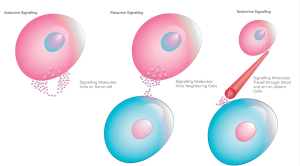
As per Cell-Cell communication, cells use three main ways to send these messages, mostly categorized by how far the signal has to travel:
Autocrine signaling: The cell talks to itself. It secretes a molecule that binds right back onto its own receptors.
Paracrine signaling: Local gossip. The cell sends a message to its immediate neighbors.
Endocrine signaling: Long-distance broadcasting. Molecules like hormones travel all the way through the bloodstream to reach far-away cells.
Signaling Pathways in Cell-Cell communication For IIT JAM
To score well in the IIT JAM, you need to know how these pathways operate in real time.
Let’s look at paracrine signaling. Since this is all about local coordination, the signaling molecules don’t travel far. They just diffuse through the extracellular matrix to hit nearby cells. For example, when you get a minor cut, platelets at the site release growth factors. This local signal tells neighboring skin cells to start dividing and healing the wound.
Autocrine signaling is a bit more self-centered but incredibly important for development and immune responses. Here, a cell releases a signal and responds to it directly to change its own behavior.
Then we have endocrine signaling, the long-distance champ. This involves endocrine glands dumping hormones directly into your bloodstream so they can travel to distant target cells. Think of how insulin or adrenaline works—they are released in one part of the body but manage your energy levels everywhere else.
Paracrine: Short range, targets nearby neighbors.
Autocrine: Self-communication, targets the same cell.
Endocrine: Long range, travels through the blood.
Worked Example: Signaling Pathways in Cell-Cell communication For IIT JAM
Let’s look at a quick, fictional scenario to see how this plays out.
Imagine a 25-year-old runner named Priya who scrapes her knee during a morning jog. Right away, damaged tissue cells release local growth factors to stimulate nearby cells to repair the skin. This is a classic example of paracrine signaling.
At the same time, her immune cells might release specific cytokines that bind to those very same immune cells to boost their own activation—that’s autocrine signaling.
Meanwhile, because she is running, her pancreas adjusts insulin levels to manage glucose uptake in her leg muscles, which is a textbook case of endocrine signaling.
Every single one of these actions relies on tight receptor-ligand interactions and second messenger systems to get the job done.
Common Misconceptions in Cell-Cell communication For IIT JAM
A very common trap we see students fall into at VedPrep is mixing up paracrine and autocrine signaling.
Many aspirants assume the main difference is just the distance the molecule travels. But that is not the case. The real distinction is what the molecule interacts with. If a cell releases a signal that acts on a completely different cell nearby, it is paracrine. If it turns around and activates itself, it is autocrine.
Keep this straight: Endocrine equals the bloodstream route, while paracrine and autocrine are strictly local neighborhood business.
Real-World Applications of Cell-Cell communication For IIT JAM
Understanding how cells talk to each other isn’t just for passing exams; it is the foundation of modern medicine. For instance, cancer research heavily focuses on autocrine signaling, where mutated cells tell themselves to keep dividing uncontrollably. By designing drugs that block these specific receptors, scientists can halt tumor growth. Similarly, understanding endocrine pathways has allowed us to create targeted therapies for conditions like diabetes and thyroid disorders.
Exam Strategy for Cell-Cell communication For IIT JAM
When you are prepping this topic, don’t just memorize the names of the pathways. Focus on the flow of information. Draw out diagrams of a signal landing on a receptor, activating a G-protein, boosting cAMP, and leading to a cellular response. The IIT JAM loves to ask analytical questions about what happens when a specific step in this chain is blocked or mutated. If you know the sequence, you can solve any twist they throw at you.
Final Thoughts
If you want to look up the fine details, stick to standard, reliable references. Molecular Biology of the Cell by Bruce Alberts and Cell Signaling by Jordi Clarimon are fantastic choices. They provide excellent visual breakdowns of how these molecular switches flick on and off.
At VedPrep, we always tell our students that reading text is only half the battle; you need to test yourself. Online video lectures on platforms like Khan Academy or Coursera are great for visualizing these microscopic processes.
To learn more in detail from our faculty, watch our YouTube video:
Frequently Asked Questions
Why does autocrine signaling matter if the cell already knows what it is doing?
It acts as a feedback loop. For instance, during immune responses or development, a cell might need to self-amplify a signal to ensure it stays in an activated state or continues differentiating.
Can a single signaling molecule trigger different responses in different cells?
Yes. The response depends entirely on the type of receptor present on the target cell and the internal machinery linked to it. For example, adrenaline causes heart muscle cells to contract harder but causes smooth muscle cells in your airways to relax.
How do hydrophilic and hydrophobic signaling molecules differ in their mechanisms?
Hydrophilic molecules (like peptide hormones) cannot cross the plasma membrane, so they bind to surface receptors. Hydrophobic molecules (like steroid hormones) easily diffuse across the lipid bilayer and bind to intracellular receptors in the cytoplasm or nucleus.
What role do G-proteins play in cell communication?
G-proteins act as molecular switches. When a signal binds to a G-protein-coupled receptor (GPCR), the G-protein swaps GDP for GTP to turn "on" and activate downstream enzymes like adenylyl cyclase. It turns "off" when it hydrolyzes GTP back to GDP.
What does a "signaling cascade" actually mean?
Think of it as a molecular domino effect. One activated receptor turns on multiple target proteins, which each turn on even more proteins. This chain reaction drastically amplifies a tiny external signal into a massive cellular response.
How does cyclic AMP (cAMP) get turned off?
An enzyme called phosphodiesterase (PDE) breaks down cAMP into AMP. If PDE is blocked, cAMP levels stay high, keeping the pathway continuously active.
What is the role of Kinases in cell signaling?
Kinases are enzymes that add a phosphate group to specific proteins (phosphorylation). This structural modification acts like an "on" or "off" switch for that protein's activity.
What are cell adhesion molecules (CAMs), and are they part of signaling?
Yes. CAMs (like cadherins and integrins) physically anchor cells to each other or the extracellular matrix. Besides structural support, they send direct survival or growth signals into the cell based on its physical surroundings.
Does IIT JAM test specific pathway steps or just general concepts?
IIT JAM heavily tests both. You should know the general logic of major pathways (GPCR, RTK) and the specific consequences of mutating or blocking key steps along the way.
What is a Receptor Tyrosine Kinase (RTK)?
An RTK is an enzyme-linked cell surface receptor. When a ligand binds, two receptor molecules come together (dimerize) and phosphorylate each other’s tyrosine residues, kickstarting a signaling cascade.
How does the insulin pathway manage glucose uptake?
Insulin binds to an RTK, triggering a cascade that ultimately causes vesicles loaded with glucose transporters (GLUT4) to fuse with the plasma membrane, letting glucose enter the cell.
What is the difference between paracrine and juxtacrine signaling?
Paracrine signaling involves a molecule diffusing a short distance through extracellular fluid to hit a neighbor. Juxtacrine signaling requires direct physical contact between the signaling cell and the target cell.
What is the function of Phospholipase C (PLC) in cell communication?
PLC is an enzyme activated by certain GPCRs. It cleaves a membrane phospholipid (PIP₂) into two crucial second messengers: IP₃ (which releases calcium into the cytosol) and DAG (which activates Protein Kinase C).
How do cells prevent signal overload?
Cells use desensitization or receptor downregulation. They can pull receptors inside the cell via endocytosis, degrade them, or chemically modify them so they temporarily stop responding to the ligand.