
The Third Law of Thermodynamics states that the entropy of a perfect crystal at 0 Kelvin is zero, directly related to the disorder/randomness in a closed system. CSIR NET students must grasp this concept to ace the exam.
Thermodynamics Syllabus Unit and Key Textbooks
When you are mapping out your study schedule, you will find this topic nestled under the Thermodynamics and Statistical Mechanics unit. It is a massive chunk of the CSIR NET syllabus, and honestly, you cannot afford to skip it if you are aiming for a top rank.
If you want to move past simple memorization and actually understand the “why” behind the physics, you need the right books on your desk. Here are two absolute classics that every serious aspirant (whether you are prepping for CSIR NET, IIT JAM, or GATE) should look into:
-
Statistical Mechanics by Pathria: Excellent for connecting microscopic quantum states to macroscopic thermodynamic properties.
-
Statistical Thermodynamics by Callen: A masterpiece for understanding the foundational logic of thermodynamic postulational frameworks.
These books give you the deep dive you need. At VedPrep, we often see students get bogged down by the dense math in these texts, but if you treat them as guides to understand the physical reality rather than just formula banks, they will completely change how you approach the exam.
Definition and Basics
Let’s break down what is actually happening here. The Third Law of Thermodynamics is basically nature’s ultimate baseline. It gives us a fixed reference point to measure entropy (S), which is just the mathematical way of tracking disorder or randomness in a closed system.
Because entropy is a state function, it only cares about where a system is right now, not the chaotic journey it took to get there. Imagine a library where books are scattered everywhere—on tables, floors, and chairs. That is high entropy. Now, imagine a perfect crystal at absolute zero (0 K). It is the equivalent of every single book being perfectly alphabetized on the shelves, with absolutely zero dust and zero movement. Because there is only one possible way to arrange that perfect system, the Boltzmann entropy formula shows us the entropy drops straight to zero.
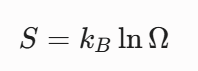
When the number of accessible microstates (Ω) equals 1, S equals 0. This zero-point gives us a starting line, letting us calculate the absolute entropy of any substance at higher temperatures.
Nernst Statement and Implications
You will also hear this law called the Nernst-Simon statement. Walther Nernst formulated it by looking at chemical reactions at low temperatures. He realized that as the temperature of a system drops toward absolute zero, the change in entropy (ΔS) for any isothermal physical or chemical transformation flattens out to zero. You can write it out like this:
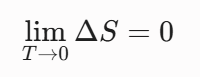
This looks like a simple limit, but it has a massive catch: the principle of unattainability.
Think of it like trying to empty a room using a vacuum that only removes a percentage of the remaining air with each pass. The first few passes remove huge chunks of air. But as the room gets emptier, each click of the vacuum pulls out less and less. You can keep doing it forever, but you will never hit a literal, absolute vacuum. Cooling a system follows a similar frustrating rule. Every cooling step relies on changing the system’s state variables. Because the entropy curves converge at 0 K, each cooling cycle becomes less effective. You can get tantalizingly close to absolute zero, but you can never actually cross the finish line in a finite number of steps.
In the real world, systems always hold onto a tiny bit of “residual entropy.” Whether it is a quantum mechanical quirk or tiny flaws locked into the crystal lattice when it froze, nature finds a way to keep things a tiny bit messy.
Common Misconceptions About Third Law of Thermodynamics For CSIR NET
One of the biggest traps CSIR NET students fall into during the exam is overthinking how entropy scales. A classic misconception is that entropy can drop below zero and become negative.
Let’s clear that up right now: entropy is a counting game of molecular arrangements. You cannot have a negative number of ways to arrange atoms. It is always non-negative. As a system chills down, its entropy drops toward its minimum possible value—which, for that perfect crystal, is zero.
Another easy mistake is confusing the Third Law with the Second Law. You might remember that for any real, spontaneous process, the total entropy of the universe always goes up:

Do not let this confuse you. The Second Law says you cannot decrease the total entropy of an isolated system. The Third Law simply tells us what the absolute floor value of that entropy is when you drain all the thermal energy out. Keeping these two laws straight in your mind will save you from tricky options in multiple-choice questions.
Real-World Applications of Third Law of Thermodynamics
While 0 K feels like a purely theoretical concept, the physics surrounding the Third Law of Thermodynamics drives some of the coolest cutting-edge tech we have today.
Take superconductors, for example. When you cool certain materials down to near-absolute zero using liquid helium, their electrical resistance completely vanishes. Imagine a racetrack where the cars can drive forever without ever burning a single drop of fuel—that is what electricity does inside a superconductor.
Then there is quantum computing. Quantum bits, or qubits, are incredibly sensitive. Even the tiniest bit of thermal jiggling can ruin a calculation. To prevent this, scientists use advanced cryogenics like dilution refrigerators to drop temperatures down to a few millikelvins.
Importance: Third Law of Thermodynamics For CSIR NET
When you are in the zone preparing for the exam, you need to focus your energy on the areas that examiners love to target. Do not just memorize the definitions; learn how to apply them to different scenarios.
To see where you stand, you should routinely test yourself with exam-style questions. Focus on how the third law impacts:
-
The exact definition and physical boundaries of absolute zero.
-
Calculating residual entropy in disordered crystals (like CO or ice) using statistical weights.
-
How specific heats (Cp and Cv) must behave as temperature approaches zero (hint: they must drop to zero too!).
At VedPrep, we always tell our students that practicing previous years’ questions is the real secret weapon. It helps you get used to the phrasing tricks that exam creators use and builds the muscle memory you need for exam day.
Important Subtopics in Third Law of Thermodynamics For CSIR NET
To make your revision sessions more manageable, break the Third Law of Thermodynamics down into these essential subtopics:
| Subtopic | What to Focus On |
| The Nernst Heat Theorem | Understand the behavior of ΔG and ΔH as temperature approaches 0 K. |
| Residual Entropy Calculations | Master the formula S = kB ln(W) for crystals with random molecular orientations. |
| Behavior of Cp and Cv | Learn why heat capacities must vanish at absolute zero to keep entropy finite. |
| Adiabatic Demagnetization | Study the actual magnetic cooling process used to get ultra-close to absolute zero. |
VedPrep offers expert guidance and comprehensive study materials to help students master the Thermodynamic Behavior For CSIR NET. With VedPrep, students can gain a deeper understanding of these subtopics and develop a strong foundation in thermodynamics, particularly in Third Law of Thermodynamics For CSIR NET.
Conclusion
At the end of the day, the Third Law of Thermodynamics is just nature’s way of setting a boundaries-of-physics baseline. It tells us that while absolute zero is a limit we can never truly touch, the way matter behaves as it gets close to that limit changes everything we know about physics.
As you push forward with your CSIR NET prep, keep your focus sharp. Dive into the numerical problems, practice your derivations, and don’t let the complex notation intimidate you.
To know more in detail from our expert, watch our YouTube video:
Frequently Asked Questions
What is absolute zero?
Absolute zero is the theoretical temperature at which the particles of a system have minimal vibrational motion, corresponding to zero entropy. It is defined as 0 Kelvin, -273.15 degrees Celsius, or -459.67 degrees Fahrenheit.
How does the Third Law of Thermodynamics relate to entropy?
The Third Law of Thermodynamics establishes a relationship between temperature and entropy, stating that as temperature decreases, entropy approaches a minimum value. This implies that it is impossible to reach absolute zero by any finite number of processes.
What are the implications of the Third Law of Thermodynamics?
The Third Law of Thermodynamics has significant implications for the behavior of materials at low temperatures, including the prediction of residual entropy in some systems and the impossibility of achieving absolute zero.
Who formulated the Third Law of Thermodynamics?
The Third Law of Thermodynamics was formulated by Walther Nernst in 1906, and is also known as the Nernst-Simon statement.
Can the Third Law of Thermodynamics be violated?
The Third Law of Thermodynamics is a fundamental principle and has not been observed to be violated in any experiments. However, some systems may exhibit apparent violations due to practical limitations.
How is the Third Law of Thermodynamics applied in CSIR NET Physical Chemistry?
In CSIR NET Physical Chemistry, the Third Law of Thermodynamics is applied to solve problems related to thermodynamic properties, such as entropy and free energy, at low temperatures.
What types of questions can be expected in CSIR NET regarding the Third Law of Thermodynamics?
CSIR NET questions on the Third Law of Thermodynamics may involve calculations of entropy changes, determination of residual entropy, and application of the law to predict material properties at low temperatures.
How can I improve my problem-solving skills on the Third Law of Thermodynamics for CSIR NET?
Practice solving problems from various sources, including previous year CSIR NET questions and standard textbooks, to improve your understanding and application of the Third Law of Thermodynamics.
Can you provide an example of a CSIR NET question on the Third Law of Thermodynamics?
An example question might ask to calculate the residual entropy of a system at low temperature, or to apply the Third Law to determine a thermodynamic property.
What are common mistakes made when applying the Third Law of Thermodynamics?
Common mistakes include assuming that absolute zero can be reached, misapplying the law to systems with residual entropy, and neglecting the implications of the law on thermodynamic properties.
What is the relationship between the Third Law of Thermodynamics and quantum mechanics?
The Third Law of Thermodynamics has connections to quantum mechanics, as the law can be derived from quantum statistical mechanics and has implications for the behavior of materials at the quantum level.
How does the Third Law of Thermodynamics relate to black hole physics?
The Third Law of Thermodynamics has been linked to black hole physics, with the law providing insights into the behavior of black holes and the holographic principle.
What are some current research areas related to the Third Law of Thermodynamics?
Current research areas include the application of the Third Law to nonequilibrium systems, and the study of the law's implications for cosmological and black hole physics.
What are the implications of the Third Law of Thermodynamics for materials science?
The Third Law of Thermodynamics has significant implications for materials science, particularly in the study of low-temperature properties and phase transitions.