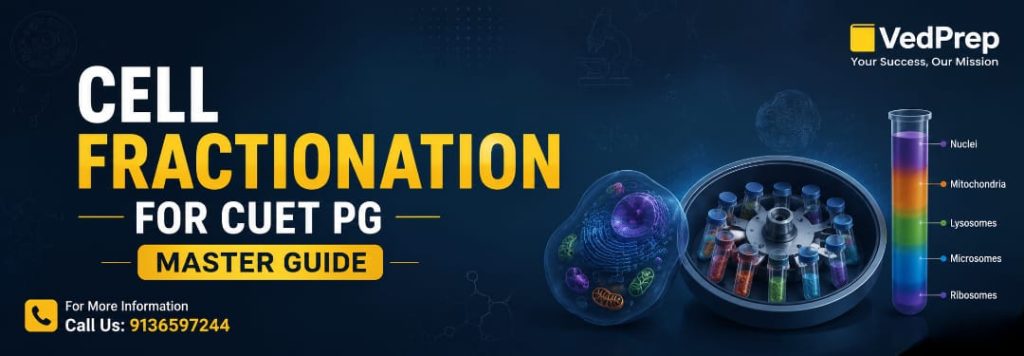

Ultra-centrifugation: A Complete Guide for CUET PG
Direct Answer: Ultra-centrifugation for CUET PG is a method used to isolate particles of varied densities by high centrifugal forces that assist in biochemical research and analysis.
CUET PG Syllabus – Physical Chemistry, Cell Biology and Biophysics
CUET PG program comprises a wide range of topics in physical chemistry, cell biology and biophysics. This topic is part of the official CSIR NET syllabus unit of Physical Chemistry and Biophysics. For a detailed study, students might refer to standard texts such as Physical Chemistry by Atkins and Cell Biology by Alberts.
An important idea in this area is ultra-centrifugation. This is based on the separation of particles by density and size by use of high-speed centrifugation. This approach has important applications in biochemistry, molecular biology and biophysics. For CUET PG applicants, it is important to have a comprehensive understanding of ultra-centrifugation and its significance.
Physical chemistry includes such areas as thermodynamics, kinetics and spectroscopy. In cell biology, students need to focus on cell structure, function and signaling pathways. Biophysics principles, such as protein structure and function, are also important. Students should concentrate on learning the basic principles and how they are applied.
Principles and Process of Ultra-centrifugation For CUET PG
Ultra-centrifugation is a laboratory technique that uses high centrifugal forces to separate particles of varied sizes, shapes and densities from a mixture. This approach is commonly utilized in numerous areas such as biochemistry, molecular biology and chemistry. The principle of ultra-centrifugation is based on the notion of centrifugal force, which is due to inertia and rotation.
Centrifugal force is a fictional force that occurs due to the inertia of an object moving along a curved path around a central axis. Ultracentrifugation subjects the particles of a mixture to a centrifugal force, which forces them away from the axis of rotation. The magnitude of this force depends on the mass of the particle, its distance from the axis of rotation and the rate of revolution.
Density gradient centrifugation is a form of ultracentrifugation that separates particles based on differences in density. This technique involves layering different densities of solution in a centrifuge tube to form a density gradient. Particles are then spun through the gradient and settle at a place where their density equals that of the surrounding solution. Separation is due to varying centrifugal forces on particles of varied density. This method is especially effective at sorting particles of comparable size but different density.
CUET PG Ultra Centrifugation
Students commonly have a misunderstanding that ultra-centrifugation is only useful for the separation of big particles, such as cells and bacteria. This is not true because ultra-centrifugation may separate particles as small as molecules. After all, it works at very high speeds, often in excess of 100,000 rpm. Under such conditions, the centrifugal force produced allows separation of particles according to density and size.
Ultra-centrifugation is a method that uses a high-speed centrifuge to generate a strong centrifugal force, enabling the separation and examination of particles at the molecular level. One of the key uses of ultra-centrifugation is density gradient centrifugation, a process utilised for the separation of molecules, such as DNA, RNA, and proteins. In this procedure, a density gradient is set up in the centrifuge tube. Particles migrate through the gradient until they reach a place at which the density of the media surrounding them is equal to their own.
Ultra-centrifugation is a very useful technique in biochemical research, especially in the areas of molecular biology and biochemistry. It is used for the purification of macromolecules, for the investigation of molecular interactions and for the determination of molecular weights. The great resolution and sensitivity of the approach make it a vital tool for researchers examining the properties and behaviours of molecules.
Red Blood Cells from Plasma – Worked Example Ultra-centrifugation For CUET PG
Ultra-centrifugation is a laboratory technique that uses high-speed centrifugation to separate and analyse biomolecules such as proteins, DNA and cells, based on their density and size. This technique is used under high centrifugal forces, frequently beyond 100,000 g, which allows separating particles with high precision.
In biomedical research, ultra-centrifugation is used for the analysis of cellular processes such as the behavior of subcellular organelles or the interactions of biomolecules. Density gradient centrifugation, a form of ultra-centrifugation, is particularly effective in this area. This is achieved by overlaying a sample on a density gradient medium such as sucrose or caesium chloride and centrifuging the mixture. The particles are then separated by density and size as they traverse the gradient.
In biomedical research, ultra-centrifugation is used extensively, giving rise to novel treatments and therapies. It is used to extract and characterise membrane-bound organelles such as microsomes and lysosomes, which are important for cellular function, for example. Besides, ultracentrifugation is helping in the research of protein-protein interactions and the investigation of cellular signalling cascades. This knowledge can be applied to design novel therapeutic techniques for a variety of diseases, such as cancer and neurodegenerative disorders.
Some main areas of application of ultra-centrifugation are:
- Structural biology: The study of the structure and function of biomolecules
- Cell biology: study of cellular processes and organelle function
Research on biomaterials aims to design new biomaterials and to explore their interaction with cells. In general, ultra-centrifugation is a very useful technique for gaining knowledge about biological systems and creating novel treatments and cures.
Study Tips: Look for Main Ideas and Do Questions
In studying this topic, it is important to think about the essential concepts and principles of ultra-centrifugation, a process used to separate particles of different densities or sizes from a mixture. One must understand the fundamentals behind sedimentation velocity and density gradient centrifugation.
The use of this strategy is best understood through practice problems. Students should be able to solve numerical questions on sedimentation coefficients, centrifugal force and separation of particles. This will help you strengthen your base and develop your problem-solving skills.
Students are advised to review textbooks and study resources for efficient preparation. VedPrep is a great resource for expert coaching and extensive study resources, including practice questions and full explanations. Important subtopics to focus on are principles of ultracentrifugation, instrumentation and applications.
Some subtopics that are regularly evaluated include:
- speed of sedimentation
- density gradient
- separation of particles
- application in biochemistry
- molecular biology
If students adopt this approach, then they are likely to have a good understanding of ultra-centrifugation and be well prepared for their exams.
Ultra-centrifugation For CUET PG: Tools and Methods
Ultra-centrifuges are special centrifuges used to apply high centrifugal forces (usually in the range of 10 5 to 10 6 g) to separate particles of varied density or size from a mixture. They find widespread application in many sectors of biochemistry, molecular biology and chemistry.
One of the primary procedures used in ultra-centrifugation is density gradient centrifugation. The method comprises setting up a density gradient in the centrifuge tube by use of a density gradient medium such as sucrose or caesium chloride. The particles separate based on their buoyant density. Particles of various densities will go to different locations in the gradient.
The equipment for ultracentrifugation generally comprises a high-speed centrifuge rotor, a vacuum chamber and a temperature control. The centrifuge rotor is designed to endure very high speeds and is often manufactured from high-strength materials such as titanium or stainless steel. Safety standards for ultra-centrifugation include adequate training, use of personal protective equipment (PPE) and adherence to established operating procedures.
Certain important factors for ultra-centrifugation:
Proper balancing of the centrifuge rotor to avoid vibration and ensure safe operation
Ultra-centrifuge tubes specifically developed for high-speed centrifugation
Temperature and vacuum monitoring to avoid sample degradation
Understanding the principles and procedures of ultra-centrifugation will enable researchers and students to make good use of this equipment.
Frequently Asked Questions
2. What is the principle of ultra-centrifugation?
The principle of ultra-centrifugation is based on sedimentation under high centrifugal force. Particles move through a medium at different rates depending on their size, shape, and density. Heavier or denser particles sediment faster, allowing separation of biological molecules and organelles into distinct layers.
3. How is ultra-centrifugation different from ordinary centrifugation?
Ordinary centrifugation uses lower speeds to separate larger particles, whereas ultra-centrifugation operates at extremely high speeds exceeding 50,000 rpm. Ultra-centrifugation can isolate very small particles such as ribosomes, viruses, and proteins. It also provides greater precision in molecular biology and biochemical research applications.
4. What are the main components of an ultra-centrifuge?
An ultracentrifuge mainly consists of a rotor, vacuum chamber, refrigeration system, motor, and control panel. The rotor holds the sample tubes and rotates at high speed. The vacuum reduces air resistance, while refrigeration prevents heat damage to biological samples during separation.
5. Why is refrigeration important in ultra-centrifugation?
Refrigeration prevents overheating caused by high rotational speeds during ultra-centrifugation. Excess heat can denature proteins, damage nucleic acids, and alter biological samples. Maintaining low temperatures preserves sample integrity and ensures accurate separation of cellular components and biomolecules during centrifugation experiments.
6. What is sedimentation coefficient in ultra-centrifugation?
The sedimentation coefficient measures the rate at which a particle sediments during centrifugation. It is expressed in Svedberg units (S). Larger and denser particles have higher sedimentation coefficients. This concept is widely used to study ribosomes, proteins, and macromolecular complexes in molecular biology.
7. What are the types of ultra-centrifugation?
The two major types are preparative ultra-centrifugation and analytical ultra-centrifugation. Preparative ultra-centrifugation is used to isolate biological materials, while analytical ultra-centrifugation studies molecular properties like size, shape, and interactions. Both are important in cell biology, biochemistry, and genetics research.
8. What is differential ultra-centrifugation?
Differential ultra-centrifugation separates cellular components through repeated centrifugation at increasing speeds. Larger organelles sediment first, followed by smaller particles. It is commonly used for cell fractionation to isolate nuclei, mitochondria, lysosomes, ribosomes, and microsomes from homogenized cells.
9. What is density gradient ultra-centrifugation?
Density gradient ultra-centrifugation separates particles according to buoyant density using a gradient medium such as sucrose or cesium chloride. Particles migrate until they reach a region equal to their density. This method is highly effective for separating DNA, RNA, viruses, and organelles.
10. What is the role of sucrose gradient in ultra-centrifugation?
A sucrose gradient creates layers of varying density that help separate particles more precisely during centrifugation. Molecules move through the gradient until they reach a matching density zone. This technique minimises mixing and improves resolution when isolating ribosomes, proteins, and nucleic acids.
11. How is ultra-centrifugation used in cell fractionation?
Ultra-centrifugation separates cellular organelles after cell disruption. Different centrifugation speeds pellet nuclei, mitochondria, lysosomes, ribosomes, and microsomes sequentially. This process allows researchers to study the structure and function of individual organelles independently in cell biology and biochemistry laboratories.
12. What is the function of a rotor in an ultracentrifuge?
The rotor is the rotating component that holds sample tubes during ultra-centrifugation. It generates the centrifugal force necessary for particle separation. Different rotor designs, including fixed-angle and swinging-bucket rotors, are selected depending on the type of sample and separation technique required.