
Cell organelles are specialized structures within a cell that perform specific functions, crucial for cellular metabolism, energy production, and waste management, which is essential for IIT JAM aspirants to understand.
Cell Organelles (Mitochondria, Chloroplast, ER, Golgi, Lysosomes) For IIT JAM Syllabus and Key Textbooks
Preparing for IIT JAM is a journey, and if you are diving into Unit 2.1 on Cellular Structure and Function, you already know it is a massive chunk of the syllabus. This section is also a staple for CSIR NET and GATE, so mastering it now gives you a serious head start later.
At the heart of this unit are cell organelles—the microscopic workers that keep the cell alive, running, and managing its energy. Think of a cell like a highly efficient tech startup; every organelle has a specific job description, and if one slacks off, the whole operation crashes.
To really nail this section, you cannot rely on surface-level internet summaries. You need solid, dependable books. Here are two classics that every serious aspirant should have on their desk:
-
“Biology for IIT JAM” by D.C. Pandey: This one is great because it aligns well with the exam pattern and covers the syllabus systematically.
-
“Cell Biology” by S.C. Tiwari: If you want to understand the why and how behind cellular structures, this book goes deep into the mechanisms and offers great illustrations.
We know how overwhelming it gets to flip through hundreds of pages of dense text. That is why at VedPrep, we focus on breaking down these heavy topics into bits that actually stick in your brain when you are sitting in the exam hall.
Cell organelles For IIT JAM: Overview
Let’s look at three heavy hitters among the cell organelles that you will see constantly in past years’ question papers.
Mitochondria
Everyone learns in school that mitochondria are the “powerhouses” of the cell, but for IIT JAM, you need to look past the catchphrase. Their main job is cranking out adenosine triphosphate (ATP), which is the currency the cell uses to pay for everything it does. Beyond energy, they are also calling the shots during cell signaling, cellular differentiation, and even apoptosis (programmed cell death). They basically decide when a cell grows and when it’s time for it to pack up and go.
Chloroplasts
Found in plant cells and some algae, these are the solar panels of the natural world. This is where photosynthesis happens. They are packed with chlorophyll, a green pigment that grabs sunlight and uses that energy to turn carbon dioxide and water into glucose and oxygen.
Endoplasmic Reticulum (ER)
The ER is a massive, interconnected network of flattened sacs and tubes. It is the cell’s main manufacturing and shipping department. It comes in two versions:
-
Rough ER: Covered in tiny dots called ribosomes. Because of those ribosomes, it is the go-to spot for protein synthesis, folding, and transport.
-
Smooth ER: No ribosomes here. Instead, it handles lipid synthesis and helps detoxify the cell.
Understanding Cell Organelles (Mitochondria, Chloroplast, ER, Golgi, Lysosomes) Through Worked Example
The Golgi apparatus is another crucial structure. It acts like the logistics and packaging hub of the cell. Let’s look at a typical problem you might encounter in competitive exams to see how this works.
Question: What is the primary function of the Golgi apparatus? Describe its role in protein processing.
Solution: The Golgi apparatus is responsible for modifying, sorting, and packaging proteins and lipids for secretion or use within the cell. It receives raw proteins synthesized by the endoplasmic reticulum (ER) and refines them through processes like glycosylation (adding sugar chains) and phosphorylation (adding phosphate groups). The modified proteins are then sorted and packaged into membrane-bound vesicles, which travel to their final destinations inside or outside the cell.
Here is a quick cheat sheet to remember how the Golgi operates:
| Function | Description |
| Modification | Handles glycosylation, phosphorylation, and other post-translational tweaks. |
| Sorting | Tags and tags proteins so they go to the exact right destination. |
| Packaging | Buds off into vesicles for smooth transport or secretion. |
Common Misconceptions About Cell Organelles
When you are cramming a lot of information, it is easy to mix up definitions. One classic trap students fall into is thinking that lysosomes are the ones running cellular respiration in Cell organelles.
Let’s clear that up right now: lysosomes have absolutely nothing to do with making energy. Instead, they are the cleanup crew—often called “suicidal bags.” They are packed with digestive enzymes and maintain a highly acidic pH to break down and recycle waste, old cell parts, and random foreign invaders.
Imagine a fictional city where two major buildings keep the lights on. The power plant (Mitochondria) burns fuel to keep the grid online. Meanwhile, the recycling plant down the road (Lysosome) takes in the city’s trash, shreds it, and salvages raw materials. You wouldn’t look at a recycling truck and expect it to power your laptop.
In short:
-
Lysosomes = Digestion, waste management, and recycling.
-
Mitochondria = Respiration and ATP production.
Real-World Application of Cell Organelles
Studying cell organelles isn’t just about clearing an exam; it connects directly to cutting-edge science and medicine.
For instance, when mitochondria stop working properly, energy production drops off a cliff. This energy starvation is a major factor in neurodegenerative conditions like Parkinson’s and Alzheimer’s. Because of this, medical researchers are looking closely at therapies that support mitochondrial health, like using coenzyme Q10 and resveratrol to protect brain cells.
On the environmental side, chloroplasts are getting a lot of attention in green tech. Scientists are trying to engineer chloroplasts in algae to pump out biofuels like biodiesel and bioethanol. If they can scale this up, it could give us a clean, renewable alternative to fossil fuels and help cut down greenhouse gases.
Even lysosomes are a big deal in cancer research. Cancer cells are tough, but they rely heavily on their lysosomes to clean up their own cellular trash and stay alive. Researchers are developing smart therapies that target and break down lysosomes specifically inside cancer cells, essentially forcing the bad cells to destroy themselves. It is showing real promise in treating breast and lung cancers.
Exam Strategy for Cell Organelles (Mitochondria, Chloroplast, ER, Golgi, Lysosomes) For IIT JAM
If you want to score high on Cell organelles questions, you have to go beyond memorizing definitions. You need to understand how these parts interact.
A great way to study is to practice drawing, identifying, and labeling organelles. When you can visualize the double membrane of a mitochondrion or the stacked cisternae of the Golgi, answering application-based questions gets a lot easier. We use this exact visual approach at VedPrep to help students build intuitive mental maps of cell structures, making the material feel less like a checklist and more like a functional system.
Keep your study sessions focused on these core areas of Cell organelles:
-
The structural details and inner workings of mitochondria and chloroplasts.
-
How the endoplasmic reticulum and Golgi apparatus collaborate to manufacture and ship proteins.
-
How lysosomes manage cellular digestion without destroying the rest of the cell.
Golgi Apparatus: A Key Cell Organelle for IIT JAM Aspirants
Let’s zoom in on the Golgi apparatus for a moment. Structurally, it is made of flat, membrane-bound sacs called cisternae, which look a bit like a stack of pancakes.
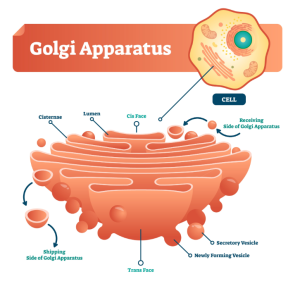
The Golgi acts as the quality control and shipping department right next to the ER factory. As per Cell organelles, the ER puts together raw proteins and lipids and sends them over to the Golgi. The Golgi takes them in, modifies them through chemical reactions like glycosylation, and then sorts them. Once everything is checked and approved, the Golgi membrane pinches off into tiny shipping containers called vesicles, sending the finished products exactly where they need to go.
It also works closely with lysosomes. The Golgi is actually responsible for packaging those powerful digestive enzymes into lysosomes in the first place. Understanding how the Golgi coordinates this entire supply chain is a favorite topic for IIT JAM paper setters, so make sure you give this organelle some extra attention during your revision cycles.
Final Thoughts
Mastering the inner workings of cell organelles is more than just crossing off a major requirement for the IIT JAM syllabus; it is about building the bedrock for your entire journey into advanced life sciences. When you start viewing the cell as a dynamic, interconnected network rather than a list of definitions to memorize, the exam questions naturally become much easier to navigate. It is completely normal to feel overwhelmed by the sheer volume of mechanisms and pathways you need to track, but taking it step-by-step makes a massive difference.
To know more in detail from our faculty, watch our YouTube video:
Frequently Asked Questions
How do 70S and 80S ribosomes differ in terms of location within eukaryotic cells?
While eukaryotic cells are characterized by 80S ribosomes in the cytoplasm and on the rough ER, they also contain 70S ribosomes inside their mitochondria and chloroplasts. This structural quirk is a major nod to the endosymbiotic theory.
What is the endosymbiotic theory, and which organelles support it?
This theory suggests that mitochondria and chloroplasts originated as free-living prokaryotes that were engulfed by an ancestral eukaryotic cell. The evidence? Both organelles have a double membrane, their own circular DNA, and 70S ribosomes, just like bacteria.
What is the difference between the cis and trans faces of the Golgi apparatus?
The cis face is the receiving dock, facing the endoplasmic reticulum to take in newly synthesized proteins. The trans face is the shipping dock, facing the plasma membrane, where modified proteins are sorted and budded off into vesicles.
Why does the smooth endoplasmic reticulum (SER) play a major role in liver cells?
The SER handles lipid synthesis and detoxification. Because the liver is the body's primary filtration and detox hub, liver cells (hepatocytes) are absolutely packed with SER to neutralize drugs, metabolic waste, and toxins.
What keeps a lysosome from digesting itself or the host cell?
Lysosomal enzymes (acid hydrolases) only function efficiently in a highly acidic environment (around pH 4.5 to 5.0). The lysosome's membrane keeps this acid locked away. If a lysosome ruptures slightly, the neutral pH of the cytosol (around 7.2) inactivates the enzymes, preventing accidental damage.
How do the functions of rough ER (RER) and smooth ER (SER) differ?
The RER is studded with ribosomes and is primarily responsible for protein synthesis, folding, and quality control. The SER lacks ribosomes and focuses on lipid and steroid synthesis, carbohydrate metabolism, and calcium ion storage.
What is glycosylation, and where does it happen?
Glycosylation is the chemical attachment of sugar chains to proteins or lipids to form glycoproteins or glycolipids. It starts in the rough ER but is extensively modified and finished in the Golgi apparatus.
Which cell organelles are bounded by a double membrane?
The nucleus, mitochondria, and chloroplasts are the three primary organelles surrounded by a double lipid bilayer.
What role do lysosomes play in apoptosis?
During programmed cell death (apoptosis), lysosomes can break open, releasing their digestive enzymes into the cytoplasm to help systematically dismantle the cell from the inside out without causing inflammation to neighboring tissues.
What is the function of the thylakoid membrane in chloroplasts?
The thylakoid membrane contains chlorophyll and electron transport complexes. It is the exact site where the light-dependent reactions of photosynthesis take place, generating ATP and NADPH.
How does the electron transport chain (ETC) generate ATP in mitochondria?
The ETC moves electrons through protein complexes in the inner mitochondrial membrane, pumping protons into the intermembrane space. This creates a proton gradient. As protons flow back into the matrix through ATP synthase, it drives the production of ATP via chemiosmosis.
Where do proteins go after being processed by the Golgi apparatus?
Vesicles budding from the trans Golgi transport proteins to three main places: the plasma membrane for secretion, the extracellular space, or to specific internal destinations like lysosomes.
What is the function of the signal peptide in protein targeting?
A signal peptide is a short sequence of amino acids at the beginning of a growing protein chain. It acts like a mailing address, telling the cell to direct the protein to the ER for further processing and shipping.
Can animal cells survive without chloroplasts?
Yes, animal cells are heterotrophic and get their energy by consuming organic molecules (like glucose) made by autotrophs (plants). They rely entirely on mitochondria to break down that food into usable ATP.