
Understanding membrane structure and function is crucial for competitive exams like IIT JAM, where it plays a significant role in determining the transport of materials across the cell membrane, affecting various cellular processes.
Membrane structure and function For IIT JAM: Relevant Concepts and Textbooks
If you are gearing up for the IIT JAM, you already know that cell biology isn’t something you can just skim through. Specifically, membrane structure and function are a heavyweight topic in Unit 1 of the official syllabus. Whether you look at animal cells or plant cells, the plasma membrane is the ultimate gatekeeper, and the exam loves testing you on exactly how it controls the cellular VIP list.
To ace this section, you need to get comfortable with terms like selective permeability and the fluid mosaic model. These aren’t just definitions to memorize; they are the foundation for how cells talk, eat, and survive.
When it comes to hitting the books for membrane structure and function, your best bets are Lehninger Principles of Biochemistry by David L. Nelson and Michael M. Cox and Biology by Campbell and Reece. They break down everything from basic lipid layers to complex active and passive transport mechanisms without making your brain short-circuit. At VedPrep, we always tell our students that mastering these core texts early makes solving those tricky MSQs (Multiple Select Questions) much easier down the road.
Membrane structure and function For IIT JAM: Core Structure of the Cell Membrane
Let’s look at what the cell membrane actually looks like. Think of it as a ultra-thin, highly dynamic security fence surrounding the cytoplasm.
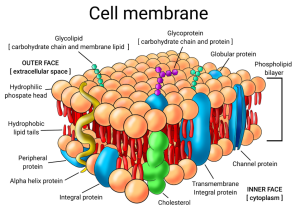
Its backbone is a phospholipid bilayer. You can picture phospholipids as little matchsticks with round heads and twin tails. As per the membrane structure and function, the heads love water (hydrophilic), so they face outward toward the watery world outside and inside the cell. The tails hate water (hydrophobic), so they hide on the inside, facing each other.
Floating in this lipid sea are protein molecules that act as the doors, windows, and scanners of the cell.
-
Integral proteins plunge straight through the bilayer, anchored permanently.
-
Peripheral proteins just hang out on the edges, loose and ready to detach when needed.
-
Carbohydrate chains attach to these lipids and proteins like tiny ID tags, helping cells recognize friend from foe.
In 1972, scientists Singer and Nicolson put all of this together into the fluid mosaic model. The word “fluid” is key here. The membrane isn’t a brick wall; it is more like a crowded dance floor where lipids and proteins are constantly shifting and sliding past each other laterally.
Key Takeaways of the Fluid Mosaic Model:
-
A lipid bilayer with water-loving heads on the outside and water-fearing tails on the inside.
-
Embedded proteins handling everything from moving cargo to catching signals.
-
Sugars acting as cellular ID tags.
-
A shifting, dynamic setup where molecules move around constantly.
Membrane structure and function For IIT JAM: Overview
At its core of membrane structure and function, the main job of the plasma membrane is keeping the cell’s internal environment stable, a state called homeostasis. It does this through selective permeability. Imagine a high-end club—some molecules get right past the velvet rope, some need an escort, and others are completely blocked.
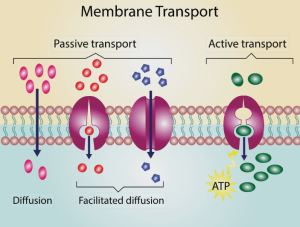
The membrane handles traffic using a few different transport styles:
-
Passive Transport: Things move from high concentration to low concentration naturally. This includes simple diffusion, osmosis (for water), and facilitated diffusion (where a protein channel lends a hand). No cellular energy required.
-
Active Transport: This is like pushing a boulder uphill. The cell uses energy (usually ATP) to pump ions against their natural gradient. The famous sodium-potassium pump is a classic example you will see all over the IIT JAM papers.
Beyond moving cargo, the membrane is a massive communication hub. Receptor proteins catch chemical messages from the outside world and pass the message inward, changing how the cell behaves. It also uses adhesion molecules like integrins and cadherins to latch onto neighboring cells, which is how tissues stay glued together.
Core: Types of Cell Membranes and Their Functions
We often spend all our time talking about the outer plasma membrane (or plasmalemma), but cells are actually packed with internal membranes too. These internal boundaries partition off specific organelles like the nucleus, mitochondria, and endoplasmic reticulum, giving them a private space to do their jobs safely.
Different membranes have very different job descriptions:
| Membrane Type | Primary Functions |
| Plasma Membrane | Cell signaling, selective transport, and sticking to other cells. |
| Nuclear Membrane | Guarding DNA and controlling which genetic messages get out. |
| Mitochondrial Membrane | Hosting the electron transport chain to generate ATP energy. |
Worked Example: Solved Question on Cell Membrane Structure and Function
Let’s look at a typical problem you might run into during your prep.
Question: A cell membrane is composed of a phospholipid bilayer with embedded proteins. The fluid mosaic model describes this structure, where phospholipid molecules have hydrophilic heads and hydrophobic tails. A particular cell membrane has a cholesterol content of 20% and a protein content of 50%. Which of the following statements about this cell membrane is correct?
A) The cell membrane is impermeable to water.
B) The cell membrane is semi-permeable.
C) The cholesterol content increases the fluidity of the membrane.
D) The protein content makes the membrane more hydrophobic.
Correct Answer: B
Explanation: Cell membranes are inherently semi-permeable (or selectively permeable). They let small, non-polar molecules slip through while forcing larger or charged molecules to go through dedicated protein channels.
Why the others fall flat: Option A is wrong because water can cross via osmosis (and through aquaporins). Option C is a trap—cholesterol actually stabilizes the membrane and decreases fluidity at normal body temperatures, preventing it from becoming too liquid. Option D is incorrect because membrane proteins have both hydrophilic and hydrophobic regions to sit comfortably inside the bilayer.
Marking Scheme: 2 marks for the correct answer, 1 mark for the correct explanation.
Misconception: Common Mistakes in Understanding Cell Membrane Structure and Function
A really common trap for JAM aspirants is thinking of the membrane as a static, rigid sandwich. It is easy to look at a textbook diagram and assume the proteins and lipids are locked in place.
But remember, the fluid mosaic model is all about movement. To picture how this works in real life, imagine a fictional scenario where you fill a large sink with water and drop a bunch of ping-pong balls to cover the surface. That is your lipid bilayer. Now, toss a few rubber ducks into the mix. Those ducks (your proteins) will float, drift, and bump into each other across the surface.
Because the membrane is this fluid, it can bend, pinch, and fuse. As per the membrane structure and function, this flexibility is exactly what allows for endocytosis (the membrane wrapping around a particle to gulp it in) and exocytosis (spitting waste out). If the membrane were a static wall, these processes would be impossible.
Application: Real-World Applications of Cell Membrane Structure and Function
Learning membrane structure and function isn’t about clearing an exam; it has massive real-world applications that shape modern science.
Medicine and Drug Delivery
Think about cancer treatments. Chemotherapy drugs can be incredibly harsh on healthy cells. To fix this, scientists design liposomes—fictionalize them as microscopic, artificial soap bubbles made of the exact same phospholipid bilayer as our cells. By hiding the drug inside these tiny lipid bubbles, doctors can guide them straight to a tumor, bypassing healthy tissue and cutting down on nasty side effects.
Industrial Tech
In manufacturing, engineers use membrane-inspired tech for bioseparation. If a factory is brewing a specific medical enzyme in a massive vat of bacteria, they use ultrafiltration and microfiltration membranes to separate the valuable proteins from the rest of the chemical soup based purely on size and charge.
Environmental Cleanup
We are even using this science to clean up the planet. Researchers are working on engineering specialized liposomes packed with pollutant-eating enzymes. These bubbles can be dropped into soil or water to break down stubborn organic pollutants without harming the local ecosystem.
Final Thoughts
If you want to maximize your score on membrane structure and function, blindly memorizing facts won’t cut it. Start by sketching out the components. Draw the lipids, the integral channels, and the peripheral receptors. Creating a quick concept map to link transport types (like passive vs. active) to their specific energy requirements will save you a lot of confusion later.
Make sure to spend extra time on high-yield subtopics like membrane potential and cell signaling pathways, as these frequently show up in the trickier sections of the paper.
If you ever find yourself stuck or staring blankly at your notes, we have plenty of free video resources over on the VedPrep channel, including a comprehensive lecture dedicated entirely to membrane structure and function for IIT JAM.
To know more in detail from our faculty, watch our YouTube video:
Frequently Asked Questions
Why is the cell membrane described as "amphipathic"?
The membrane is composed of phospholipids, which are amphipathic molecules because they contain both hydrophilic (water-loving, polar) heads and hydrophobic (water-fearing, non-polar) tails. This dual nature causes them to spontaneously form a bilayer in aqueous environments.
What is the difference between integral and peripheral membrane proteins?
Integral proteins span entirely across or are permanently embedded within the lipid bilayer. Peripheral proteins are loosely attached to the outer or inner surfaces of the membrane and can be easily detached without disrupting the bilayer's core structure.
How does cholesterol affect membrane fluidity?
Cholesterol acts as a fluidity buffer. At high or normal body temperatures, it restrains lipid movement and decreases fluidity to prevent the membrane from becoming too liquid. At low temperatures, it prevents phospholipids from packing tightly together, stopping the membrane from freezing or becoming too rigid.
What does "selective permeability" mean?
Selective permeability is the property of a cell membrane that allows it to regulate traffic. It permits certain small, non-polar molecules (like oxygen and carbon dioxide) to pass through easily while restricting larger, polar, or highly charged molecules (like ions and glucose) unless they use specific transport proteins.
What is the main difference between active and passive transport?
Passive transport moves molecules down their concentration gradient (from high to low concentration) without using cellular energy (ATP). Active transport pumps molecules against their concentration gradient (from low to high concentration) and requires the consumption of ATP.
What are the types of passive transport?
The three primary types are:
-
Simple Diffusion: Direct movement of small or non-polar solutes through the lipid bilayer.
-
Osmosis: The diffusion of water molecules across a selectively permeable membrane.
-
Facilitated Diffusion: The movement of larger or polar molecules across the membrane with the help of specialized channel or carrier proteins.
What is the difference between primary and secondary active transport?
Primary active transport directly uses chemical energy from ATP hydrolysis to move solutes against their gradient. Secondary active transport uses the electrochemical gradient established by primary active transport to power the movement of a second molecule (e.g., the sodium-glucose cotransporter).
What roles do carbohydrates play on the cell membrane?
Carbohydrates attach to proteins (glycoproteins) or lipids (glycolipids) on the extracellular surface. They function as molecular identification tags, allowing cells to recognize each other, stick together, and interact with immune system components.
What are aquaporins?
Aquaporins are specialized channel proteins embedded in the cell membrane that facilitate the rapid transport of water molecules into and out of the cell, greatly accelerating the process of osmosis.
How do endocytosis and exocytosis work?
Both are bulk transport mechanisms that require energy:
-
Endocytosis: The cell membrane folds inward to engulf external materials, pinching off to form an internal vesicle.
-
Exocytosis: An internal vesicle fuses with the plasma membrane to release its contents into the extracellular space.
What are liposomes, and how are they used in medicine?
Liposomes are artificially prepared spherical vesicles made of a lipid bilayer. In medicine, they are engineered to encapsulate therapeutic drugs, acting as targeted delivery vehicles that protect the drug and release it specifically at tumor sites to minimize side effects.
How does the cell membrane help maintain cellular homeostasis?
By utilizing selective permeability alongside active and passive transport mechanisms, the cell membrane precisely controls the internal concentrations of water, nutrients, ions, and metabolic waste products, keeping the internal cellular environment highly stable.
What are cell adhesion molecules (CAMs)?
CAMs are specialized proteins on the cell surface (such as integrins and cadherins) that allow cells to physically bind to each other and to the extracellular matrix, which is vital for forming tissues and enabling cell communication.
Why is membrane structure and function considered high-yield for exams like IIT JAM?
This topic forms the fundamental basis of Cell Biology (Unit 1). It directly connects to core biochemical concepts, signaling cascades, metabolic pathways, and biophysical principles, making it a favorite area for examiners designing conceptual Multiple Select Questions (MSQs) and numerical problems.