
Preparing for the RPSC Assistant Professor exam can feel like a marathon, especially when you have to balance your prep with other teaching duties or research. If you are eyeing this position, you already know that master’s level chemistry or physics demands a rock-solid grip on core topics. Among them, the Laws of Thermodynamics stand out as a massive scoring area. Getting these principles down patch doesn’t just help with the RPSC exam; it also sets you up perfectly for overlapping papers in CSIR NET, IIT JAM, and GATE.
Syllabus: Thermodynamics
Thermodynamics is a heavy hitter across all major higher-education exams in India. To clear these exams, standard textbooks are your best friends. Most of us have spent late nights flipping through Physical Chemistry by Peter Atkins and Julio de Paula, or trying to wrap our heads around statistical concepts in Schroeder’s Thermodynamics.
Both the chemistry and physics papers expect you to seamlessly handle thermodynamic properties, system boundaries, and cyclic processes. Because the RPSC Assistant Professor syllabus draws heavily from these national-level standards, a unified study approach saves you a ton of time. Here at VedPrep, we always remind aspirants that you aren’t just studying for one exam—you are mastering the subject for your entire academic career.
Laws of Thermodynamics For RPSC Assistant Professor: An Introduction
At its heart, Laws of Thermodynamics is just a formal way of looking at how heat, work, and energy interact with each other. Instead of getting bogged down by massive equations right away, think of it as a set of cosmic rules that energy always follows, whether it is inside a test tube in your college lab or inside a massive star.
There are four core laws, and they build on top of each other like chapters in a story. The Zeroth Law gives us a reliable way to define temperature. The First Law keeps track of the energy ledger, proving that energy just changes outfits rather than disappearing. The Second Law introduces entropy—the universe’s natural slide into disorder. Finally, the Third Law sets a floor for that disorder as things get freezing cold.
Understanding these principles inside out is what separates a good candidate from a great one. Let’s break down how these play out in real life and how the RPSC exam likes to frame them.
Laws of Thermodynamics For RPSC Assistant Professor: Zeroth Law of Thermodynamics
The Zeroth Law sounds like a bit of an afterthought because of its name, but it is actually the logical foundation for everything else. It tells us about thermal equilibrium. Simply put: if System A is at the same temperature as System B, and System B is at the same temperature as System C, then A and C are also at the same temperature. It sounds obvious, right? It is a transitive property.
But without this law, we couldn’t build a working thermometer. Imagine a fictional scenario where you are testing a brand-new laboratory thermometer. The mercury inside the glass bulb (System B) reaches a stable point when placed in a beaker of warm water (System A). When you move that same thermometer to a second beaker (System C) and the mercury level doesn’t budge, you know for a fact that both beakers are at the exact same temperature, even without mixing the liquids.
The Zeroth Law gives us a universal scale to quantify thermal energy. For an assistant professor candidate, remembering that this law establishes the concept of temperature as a measurable state function is an easy mark on exam day.
Laws of Thermodynamics and Their Applications For RPSC Assistant Professor
As per the Laws of Thermodynamics, The First Law is the classic law of conservation of energy. Energy cannot be created out of thin air, and it cannot be destroyed. It can only be transformed. The total amount of energy in an isolated system is fixed.
In mathematical terms, we write this as:
ΔE = Q – W
Where ΔE is the internal energy change, Q is the heat added to the system, and W is the work done by the system.
Note on Sign Conventions: Be careful here! Different textbooks use different signs for work depending on whether they take a chemical or mechanical perspective. In standard IUPAC chemistry notation, we often use ΔE = Q + W, where W is the work done on the system. Always verify the convention used in your specific exam paper to avoid silly negative-sign errors.
This law governs every single energy conversion around us. When you solve exam problems on isothermal expansions or adiabatic drops, you are simply balancing this exact energy ledger.
Worked Example: Calculating the Change in Internal Energy For Laws of Thermodynamics For RPSC Assistant Professor
Let’s look at a straightforward problem that frequently pops up in the numerical sections of competitive exams.
Problem: A system undergoes a process from state A to state B. During this change, it absorbs 500 J of heat and performs 200 J of work on its surroundings. Calculate the change in internal energy of the system.
Solution:
Using the formula where work done by the system is subtracted:
ΔE = Q – W
Given values:
- Q = 500 J (heat absorbed)
- W = 200 J (work done by the system)
Substitute the numbers into the equation:
ΔE = 500 J – 200 J = 300 J
The internal energy of the system increases by 300 J. This internal energy is the sum of all the microscopic kinetic and potential energies of the molecules inside.
Common Misconceptions: Thermodynamic Equilibrium in Laws of Thermodynamics For RPSC Assistant Professor
A common trap that trips up many aspirants is confusing thermodynamic equilibrium with simple mechanical equilibrium.
Let’s clear this up before the exam pressure gets to you:
- Mechanical Equilibrium: This happens when the forces inside a system are balanced. The pressure is uniform everywhere, meaning there is no net force and no spontaneous change in volume.
- Thermodynamic Equilibrium: This is a much stricter condition. For a system to be in true thermodynamic equilibrium, it must satisfy three conditions simultaneously: mechanical equilibrium (uniform pressure), chemical equilibrium (no net chemical reactions), and thermal equilibrium (uniform temperature with no heat flow).
If a system only has uniform pressure but its temperature varies from one corner to another, it is not in thermodynamic equilibrium. Spotting these subtle conceptual differences prevents easy marks from slipping away.
Real-World Application: Carnot Engine For Laws of Thermodynamics For RPSC Assistant Professor
The Carnot engine is a classic theoretical model that helps us understand the absolute upper limits of the Second Law of Thermodynamics. It describes an idealized heat engine that operates perfectly reversibly between a hot source and a cold sink.
While a real, 100% frictionless engine doesn’t exist, the Carnot cycle gives engineers and scientists a benchmark. The efficiency of a Carnot engine depends entirely on the absolute temperatures of the two reservoirs:
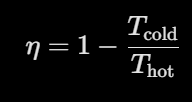
This tells us that you can never build an engine that is 100% efficient unless your cold sink is at absolute zero (0 K), which brings us face-to-face with the limits of the physical world.
Exam Strategy: Focus on Key Concepts of Laws of Thermodynamics For RPSC Assistant Professor
When you are preparing for a specialized role like an Assistant Professor, the exam panel doesn’t just want you to memorize formulas; they want to see if you can apply Laws of Thermodynamics under pressure. Focus your revision on calculating entropy changes for ideal gases, understanding Maxwell’s relations, and analyzing cyclic paths.
We design our practice series at VedPrep to mirror these specific needs, helping you move past basic definitions into deep problem-solving. Reviewing past question trends shows that state functions, exact differentials, and the criteria for spontaneity are regular favorites. If you want to brush up on these derivations visually, checking out specialized video tutorials can give you a quick refresher on the trickier proofs.
Laws of Thermodynamics For RPSC Assistant Professor: Key Takeaways
Mastering the Laws of Thermodynamics gives you a massive advantage in the RPSC exam. Laws of Thermodynamics explain how macro-systems behave, let us predict whether a chemical reaction will happen spontaneously, and form the backbone of physical science.
| Law | Core Focus | Key takeaway for Exams |
| Zeroth Law | Thermal Equilibrium | Defines temperature and validates thermometers. |
| First Law | Energy Conservation | ΔE = Q – W; tracks heat and work exchanges. |
| Second Law | Entropy (ΔS) | Determines the direction of spontaneous processes; Δ Suniverse> 0. |
| Third Law | Absolute Zero | The entropy of a pure crystalline substance is zero at 0 K. |
Final Thoughts
At the end of the day, cracking Laws of Thermodynamics comes down to consistent practice and clear concepts. Keep working through numerical problems, stay focused on your study schedule, and remember that we are here at VedPrep to help you break down the tough topics whenever you need a hand.
To know more in detail from our faculty, watch our YouTube video:
Frequently Asked Questions
What is the zeroth law of thermodynamics?
The zeroth law states that if two systems are in thermal equilibrium with a third system, then they are also in thermal equilibrium with each other. This law introduces the concept of temperature.
What is the first law of thermodynamics?
The first law, also known as the law of energy conservation, states that energy cannot be created or destroyed, only converted from one form to another. Mathematically, ΔE = Q - W, where ΔE is the change in energy, Q is the heat added, and W is the work done.
What is the second law of thermodynamics?
The second law states that the total entropy of an isolated system always increases over time. Entropy measures the disorder or randomness of a system. This law explains the direction of spontaneous processes.
What is the third law of thermodynamics?
The third law, also known as the Nernst-Simon statement, states that as the temperature of a system approaches absolute zero, the entropy of the system approaches a minimum value. This law provides a fundamental limit on the efficiency of any heat engine.
What is the significance of the laws of thermodynamics in Thermo & Stat Phys?
The laws of thermodynamics form the foundation of Thermo & Stat Phys, providing a framework for understanding energy interactions and system behavior. They have far-reaching implications for various scientific and engineering disciplines.
What is the relationship between thermodynamics and energy conservation?
Thermodynamics, particularly the first law, is closely related to energy conservation. The laws of thermodynamics govern how energy is converted from one form to another, highlighting the importance of efficient energy use.
How are the laws of thermodynamics applied in the RPSC Assistant Professor exam?
The laws of thermodynamics are crucial in various engineering and scientific disciplines. In the RPSC Assistant Professor exam, questions may focus on applying these laws to solve problems related to heat transfer, energy conversion, and system efficiency.
Can you give an example of a thermodynamics problem in the RPSC Assistant Professor exam?
For instance, a question might ask you to calculate the efficiency of a Carnot engine given the temperatures of the hot and cold reservoirs, using the second law of thermodynamics.
How can I prepare for thermodynamics questions in the RPSC Assistant Professor exam?
To prepare, focus on understanding the fundamental laws, practice problem-solving, and review relevant applications in Thermo & Stat Phys. VedPrep EdTech offers comprehensive resources and guidance to help you succeed.
How are thermodynamics problems typically presented in the RPSC Assistant Professor exam?
Thermodynamics problems in the RPSC Assistant Professor exam often involve applying the laws to real-world scenarios or systems, requiring you to analyze and solve problems using mathematical and conceptual tools.
What are common mistakes when applying the laws of thermodynamics?
Common mistakes include confusing the signs of heat and work, misapplying the concept of entropy, and neglecting to consider the system boundaries. Careful attention to detail and a clear understanding of the laws can help avoid these errors.
What are some advanced applications of the laws of thermodynamics?
Advanced applications include quantum thermodynamics, nonequilibrium thermodynamics, and the study of black holes. These areas have garnered significant attention in recent research and have implications for various fields.
How do the laws of thermodynamics relate to statistical physics?
The laws of thermodynamics can be derived from statistical mechanics, which provides a microscopic explanation of thermodynamic phenomena. This connection helps bridge the gap between individual particle behavior and macroscopic properties.
What are some current research areas in thermodynamics?
Current research areas include the study of nonequilibrium systems, quantum thermodynamics, and the thermodynamics of black holes. These areas are actively being explored and have significant implications for our understanding of the universe.